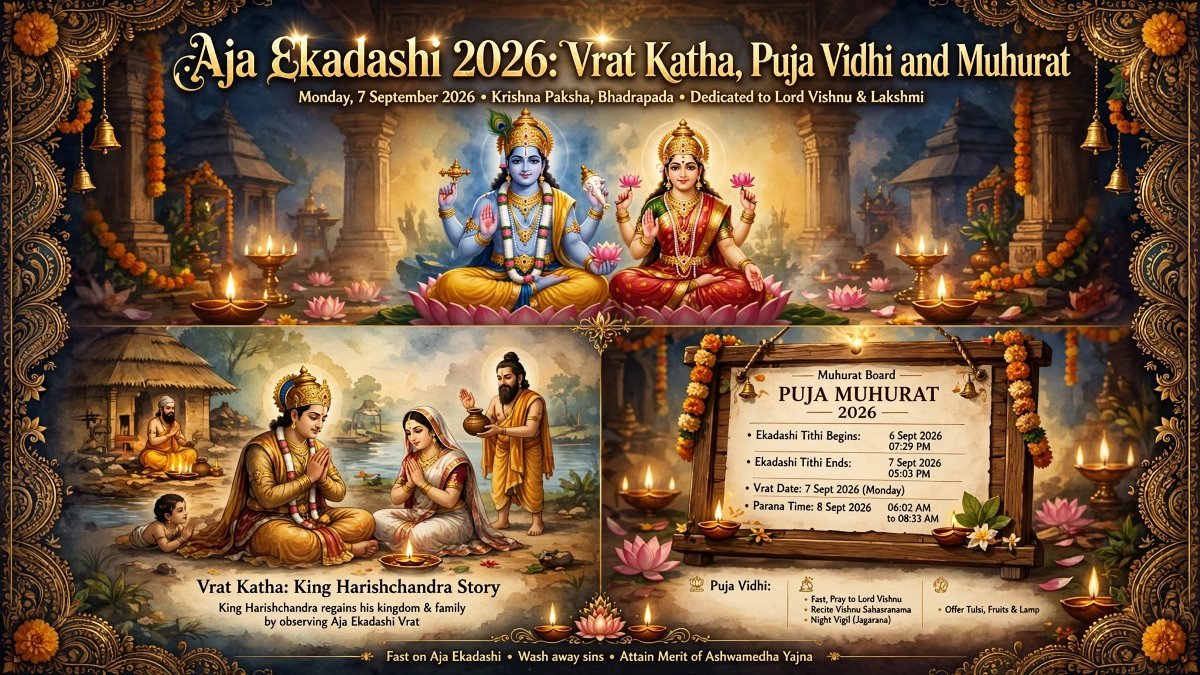
Aja Ekadashi 2026: Quick Facts
| Detail | Timing |
|---|---|
| Vrat Date | Monday, September 7, 2026 |
| Also Known As | Annada Ekadashi, Ananda Ekadashi |
| Hindu Month | Bhadrapada, Krishna Paksha |
| Presiding Deity | Lord Hrishikesha (a form of Vishnu) |
| Ekadashi Tithi Begins | 7:29 PM, September 6, 2026 |
| Ekadashi Tithi Ends | 5:03 PM, September 7, 2026 |
| Parana Date | Tuesday, September 8, 2026 |
| Parana Time | 6:02 AM – 8:33 AM* |
| Dwadashi Tithi Ends | 2:42 PM, September 8, 2026 |
*Parana timing can shift by 15–40 minutes depending on your city’s sunrise. Always cross-check with a local Panchang before breaking the fast.
Every year, thousands of Vishnu devotees search for the exact date of Aja Ekadashi, because getting the day right matters more here than with an ordinary fast. In 2026, Aja Ekadashi falls on Monday, September 7 — and because Monday belongs to Lord Shiva while Ekadashi belongs to Lord Vishnu, this particular observance carries a rare double blessing. Below is everything you need: the story that gives this vrat its power, the complete puja method, and the precise muhurat to open and close your fast correctly.
Significance of Aja Ekadashi
Aja Ekadashi falls on the eleventh lunar day of the Krishna Paksha (waning moon fortnight) in the Hindu month of Bhadrapada, which usually corresponds to August–September on the Gregorian calendar. The word “Aja” itself means “unborn” or “eternal” — one of the many names of Lord Vishnu, who exists beyond the cycle of birth, death, and rebirth. In some regions, particularly in eastern India, this same Ekadashi is called Annada Ekadashi, and it is dedicated to Hrishikesha, the form of Vishnu who governs the senses.
What sets Aja Ekadashi apart from the other twenty-three Ekadashis in the yearly cycle is its specific reputation for reversing misfortune. Scriptures describe it as the fast for people who have lost something significant — status, wealth, a loved one, or peace of mind — and are looking to rebuild. This reputation comes directly from the vrat katha associated with the day: the story of King Harishchandra, a ruler who lost everything yet gained it all back through truth and this single vrat.
Hindu texts also equate the merit of observing Aja Ekadashi with sponsoring an Ashwamedha Yajna, one of the most elaborate and costly rituals a king could perform in ancient India. For an ordinary householder, that means a single day of sincere fasting and worship is believed to carry the same spiritual weight as an enormous act of devotion — which is part of why this Ekadashi is observed with such dedication across the country.
Aja Ekadashi Vrat Katha: The Story of King Harishchandra
The story of Aja Ekadashi comes down to us through Lord Krishna’s conversation with Yudhishthira, the eldest of the Pandavas. Yudhishthira asked Krishna to describe the Ekadashi of the Krishna Paksha in Bhadrapada, and Krishna answered with the story of a king from his own ancestral line — Harishchandra of Ayodhya.
Harishchandra was known across the three worlds for one quality above all others: he never spoke an untruth, no matter the cost. The sage Vishwamitra decided to test this reputation. Through a dream, he arranged for Harishchandra to believe he had already promised his entire kingdom in charity. When Vishwamitra arrived the next morning to claim what was “promised,” Harishchandra — bound by his own word, even a word spoken in a dream — gave up his throne, his palace, and his wealth without hesitation.
That alone might have tested most men, but Vishwamitra was not finished. He then demanded dakshina — a fee owed to him as guru — of five hundred gold coins, a sum the now-penniless king had no way of raising. Rather than break his vow, Harishchandra sold himself into service at a cremation ground in Kashi, working under a low-caste keeper of the burning ghats, so that he could pay off the debt honestly.
It was here, at the lowest point of his life, that tragedy struck again. Harishchandra’s wife arrived at the cremation ground carrying the body of their only son, Rohitashva, who had died of a snakebite while gathering flowers in the forest. She had no money to pay for the cremation. In a cruel twist that only deepened the king’s suffering, it was Harishchandra’s own duty, as the ghat’s keeper, to demand payment before any body could be burned — even his own son’s. His wife tore a piece of her sari to offer as payment, and only then, weeping, did the grieving parents realize whose son lay before them.
That day, the text tells us, was Ekadashi, and the destitute family had nothing to eat regardless — they simply had no food to their name. Sometime before this, sage Gautama had crossed paths with the suffering king and, moved by his plight, had given him a single piece of advice: observe the vrat of Aja Ekadashi in the month of Bhadrapada with full faith, remain awake through the night, and every sin standing between him and relief would be washed away.
Harishchandra held on to that instruction through everything that followed. When Aja Ekadashi arrived again, he observed it exactly as Gautama had described — fasting completely, keeping vigil all night, his mind fixed on Vishnu even as his own son’s funeral pyre and his own ruin surrounded him. The merit of that vow, the Purana says, was enough to undo it all. Rohitashva was restored to life. Harishchandra’s wife was returned to him. Vishwamitra, satisfied that the test of truth had been passed beyond any doubt, restored his kingdom. The gods themselves are said to have honored him for the steadiness of his devotion under the worst possible pressure.
This is why Aja Ekadashi is recommended, even today, to anyone going through a period of loss — of a job, a relationship, financial standing, or self-respect. The story doesn’t promise an easy fix; it promises that faithfulness through hardship, backed by this specific vow, eventually turns things around.
Aja Ekadashi Puja Vidhi (Step-by-Step)
The rituals for Aja Ekadashi follow the general Ekadashi framework, with a few practices specific to Hrishikesha worship layered on top.
1. Preparation on Dashami (the day before): Eat a simple, sattvic meal before sunset on Dashami (September 6). Avoid grains at this meal if possible, and avoid eating anything after dark, so the body enters the fast with an empty stomach.
2. Wake before sunrise: On Ekadashi morning (September 7), rise in the Brahma Muhurat, ideally before sunrise. Bathe, and if a river or sacred water source is nearby, that is considered especially purifying.
3. Take the Sankalp: Sit facing east or north, and take a formal vow (sankalp) to observe the Aja Ekadashi fast, specifying the type of fasting you intend to follow — nirjala (no water), phalahar (fruits only), or ekbhukta (one meal, taken the previous day).
4. Set up the altar: In your puja space or the northeast corner of the home, place a low wooden platform (chowki). Arrange a small heap of whole wheat grains, and set a kalash (a pot filled with clean water) on top. Place mango or betel leaves around the rim of the pot and a coconut at its mouth.
5. Invoke and worship Lord Hrishikesha: Install or focus on an image or idol of Vishnu, Krishna, or a Shaligram Shila if you have one. Offer panchamrit and water for abhishek if a Shaligram is present. Apply chandan (sandalwood paste) tilak, offer fresh flowers, tulsi leaves, and a garland, and light a ghee diya.
6. Chant and recite: Recite the Vishnu Sahasranama or chant “Om Namo Bhagavate Vasudevaya” as many times as your practice allows. Read or listen to the Aja Ekadashi vrat katha itself as part of the worship — this is considered an essential part of the observance, not an optional add-on.
7. Maintain the fast through the day: Avoid grains, beans, onion, garlic, and non-vegetarian food entirely. Avoid anger, gossip, and harsh speech, since scripture treats these as breaking the spirit of the vrat even if the body technically keeps fasting.
8. Keep vigil at night: Staying awake through the night in prayer or devotional singing (jagran) is considered central to Aja Ekadashi, directly echoing what Sage Gautama told Harishchandra.
9. Parana the next morning: Break the fast only after the correct Parana muhurat on Dwadashi (see timing below), after offering prayers and, if possible, giving charity to those in need.
Aja Ekadashi 2026 Muhurat and Parana Timing
Getting the date right matters because Ekadashi tithi can span two Gregorian days, and the “correct” fasting day is decided by which sunrise the tithi is active for (Udaya Tithi), not by when the tithi technically starts or ends.
For 2026, the Ekadashi tithi begins at 7:29 PM on September 6 and continues until 5:03 PM on September 7. Because it is active at sunrise on September 7, that Monday is the day to observe the fast — not September 6.
The fast is broken the following day, September 8, during the Parana window. For most of India, this window falls between approximately 6:02 AM and 8:33 AM, with the Dwadashi tithi itself ending at 2:42 PM that day. Two rules govern Parana regardless of the exact clock time in your city: it must happen after sunrise, and it must not happen during Hari Vasara (the first quarter of the Dwadashi tithi), which is considered an inauspicious window to end a fast. If your local sunrise or tithi timing differs slightly from the figures above, a quick check of your city-specific Panchang will give you the adjusted window — the principle stays the same even when the clock time shifts by a few minutes.
Aja Ekadashi Vrat Rules: What to Do and Avoid
Do:
- Wake early, bathe, and take a clear sankalp before starting the fast
- Worship Vishnu with tulsi leaves, which are considered especially dear to him
- Recite or listen to the vrat katha during the day
- Practice charity (daan) on Dwadashi before or after breaking the fast
- Stay calm, avoid conflict, and keep the mind focused on the day’s purpose
Avoid:
- Grains, lentils, onion, garlic, and non-vegetarian food
- Alcohol, tobacco, and any intoxicants
- Sleeping during the day
- Speaking ill of others or engaging in arguments
- Breaking Parana before sunrise or during Hari Vasara
People who are elderly, pregnant, unwell, or on essential medication are generally advised to follow a modified version of the fast (phalahar or a single sattvic meal) rather than a strict waterless fast, since scripture places the intention and devotion of the vrat above physical hardship for its own sake.
Benefits of Observing Aja Ekadashi
According to the Purana, sincere observance of Aja Ekadashi is believed to:
- Cleanse sins accumulated across past lives, not just the present one
- Restore lost wealth, status, or family relationships, mirroring Harishchandra’s own story
- Build mental steadiness and detachment, since the fast trains the mind to stay composed under pressure
- Bring the devotee closer to moksha, freedom from the cycle of birth and rebirth that the word “Aja” itself refers to
- Grant the same spiritual merit as performing an Ashwamedha Yajna, according to the scriptural comparison Krishna makes to Yudhishthira
Frequently Asked Questions
When is Aja Ekadashi in 2026?
Aja Ekadashi falls on Monday, September 7, 2026. The fast is broken the next day, September 8, during the Parana window.
Why is it called Aja Ekadashi?
“Aja” means unborn or eternal, referring to Lord Vishnu’s nature beyond birth and death. Observing this vrat is believed to free the devotee from that same cycle.
What is the Aja Ekadashi vrat katha about?
It tells the story of King Harishchandra, who lost his kingdom, wealth, and son while upholding his vow of truth, and who regained everything after observing this Ekadashi on sage Gautama’s advice.
Can I drink water during the Aja Ekadashi fast?
Yes, if you are observing phalahar (fruit-based) fasting rather than nirjala (waterless) fasting. The type of fast is decided at the time of taking sankalp, based on your health and capacity.
What should I eat to break the fast?
Break the fast with simple, sattvic food — fruit, a light meal without grains if you are extending the fast further into the day, or a full meal once Parana time has passed, depending on tradition.
Is Aja Ekadashi the same as Annada Ekadashi?
Yes, Annada Ekadashi (also written Ananda Ekadashi) is simply another name for the same Bhadrapada Krishna Paksha Ekadashi, more commonly used in eastern India.
Conclusion
Aja Ekadashi 2026 falls on Monday, September 7, giving the year’s observance an unusual double significance since it coincides with Shiva’s day. But what makes this Ekadashi worth marking on the calendar isn’t the astronomical coincidence — it’s the story behind it. Harishchandra didn’t observe this vrat from a position of comfort; he observed it while standing at a cremation ground, having just lost his son, with nothing left to his name. If there’s a lesson in that for anyone approaching September 7 with their own version of loss or hardship, it’s that the fast is less about ritual perfection and more about holding on to what matters until things turn around.
