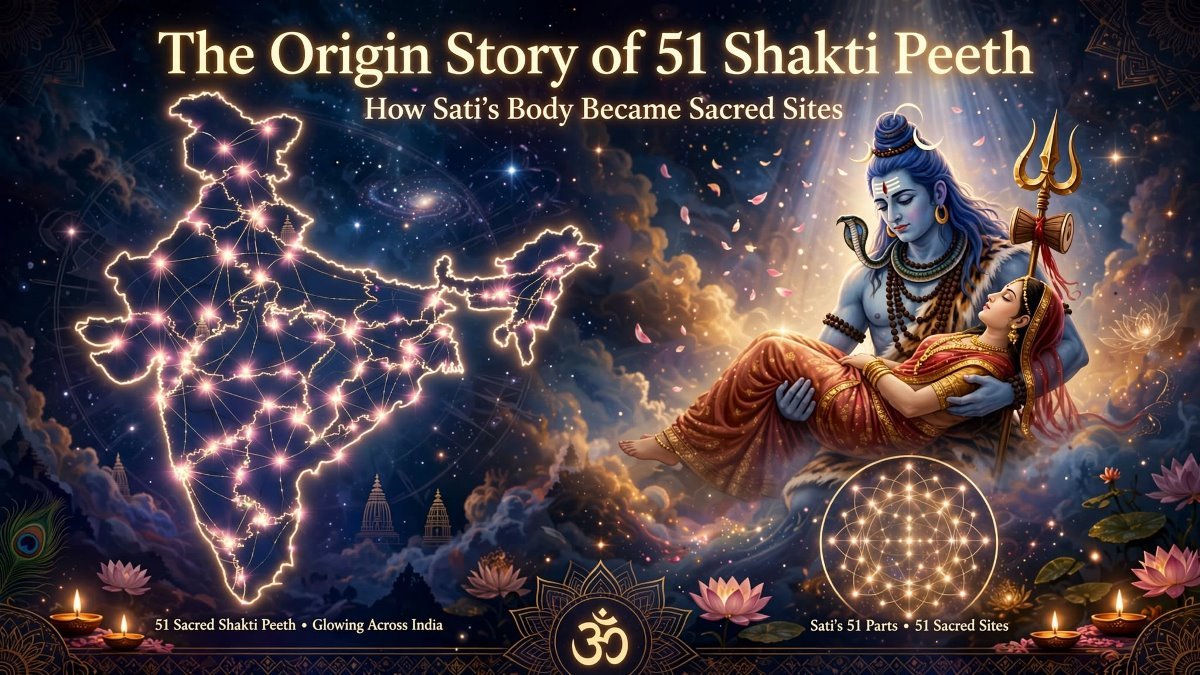
The Shakti Peethas trace back to Sati, Daksha’s daughter and Shiva’s first wife, who immolated herself after her father publicly insulted her husband at a yajna Shiva was deliberately not invited to. Shiva’s grief turned into a cosmic dance of destruction so severe it threatened the universe, and Vishnu, to release him from it, used his Sudarshan Chakra to cut Sati’s body apart. Wherever a piece fell to earth, that site became a Shakti Peetha — a permanent seat of the Goddess’s power. Most traditions count 51 such sites, though 52, 18, and 108 all appear in different texts, spread across what is today India, Pakistan, Bangladesh, Nepal, Sri Lanka, and Tibet.
Sati and Daksha: A Marriage Her Father Never Accepted
Sati was the daughter of Daksha, a powerful Prajapati and one of Brahma’s mind-born sons, and from an early age she was drawn to Shiva — an ascetic god who kept to the Himalayas, meditated for ages at a stretch, and lived by none of the courtly conventions Daksha valued. When Sati chose to marry him anyway, Daksha never really accepted the match. In his eyes, his son-in-law was an unkempt wanderer with no rank in the social order he took seriously, and that resentment sat quietly beneath the surface for years before it finally found its occasion.
The Yajna That Wasn’t Meant to Include Her
That occasion was a grand yajna Daksha organized — described in some tellings as the Brihaspati Sarva Yagya, held at Kankhal near modern Haridwar — to which he invited every major deity and sage of consequence. Shiva’s name was left off the list on purpose.
Sati learned of the yajna, and of her own exclusion from it, through the sage Narada. When she hesitated, Narada is said to have told her plainly that a daughter needs no invitation to enter her own father’s house. Shiva warned her not to go, sensing correctly how the visit would end, but Sati went anyway, hoping either to make peace with her father or, at the very least, to confront him over the slight directly.
The Insult, and Sati’s Fire
She got her confrontation. In front of the assembled gods and sages, Daksha insulted Shiva openly, dismissing him — in some tellings, calling him little better than a disreputable vagabond unworthy of a Prajapati’s daughter. Sati, unable to bear hearing her husband degraded in public, and unable to undo the insult any other way, invoked her own yogic power and gave up her body in the sacrificial fire in front of everyone present. Several versions of the story preserve a vow she made as she did it — that she would be reborn to a father worthy of her, and return once again to marry Shiva. It’s a detail worth holding onto, since it’s the reason her story doesn’t actually end here.
Virabhadra’s Fury and a Goat-Headed King
Word reached Shiva, and grief broke almost instantly into rage. From that fury he brought forth Virabhadra, a fearsome form powerful enough to descend on Daksha’s yajna and tear it apart — scattering the assembled gods, wrecking the ritual grounds, and beheading Daksha himself in the chaos. It was only after the other gods interceded, pleading with Shiva to relent, that Daksha was revived at all — restored, in most versions, with the head of a goat, since his own could no longer be found or made whole again.
The Grief That Threatened the Universe
Destroying the yajna didn’t end Shiva’s mourning. He lifted Sati’s body and began to wander the three worlds locked in the Rudra Tandava, the cosmic dance of grief and destruction, unable to set down what he had lost. This wasn’t a private sorrow playing out quietly in a corner of creation — Shiva’s dance was powerful enough to threaten the stability of the universe itself, and the longer it went on, the more the other gods understood that grief this total was going to need outside intervention to end.
Vishnu’s Mercy: The Sudarshan Chakra
They turned to Vishnu, who followed Shiva through his wandering and, rather than confronting him directly, released the Sudarshan Chakra at Sati’s body as Shiva carried it. It’s worth being clear about how tradition frames this act: not as violence done to Shiva or disrespect toward Sati, but as a deliberate act of mercy, meant to release Shiva from a grief he had no way of setting down on his own. The discus cut through the body cleanly, and its pieces fell to earth one by one, scattered across the land below.
Wherever a piece touched down, tradition holds that the spot became permanently charged with the Goddess’s presence — not a memorial to a tragedy, but a living seat of her Shakti, her power, still active at that location today.
Why 51? The Numbers Behind the Number
Ask how many Shakti Peethas there actually are, and you’ll get more than one answer depending on which text you’re reading. Fifty-one is the number most widely cited today, and it’s commonly connected to the fifty-one letters of the Sanskrit alphabet, with each Peetha understood as corresponding to one letter — a symbolic reading that ties the geography of the Goddess’s presence directly to the structure of sacred sound itself. But other sources put the number at fifty-two, and older or more tightly focused traditions cite eighteen — the Ashtadasha Shakti Peetha, a shorter, more selective list of the most major sites, associated with a stotra traditionally credited to Adi Shankaracharya. A handful of Tantric sources go even further, counting as many as a hundred and eight.
None of these numbers are simply wrong relative to the others — they reflect different textual traditions compiling and counting the sites differently, sometimes assigning the same body part to more than one location in the process. Fifty-one has become the standard figure in popular use today, but it’s worth knowing going in that “51” is the most widely accepted answer, not the only one on record.
What Makes a Shakti Peetha Different From an Ordinary Temple
Most temple deities are ritually invoked and installed through consecration — a priest performs the rites that call the divine presence into an image. Shakti Peethas work differently in Shakta theology: they’re considered swayambhu, self-manifest, because the Goddess’s power is understood to have arrived at each site directly, through Sati’s own body, rather than through a later ritual. That’s part of why these sites are treated as unusually potent, particularly within Tantric practice, where they’re approached as places where the boundary between the physical location and the Goddess’s actual presence is thinner than almost anywhere else.
Each Peetha is also traditionally paired with a Bhairava — a local, fierce form of Shiva specific to that site — reflecting the broader principle that Shakti and Shiva are never really separated, even across fifty-one different locations. Every Peetha, in other words, carries both of them: the Goddess in her local name and form, and a Bhairava standing guard beside her.
A Few of the Most Revered Sites
A handful of these locations are especially well known well beyond their immediate regions. Kamakhya, in Assam, is associated with Sati’s womb and stands as one of the most important centers of Tantric worship in the subcontinent. Kalighat, in Kolkata, is linked to her toes, and gave the city its original name, Kalikata. Jwalamukhi, in Himachal Pradesh, is tied to her tongue and is unusual for how the goddess is worshipped there — not through an image, but through naturally occurring flames fed by underground gas vents, treated as her direct manifestation. Others sit well outside modern India altogether: Hinglaj, associated with the crown of her head, lies in Balochistan, Pakistan, and remains an active pilgrimage site despite the international border now running through what was once a single, continuous sacred landscape.
Visiting the Shakti Peethas Today
Few devotees ever attempt all fifty-one in a single lifetime — the sites are scattered across several modern countries, and some, like Hinglaj, involve genuinely difficult travel even for the dedicated. What’s more common is devotion built around proximity and occasion: visiting whichever Peetha is nearest during Navratri, undertaking a single major pilgrimage to a site like Kamakhya or Kalighat as a once-in-a-lifetime journey, or focusing on the eighteen sites of the shorter Ashtadasha list as a more achievable devotional goal. Regional identity plays a role too — a Bengali devotee is far more likely to grow up visiting Kalighat regularly than a devotee from Gujarat, even though both sites belong to the same fifty-one. The pilgrimage tradition isn’t really built around completism; it’s built around the idea that reaching even one of these places puts a devotee in direct contact with something the rest of the story only describes from a distance.
51 Shakti Peeth: Complete List With Locations, States & Best Time to Visit
For the full origin story — Sati, Daksha’s yajna, and Vishnu’s Sudarshan Chakra — see the companion article. This page is the reference list: all 51 sites, where they are, and when to go.
A note before the table: unlike a list of state capitals, this one isn’t perfectly standardized. Different Puranic sources (Shiva Purana, Devi Bhagavata Purana, Kalika Purana, Devi Purana) compile slightly different versions, a few sites’ exact districts are disputed between regional traditions, and at least two entries in the Bogura, Bangladesh area are described almost identically across sources, which may reflect two genuinely distinct local shrines or a historical duplication in how the list spread. Treat this as the most complete and widely cited version rather than a single unimpeachable original.
The Complete List
| # | Shakti Peeth | City / Area | State / Country | Sati’s Body Part |
|---|---|---|---|---|
| 1 | Mahamaya | Bilaspur | Chhattisgarh, India | Throat |
| 2 | Katyayani | Khagaria | Bihar, India | Hair |
| 3 | Vishalakshi | Varanasi | Uttar Pradesh, India | Earring / face |
| 4 | Lalita Devi | Prayagraj (Triveni Sangam) | Uttar Pradesh, India | Finger |
| 5 | Ramgiri | Chitrakoot | Uttar Pradesh, India | Right breast |
| 6 | Panch Sagar | Varanasi | Uttar Pradesh, India | Lower teeth / jaw |
| 7 | Shri Parvat | Anantnag | Jammu & Kashmir, India | Right anklet |
| 8 | Jwala Devi | Kangra | Himachal Pradesh, India | Tongue |
| 9 | Tripurmalini | Jalandhar | Punjab, India | Left breast |
| 10 | Savitri | Kurukshetra | Haryana, India | Palm |
| 11 | Patan Devi | Patna | Bihar, India | Right thigh |
| 12 | Mithila | Darbhanga | Bihar, India | Left shoulder |
| 13 | Janasthan | Nashik | Maharashtra, India | Chin |
| 14 | Ambaji | Banaskantha | Gujarat, India | Heart |
| 15 | Gayatri Manibandh | Pushkar | Rajasthan, India | Both wrists |
| 16 | Ambika | Bharatpur | Rajasthan, India | Navel |
| 17 | Sarvashail (Rakini) | Rajahmundry | Andhra Pradesh, India | Cheeks |
| 18 | Bhramaramba | Srisailam | Andhra Pradesh, India | Neck |
| 19 | Bhagavathy Amman | Kanyakumari | Tamil Nadu, India | Spine / back |
| 20 | Suchindram | Kanyakumari | Tamil Nadu, India | Teeth |
| 21 | Kamakshi Amman | Kanchipuram | Tamil Nadu, India | Navel |
| 22 | Maa Phullara | Attahas, Birbhum | West Bengal, India | Lips |
| 23 | Bahula | Bardhaman | West Bengal, India | Left arm |
| 24 | Mahishasuramardini | Bakreshwar, Birbhum | West Bengal, India | Right wrist |
| 25 | Kali Ghat | Kalighat, Kolkata | West Bengal, India | Right toe |
| 26 | Kankalitala | Birbhum | West Bengal, India | Waist |
| 27 | Ratnavali | Khanakul, Hooghly | West Bengal, India | Right shoulder |
| 28 | Tristrota | Tista river area | West Bengal, India | Left leg |
| 29 | Nandipur | Sainthia, Birbhum | West Bengal, India | Necklace |
| 30 | Ujani | Bardhaman | West Bengal, India | Right wrist |
| 31 | Bhargabhima | Tamluk, Purba Medinipur | West Bengal, India | Left ankle |
| 32 | Kamakhya | Nilachal Hill, Guwahati | Assam, India | Womb / yoni |
| 33 | Nartiang Durga | Nartiang, Jaintia Hills | Meghalaya, India | Left thigh |
| 34 | Tripura Sundari | Udaipur, Gomati | Tripura, India | Right foot |
| 35 | Biraja | Jajpur | Odisha, India | Navel |
| 36 | Vimala (Bimala) | Jagannath Temple, Puri | Odisha, India | Feet |
| 37 | Jay Durga | Near Baidyanath Dham, Deoghar | Jharkhand, India | Heart |
| 38 | Bhairav Parvat | Ujjain | Madhya Pradesh, India | Upper lip |
| 39 | Kalmadhav | Amarkantak | Madhya Pradesh, India | Right buttock |
| 40 | Narmada | Amarkantak | Madhya Pradesh, India | Right hip |
| 41 | Nagapooshani Amman | Nainativu Island | Sri Lanka | Anklets |
| 42 | Gandaki Chandi | Muktinath | Nepal | Knees |
| 43 | Guhyeshwari | Kathmandu | Nepal | Hips |
| 44 | Sugandha | Shikarpur, Barisal | Bangladesh | Nose |
| 45 | Bhabanipur | Bogura | Bangladesh | Left anklet / clothing |
| 46 | Jeshoreshwari | Jessore | Bangladesh | Palms |
| 47 | Bhavanipur | Sherpur, Bogura | Bangladesh | Left anklet / clothing |
| 48 | Maa Lakshmi (Mahalakshmi) | Kolhapur | Maharashtra, India | Left hand |
| 49 | Manasa | Monghyr (Munger) | Bihar, India | Right hand |
| 50 | Shivaharkaray | Karachi, Sindh | Pakistan | Eyes / third eye |
| 51 | Hinglaj | Hingol National Park, Balochistan | Pakistan | Brahmarandhra (crown of head) |
Best Time to Visit, By Region
Since precise seasonal advice for 51 individual sites would mean guessing rather than researching, here’s the honest, regionally grounded version:
Jammu & Kashmir (Shri Parvat): Late spring through early autumn, roughly April to October. Winters bring heavy snow and limited access.
Nepal and high-altitude sites (Gandaki Chandi, Guhyeshwari): March to June or September to November. Muktinath in particular sits at high altitude and is best avoided during peak winter cold or the height of monsoon.
North Indian plains (Uttar Pradesh, Bihar, Haryana, Punjab, Rajasthan, Madhya Pradesh sites): October to March. Summers here (April–June) get extremely hot, and monsoon months (July–September) bring heavy rain and travel disruption.
Himachal Pradesh (Jwala Devi): March to June and September to November avoid both winter cold and monsoon landslide risk in the hills.
West Bengal, Odisha, Jharkhand, Assam, Meghalaya, Tripura (the Bengal and Northeast cluster): October to March is most comfortable, avoiding both summer humidity and the monsoon. If you’re specifically going for Kamakhya, note that the Ambubachi Mela in mid-June — a major festival specific to that temple — draws enormous crowds and is a distinct experience from a regular visit; decide in advance whether you want the festival crowds or a quieter darshan.
South India (Andhra Pradesh, Tamil Nadu): November to February. The region stays warm to hot most of the year, and these cooler months are far more comfortable for temple visits and any walking involved.
Maharashtra (Janasthan, Kolhapur): October to March, avoiding the intense pre-monsoon heat of April–May.
Sri Lanka (Nagapooshani Amman): December to March is generally driest and most pleasant, though this varies by which coast you’re approaching from.
Pakistan (Shivaharkaray, Hinglaj): November to March. Hinglaj specifically sits in a hot, arid region, and the annual Hinglaj Yatra pilgrimage itself is traditionally held in spring (around April), which is worth knowing if you want to time a visit around the organized pilgrimage rather than travel independently.
Universally, across every site: Navratri — both Chaitra Navratri in spring (around March–April) and Sharad Navratri in autumn (around September–October) — is considered the most spiritually significant time to visit any Shakti Peetha, regardless of region or climate.
Very few devotees attempt all 51 in one lifetime, given the geographic spread across six countries and the genuine difficulty of reaching sites like Hinglaj or Nagapooshani Amman. Most pilgrims focus on whichever Peetha is nearest to them, plan one or two major journeys to the most renowned sites — Kamakhya, Kalighat, Jwala Devi, Kanchipuram’s Kamakshi Amman — or work through the shorter eighteen-site Ashtadasha list rather than the full 51.
The Story Doesn’t End With Sati
It’s easy to read this as a story that closes in tragedy — a wife’s death, a father’s punishment, a husband’s inconsolable grief. But the vow Sati made in the fire is the part that carries the story forward: she would be reborn to a father who honored her choice, and find her way back to Shiva again. That return comes as Parvati, daughter of the Himalayas, who eventually becomes Shiva’s second wife and completes the relationship Sati’s death interrupted. The fifty-one sites left behind aren’t only markers of where a goddess’s body fell — they’re what remained in the world while the rest of the story was still being written.
Frequently Asked Questions
Why did Vishnu cut Sati’s body with the Sudarshan Chakra?
To release Shiva from a grief so total it threatened to destabilize the universe through his unending Tandava dance — not as an act of violence or disrespect, but as intervention meant to bring the mourning to an end.
Is 51 the only number of Shakti Peethas mentioned in Hindu texts?
No. While 51 is the most widely cited figure today, tied to the 51 letters of the Sanskrit alphabet, other traditions count 52, 18 (the Ashtadasha Shakti Peetha), or as many as 108.
What happened to Daksha after Virabhadra beheaded him?
The other gods pleaded with Shiva to relent, and Daksha was revived — in most versions, with the head of a goat, since his original head could not be recovered or restored.
What is a Bhairava, and why does every Shakti Peetha have one?
A Bhairava is a local, fierce form of Shiva paired with each Shakti Peetha, reflecting the belief that Shakti and Shiva are never truly separate, even across the many sites where the Goddess is worshipped individually.
Is Sati the same as Parvati?
Sati was Shiva’s first wife. After her death, she was reborn as Parvati, daughter of the Himalayas, who later married Shiva as his second wife — making the two figures connected through rebirth rather than simply the same identity.
Are all the Shakti Peethas located in India?
No. While most are within modern India, notable sites also lie in Pakistan, Bangladesh, Nepal, Sri Lanka, and Tibet, reflecting a sacred geography that predates today’s national borders.
Do you have to visit all 51 to gain the pilgrimage’s benefit?
No — most devotees never attempt the full set. Visiting the nearest Peetha during Navratri, or making a single major journey to a well-known site like Kamakhya or Kalighat, is treated as a complete and meaningful pilgrimage in its own right.
Conclusion
Strip away the drama of the yajna and the Tandava, and the Shakti Peethas are really a story about what a body of devotion leaves behind once the devotion itself has been through unbearable loss. Fifty-one places, scattered across a subcontinent and beyond, each carrying a fragment of the same story — a marriage her father never accepted, a grief no god could contain, and an act of mercy that turned a single tragedy into fifty-one places where the Goddess never really left.
