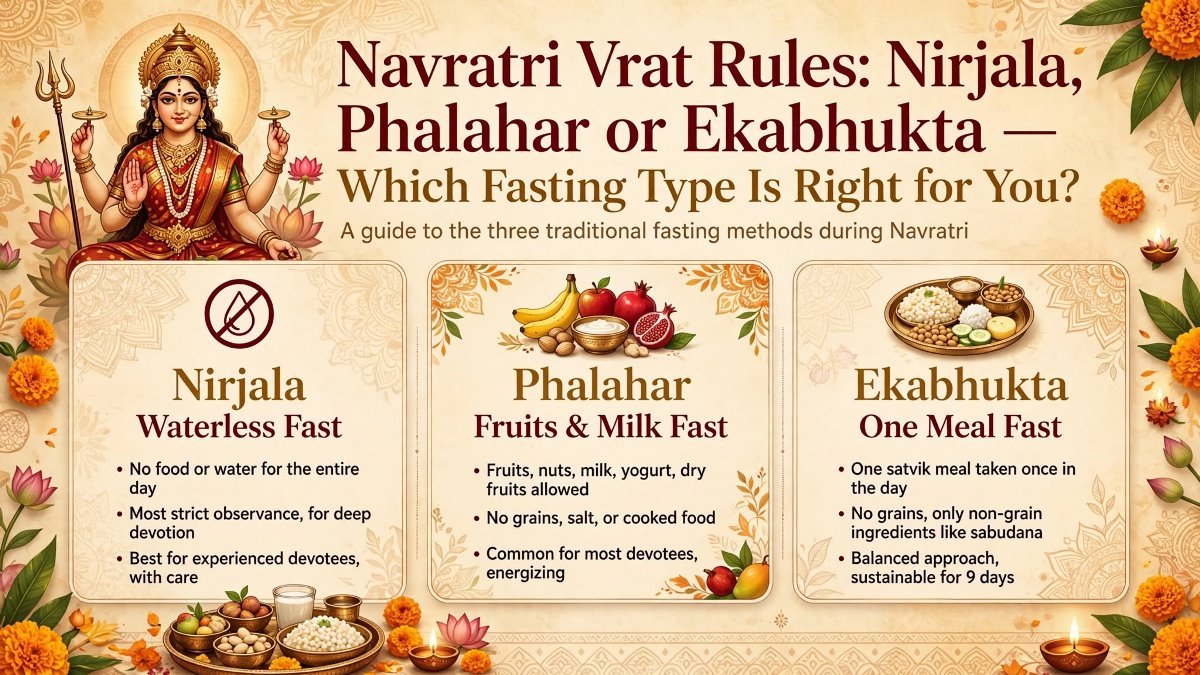
Nirjala is complete abstinence from both food and water, Phalahar allows fruits, dairy, nuts, and specific vrat-friendly flours throughout the day, and Ekabhukta means eating just one vrat-appropriate meal rather than fasting all day. None of the three is considered more devout than the others — Hindu tradition is explicit that the point of Navratri fasting is mindfulness and discipline, not physical hardship, and the right choice depends on your health, your daily demands, and how your body actually handles restriction, not on which option looks the most impressive.
The Three Main Types of Navratri Fasting
Nirjala Vrat is the strictest form: no food and no water for the entire day, sustained purely through prayer and devotion. It demands real physical endurance and is generally attempted only by devotees with prior fasting experience and good baseline health — this is not the type to try for the first time on a whim.
Phalahar Vrat is by far the most commonly observed form. It permits fruits, milk and dairy products, nuts, and a specific set of foods considered acceptable during vrat even though they aren’t strictly fruit — tapioca pearls (sabudana), buckwheat flour (kuttu), water chestnut flour (singhara), and barnyard millet (samak or sama ke chawal). It excludes ordinary grains, lentils, onion, garlic, regular table salt, and anything processed.
Ekabhukta Vrat (also called Ekahaar) restricts eating to a single meal a day, made up of the same vrat-appropriate foods allowed under Phalahar, typically eaten in the evening after that day’s puja. A closely related variant, Naktabhoji, specifies that single meal must come before sunset rather than after.
A few other variants show up in different households and regions — Ksheerbhoji, restricted to milk and dairy only, and multi-day vrats that run continuously from the first sunrise to the last sunset of the festival. None of these are “more correct” than the others; which one a family follows usually comes down to regional custom and what’s been passed down rather than scriptural mandate.
What You Can Actually Eat During Phalahar
Since Phalahar is what most people mean when they say they’re “doing Navratri vrat,” it’s worth being specific about what’s actually on the table. Fruits of essentially any kind are allowed — apples, bananas, pomegranates, papaya, grapes, watermelon. Dairy is fully permitted: milk, yogurt, paneer, and ghee. Dates and nuts (almonds, cashews, walnuts, pine nuts) are commonly eaten both as snacks and for sustained energy.
Beyond fruit and dairy, several starches are treated as acceptable substitutes for grain, since they’re technically seeds or tubers rather than cereal grains: sabudana (used for khichdi, vada, or kheer), kuttu and singhara flour (used for rotis, puris, or pakoras), samak rice (steamed plain, or made into pulao, upma, or dosa), and potatoes in almost any preparation, from a simple jeera aloo to a lightly spiced dahi aloo. Rock salt, sendha namak, replaces regular table salt throughout. Spices like cardamom, cloves, black pepper, cinnamon, and nutmeg are allowed, along with dry pomegranate seeds and fresh or dried ginger. A few items sit in a genuine gray zone — coriander, mint, curry leaves, amchur powder, and black salt are included by some families and skipped by others, so it’s worth checking with whoever in your family sets the standard.
What’s consistently excluded: regular grains like rice, wheat, and barley, all pulses and lentils, onion and garlic, meat, fish, and eggs, alcohol, and most sources also exclude caffeine — tea and coffee — though this varies by household as well.
Why the Diet Restricts What It Does
The underlying framework is what Ayurveda calls sattvic eating — food chosen for purity and lightness rather than heaviness or excess, on the theory that what you eat shapes the clarity of your mind as much as the state of your body. There’s also a seasonal logic layered underneath the spiritual one: Sharad Navratri falls during Ritu Sandhi, the transitional window between summer and the onset of winter, a period Ayurvedic tradition treats as a time when the body’s digestion and immunity are naturally in flux. Lighter, simpler eating during exactly this window is framed as supporting the body through that transition, not just symbolically purifying it — practical and spiritual reasoning arriving at the same conclusion from two different directions.
Which One Is Actually Right for You
This is less a spiritual question than a practical one, and it’s worth treating it that way. A few honest questions to weigh:
Have you fasted like this before? If Nirjala or even a full-day Phalahar fast is new to you, starting with Ekabhukta or a modified Phalahar that includes small meals through the day is a far safer entry point than jumping straight into the strictest version.
What does your day actually demand? Physical labor, a demanding job, caring for young children, or any role that doesn’t allow rest breaks makes strict fasting considerably harder to sustain safely. Matching the fast to your actual schedule, not an idealized one, matters more than which type sounds more devout.
How does your body handle low blood sugar or dehydration? Some people genuinely manage extended fasting well; others feel unwell quickly. This isn’t a character difference — it’s physiology, and it’s worth being honest with yourself about which category you’re in before committing to nine days of anything.
What has family or personal experience already taught you? If you’ve fasted in previous years, you likely already know which type left you feeling clear and devoted versus which left you exhausted or unwell by day four. That experience is better evidence than any general guide, including this one.
Hindu tradition itself backs this kind of individualized approach — the fasting isn’t a competition, and matching the practice to what your health and life can actually sustain is treated as the wise choice, not a lesser one. Some families do observe a stricter type collectively, with everyone following the same rule out of shared custom, and there’s nothing wrong with that either — the point isn’t that individualized choice is always required, only that it’s always available, and that no one type carries more spiritual weight simply for being harder.
Who Should Modify or Skip Strict Fasting Entirely
A few groups are consistently advised, across most traditional and medical guidance, to avoid Nirjala fasting specifically, and to consider whether even Phalahar or Ekabhukta needs modification:
- Pregnant and breastfeeding women, whose nutritional needs extend beyond their own body
- People managing diabetes or other blood sugar conditions, for whom extended periods without food can be genuinely risky rather than just uncomfortable
- Anyone with kidney issues, heart conditions, or a chronic illness, particularly where water restriction specifically could cause real harm
- The elderly and young children, whose bodies handle dehydration and calorie restriction less predictably
- Anyone on medication that requires food to be taken safely
- Anyone with a history of disordered eating, for whom a structured restriction period can be a difficult trigger regardless of its spiritual intent
None of this is a smaller or lesser way to observe Navratri. A modified fast, a single simplified meal, or even prayer and puja without any dietary change at all are all complete, valid ways to mark the festival. The devotion is in the intention and the observance, not in how much the body was made to endure.
Practical Tips for Whichever Type You Choose
If you’re doing Phalahar or Ekabhukta rather than Nirjala, staying hydrated with water, coconut water, or unsweetened fruit juice throughout the day matters more than most people expect — dehydration creeps up quietly during lighter fasting too, not just the waterless kind.
If you manage diabetes and are choosing to fast in some modified form after discussing it with your doctor, favor lower-glycemic options — almonds, walnuts, makhana, cashews — over high-sugar dried fruit like dates and raisins, and if you do eat something sugar-heavy, pairing it with a handful of nuts helps slow the sugar spike.
If you are doing a Nirjala fast, breaking it gently matters: a small amount of water or coconut water first, followed by something easy to digest like fruit, rather than a large or heavy meal immediately after a full day without food.
Signs Worth Taking Seriously Mid-Fast
Whatever type you’ve chosen, a handful of signs are worth treating as a signal to modify or stop rather than push through: persistent dizziness or lightheadedness, a headache that doesn’t ease with rest, unusual heart palpitations, confusion, or simply feeling far worse than tired. These aren’t signs of insufficient devotion — they’re signs your body needs food or water regardless of which day of the nine you’re on. Switching from Nirjala to Phalahar partway through, or from Phalahar to a modified single meal, is a completely normal adjustment, not a failure to complete what you started.
Frequently Asked Questions
What’s the difference between Phalahar and Ekabhukta?
Phalahar refers to what you eat — fruits, dairy, and vrat-appropriate substitutes, generally consumed across multiple small meals through the day. Ekabhukta refers to when you eat — the same category of food, but limited to a single meal.
Is Nirjala fasting required for Navratri to count?
No. Tradition explicitly treats mindfulness and discipline, not physical hardship, as the actual point of the observance. Phalahar and Ekabhukta are complete, valid ways to observe Navratri.
Can I switch fasting types partway through the nine days?
Yes. Many devotees adjust as the days go on based on how they’re feeling — starting with Phalahar and moving to Ekabhukta, or scaling back if health or energy demands it. There’s no rule against adjusting.
Is it safe to do a Nirjala fast in hot weather?
This is exactly the situation where Nirjala fasting carries the most real risk, given how quickly dehydration can set in. Many people choose Phalahar specifically for this reason during warmer years or in hotter regions.
Can children observe Navratri fasting?
Most guidance recommends against strict fasting for children, given how differently their bodies handle calorie and water restriction. A shortened, lighter version, or participation in puja without dietary restriction, is a common and complete alternative.
What should I eat to break a fast at the end of Navratri?
Something light and easy to digest rather than a large, heavy meal — fruit, a small vrat-appropriate dish, or a modest regular meal once the fast has ended, giving your digestive system time to readjust gradually.
Is it normal to feel irritable or low-energy partway through a Navratri fast?
Mild fatigue or a dip in energy, especially by day four or five, is common enough with any restricted eating and isn’t automatically a cause for concern. Persistent dizziness, confusion, or feeling significantly unwell is different, and is a reasonable signal to eat, hydrate, or switch to a gentler form of the fast.
Conclusion
The honest answer to “which type is right for you” is the one that lets you actually stay present for nine days of devotion without your body becoming the main thing you’re thinking about. Nirjala has its place for those with the experience and health to sustain it safely. For everyone else, Phalahar, Ekabhukta, or something gentler still get you to the same place tradition actually cares about — nine days of intention, held with a clear enough mind to notice you were holding it at all.
