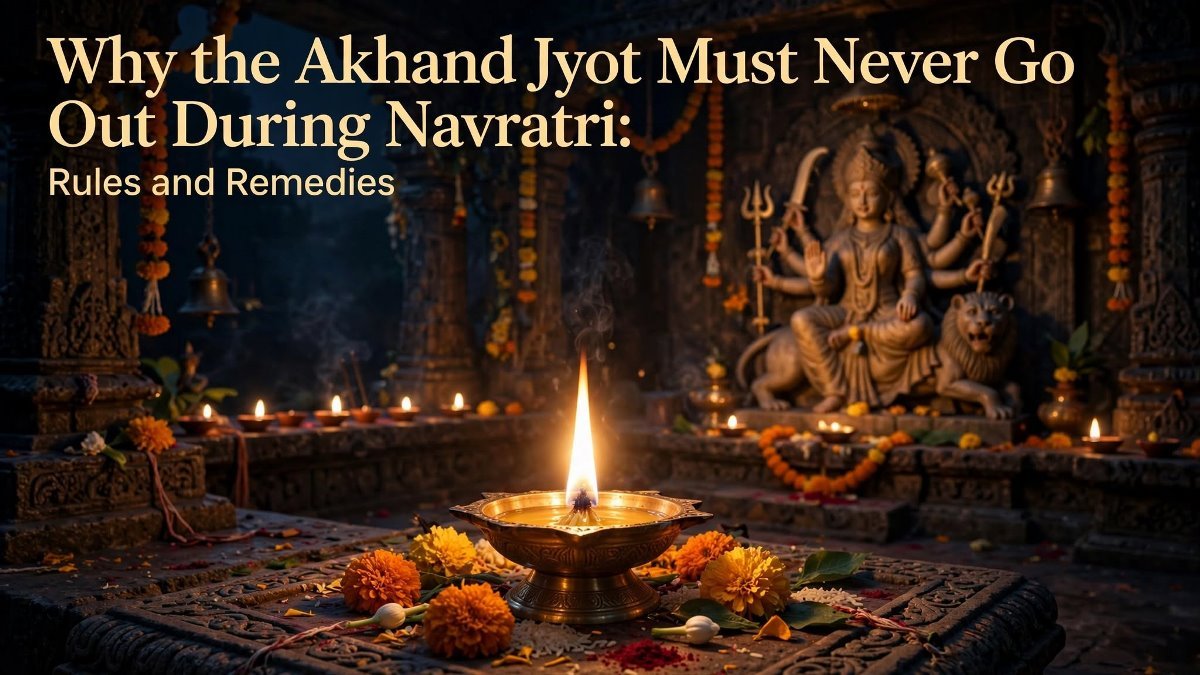
The Akhand Jyot is a continuously burning ghee or oil lamp lit on the first day of Navratri, meant to stay alight for all nine days as a living symbol of Goddess Durga’s unbroken presence in the home. Traditionally, letting it go out is considered inauspicious, which is why the setup and maintenance rules exist in the first place. But if it does go out despite your care, tradition is consistent and clear on this point: it isn’t treated as divine punishment or an unfixable omen. There’s a specific, well-established way to relight it and continue, and scripture itself is cited as saying unintentional lapses are forgivable.
What the Akhand Jyot Actually Represents
Akhand means unbroken or uninterrupted; Jyot means flame. Together, the name describes exactly what the ritual is: a lamp lit at Ghatasthapana, the ceremonial start of Navratri, and kept burning without interruption until the ninth day concludes. It’s considered more than a decorative or symbolic gesture — many traditions describe the Akhand Jyot as the actual personification of the Goddess in the home for those nine days, not merely a reminder of her.
The flame is read on several levels at once. It represents knowledge and awareness overcoming ignorance and darkness, a theme that runs through Hindu symbolism far beyond just this ritual. It represents the unwavering nature of real devotion — a flame that doesn’t flicker in and out mirrors a faith that doesn’t either. And it’s meant to embody the qualities associated with the Divine Mother herself: compassion, generosity, contentment, and unconditional love, present and active in the household for as long as the light holds. Some traditions also connect the practice to more specific benefits, holding that a properly maintained Akhand Jyot helps soften the difficult effects of Rahu, Ketu, and Saturn in a household’s astrological circumstances — a claim rooted in belief rather than something to take as settled fact, but one that adds another layer to why families take the nine days of upkeep seriously.
Setting It Up Correctly
The lamp itself is usually brass, silver, or earthen — if you’re using an earthen lamp, soaking it in water overnight beforehand keeps it from absorbing too much of the oil or ghee once lit. Pure desi ghee is the most traditional fuel, though sesame or mustard oil are also widely used and considered acceptable. A long, thick cotton wick matters more than it might seem: too thin, and it burns down and needs replacing constantly; long and substantial, and it has a far better chance of lasting the distance.
The setup itself typically follows a set sequence: bathe and clean the worship space, spread a red cloth over the altar, and draw a pattern — commonly a swastika or an eight-petalled lotus — using rice, wheat, or gulal beneath where the lamp will sit. The lamp is placed on this base, the wick inserted, and the reservoir filled before it’s lit while focusing on Durga. A ghee lamp is traditionally placed to the right of the altar, an oil lamp to the left. Many devotees chant a specific mantra while lighting it, most commonly “Om Jayanti Mangala Kali Bhadrakali Kripalini, Durga Kshama Shiva Dhatri Swaha Swadha Namostute.”
On direction, it’s worth knowing sources genuinely differ: some traditions call for the northeast, or Ishan, corner of the home; others specify southeast instead, citing Vastu principles. Rather than treating one as definitively correct, it’s reasonable to follow whichever direction your own family or regional tradition uses, since both appear widely in practice.
The Rules for Keeping It Lit
A handful of practical rules govern the nine days once the flame is burning, and most of them exist simply because they address the actual, mundane ways a flame tends to go out — not because the rules themselves carry mystical weight. The house should never be left completely empty while it’s alight — someone should always be present, both to keep an eye on the flame itself and in keeping with the idea that the Goddess’s presence in the home shouldn’t go unattended. The oil or ghee reservoir needs regular checking and topping up well before it runs low, not after — waiting until the flame is visibly struggling is how most accidental extinguishing actually happens. Keeping the lamp covered with a glass or metal shade helps protect it from drafts, open windows, or a passing fan, which are the most common practical causes of the flame going out unintentionally.
Trimming or adjusting the wick deserves its own care: light a second, separate small lamp first, use that light to safely adjust the main wick, and only then let the spare either burn itself out or be extinguished. This way the primary flame is never genuinely unsupervised or unlit, even for the few seconds a wick adjustment takes.
There’s a piece of teaching connected to the wick itself that’s worth including here, since it reframes the whole practice as something more than a maintenance checklist. For a lamp to burn, the wick has to sit partially in the oil — touching it, drawing from it — without being fully submerged and drowned in it. Spiritual teachers have long drawn a direct comparison between that mechanism and how a person is meant to live in the world: engaged with it, drawing sustenance from it, without being so consumed by it that the light goes out. The rule about the wick isn’t just about keeping a lamp burning for nine days. It’s a small, physical demonstration of the exact balance the festival is asking devotees to practice in their own lives — present in the world’s demands and relationships without losing themselves entirely inside them.
Finally, once the ninth day concludes, the flame is traditionally allowed to extinguish on its own, as its fuel runs out naturally, rather than being deliberately put out by hand.
If It Goes Out Anyway: The Remedy
Despite every precaution, flames go out — a gust of wind through a door left open, a wick that burns down faster than expected, ghee that runs low sooner than planned. And here is where tradition is worth taking seriously precisely because of how consistently reassuring it is: this is treated as a physical occurrence, not a spiritual verdict.
The remedy itself follows a clear sequence. First, offer a sincere apology to the Goddess for any mistake, known or unknown, that may have contributed — not as an act of fear, but as a simple acknowledgment. Light a small diya in front of where the Akhand Jyot stood. Fit a fresh wick into the main lamp and relight it from there, restoring the continuous flame. Once the small supporting diya has served its purpose and burns out on its own, it’s removed from the altar, and the main flame continues as before. Some traditions also place a Raksha Sutra — a length of sacred thread roughly a hand and a quarter long — at the center of the Akhand Jyoti setup, treated as an added layer of protection for the flame through the remaining days.
Scripture itself is cited in support of exactly this approach. A verse from the Kshama Prarthana Stotra within the Durga Saptashati asks the Goddess directly to forgive mistakes done unknowingly — a request built into the tradition’s own worship rather than added afterward as reassurance. Texts like the Devi Bhagavata and Markandeya Purana are likewise cited for the same underlying principle: that devotion itself carries more weight than ritual perfection, and that an unintentional lapse in an act performed with genuine faith isn’t treated as a failure of that faith.
What Not to Do
If the flame does go out, a few reactions are worth actively avoiding, since they run against the tradition’s own guidance rather than reflecting it:
- Don’t treat it as a certain sign of misfortune or divine displeasure — tradition explicitly frames it as a physical event, not an omen carved in stone
- Don’t leave it unlit out of anxiety or uncertainty about what to do — relighting it correctly is itself the appropriate response, not something to hesitate over
- Don’t skip the small apology and simply relight in silence — the acknowledgment is part of what completes the remedy, not an optional extra
- Don’t let worry about the flame overshadow the rest of your Navratri observance — the tradition’s own texts prioritize sustained devotion over any single ritual detail going exactly to plan
Frequently Asked Questions
What does it mean if the Akhand Jyot goes out during Navratri?
Traditionally it’s considered inauspicious in a general sense, which is why care is taken to prevent it. But scripture and common practice both treat it as an unintentional, forgivable occurrence rather than a fixed bad omen, with a clear remedy available.
What’s the correct way to relight an Akhand Jyot that has gone out?
Offer a brief apology for any mistake, light a small supporting diya in front of the altar, fit a fresh wick into the main lamp and relight it, then let the small diya burn out on its own before removing it.
What oil or ghee is best for an Akhand Jyot?
Pure desi ghee is the most traditional choice, though sesame and mustard oil are both widely used and accepted, particularly for their ability to burn steadily over a long period.
Can the Akhand Jyot be left unattended overnight?
The general rule is that the house shouldn’t be left completely empty while it burns, though a sleeping household is generally treated differently from a fully vacated home — the concern is mainly about the flame never being left with no one available to notice or respond if something goes wrong.
Which direction should the Akhand Jyot face?
Both the northeast (Ishan) and southeast corners appear in different traditions. Following your own family’s established practice is a reasonable way to resolve the difference.
Is it acceptable to use an electric lamp instead of a real flame?
Traditional practice calls for an actual oil or ghee flame, since the ritual is specifically built around fire as a living, tended element. Some modern households do use electric alternatives for practical reasons, though this departs from the traditional form of the ritual.
Does the Akhand Jyot need to be lit at home, or can it be done at a temple instead?
Both are common. Many devotees light one at home specifically so it can be watched over closely, while others sponsor an Akhand Jyot at a temple, where dedicated staff maintain it — some temple flames are said to have burned continuously for years across many festivals, not just a single Navratri.
Conclusion
The rules around the Akhand Jyot ask for real attentiveness — checking the oil, shielding it from drafts, making sure someone’s always home to notice if something’s wrong. But the remedy, when it does go out anyway, asks for something gentler: an honest apology, a fresh wick, and the willingness to keep going. A tradition that built forgiveness directly into its own worship texts was never really testing whether devotees could keep a flame burning perfectly for nine straight days. It was testing whether they’d keep showing up for it even when they couldn’t.
