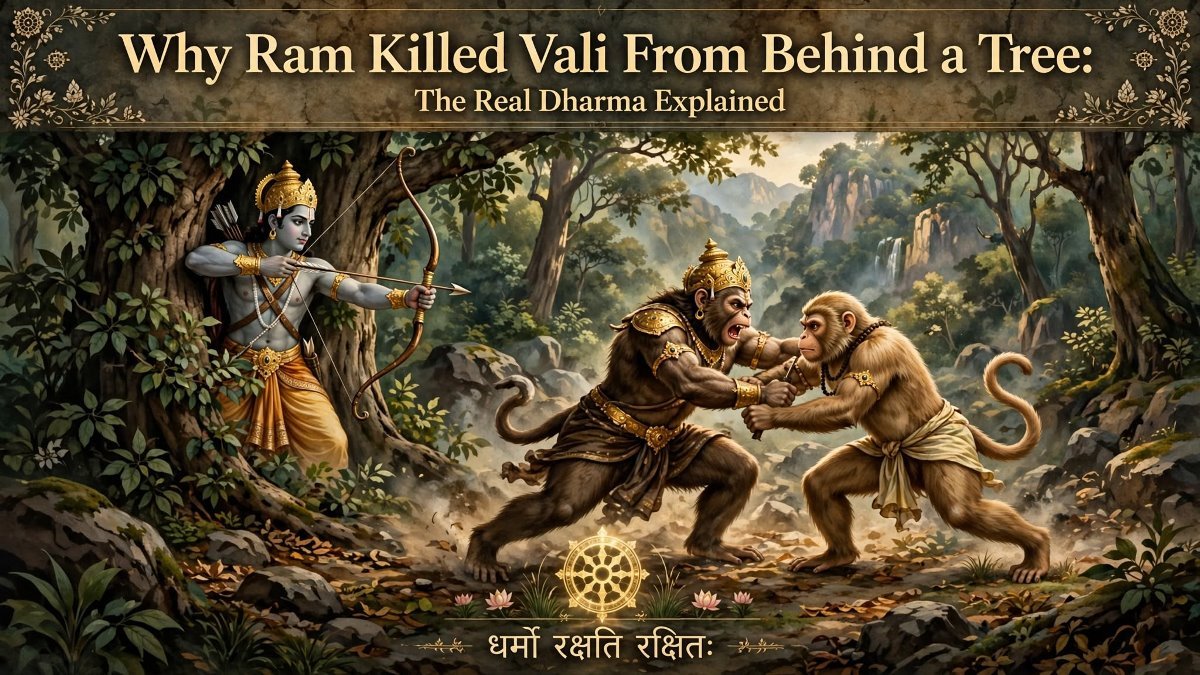
Rama shot Vali from a concealed position because Vali held a boon that made him unbeatable in any fair, face-to-face duel — he drew away half the strength of anyone who fought him directly, which meant an open contest wasn’t a fight at all, just a guaranteed loss for whoever challenged him. Beyond that tactical reality, Rama defended the act on dharmic grounds: Vali had seized his own brother’s wife, a transgression Hindu law texts treat as punishable regardless of the offender’s power, and as Sugriva’s sworn ally, Rama held that punishing this crime fell to him. Valmiki’s own text doesn’t shy away from the difficulty here — Vali raises nearly every objection a modern reader would, and Rama answers each one directly. That exchange is the real substance of this episode.
The Backstory: Two Brothers and a Cave
Vali and Sugriva ruled Kishkindha together as vanara brothers — Vali, the elder, said to be born of Indra; Sugriva, born of Surya. Their trouble began when a demon threatened the kingdom and fled into a mountain cave to escape Vali’s pursuit. Vali followed it inside, telling Sugriva to guard the entrance and wait for his return.
Sugriva waited. Days became weeks. Eventually, sounds from inside the cave and a flow of blood at its mouth convinced him his brother was dead. Grieving and afraid the demon might emerge next, Sugriva sealed the cave with a boulder and returned to Kishkindha, where he was crowned king in Vali’s place.
Vali was not dead. He had killed the demon and, finding the entrance blocked, eventually forced his way out — only to return home and discover his own brother sitting on his throne. Convinced Sugriva had trapped him deliberately to seize power, Vali refused to hear any explanation. He banished Sugriva from the kingdom, and in the process took something far more serious than a title: he took Ruma, Sugriva’s wife, as his own. Sugriva fled to the forests of Rishyamukha with a handful of loyal followers, living in constant fear of a brother who could, by all accounts, kill him without much effort.
Vali’s Invincibility: The Boon That Made Him Unbeatable
The detail that makes this whole episode make sense is one that most retellings skip: Vali had performed austerities to the sun god and received a boon that whenever anyone stood before him to fight, he would keep his own full strength while also absorbing half of his opponent’s. In practice, this made him nearly impossible to defeat in single combat — the harder his opponent fought, the stronger Vali became. Some versions of the epic even describe Ravana himself learning this the hard way, picking a fight with Vali and being casually pinned under his arm while Vali continued his prayers uninterrupted.
This is the detail that reframes the entire episode. An open, declared duel between Rama and Vali was never really an option if the goal was to actually defeat him — it would have handed Vali more power the moment the fight began.
The Alliance: Why Rama Agreed to Kill Vali
Rama met Sugriva through Hanuman while searching the forests for Sita, taken by Ravana. Sugriva offered his vanara army and his knowledge of the world’s geography to help find her; in exchange, Rama agreed to kill Vali and restore Sugriva to his throne and his wife.
Sugriva, understandably, wanted proof before staking everything on this alliance — he had seen what Vali could do. Rama demonstrated his own capability first: with a single arrow, he pierced seven massive Sapta-tala trees standing in a row, a feat tied to an old curse in which Vali himself had once turned a serpent into those very trees. Only after seeing this did Sugriva agree to challenge his brother again.
The First Duel Rama Didn’t Finish
Sugriva challenged Vali to single combat, expecting Rama to end the fight from hiding. Instead, Rama held his arrow. Vali and Sugriva, as brothers, looked identical to him in the heat of battle, and Rama refused to risk striking the wrong one. Sugriva took a severe beating and had to retreat.
This detail matters more than it first appears. Rama’s hesitation shows a version of this story where the concern for accuracy and fairness came before the kill — he was not looking for any excuse to strike quickly from concealment. He needed a way to be certain.
The Garland, the Tree, and the Arrow: What Actually Happened
For the second duel, Rama had Sugriva wear a garland of flowers so the two brothers could be told apart at a distance. Sugriva challenged Vali again. Despite Tara — Vali’s wife, known for her wisdom — warning her husband that something felt wrong about a second challenge from a brother who had just been humiliated, Vali dismissed her concern, confident in his boon, and went to fight.
Rama positioned himself behind a tree at the edge of the clearing, watched for the garland, and released a single arrow. Valmiki’s text is specific that it struck Vali in the chest, not the back — the concealment was in Rama’s position, not in the direction of the shot. Vali fell, mortally wounded, and it was only as he lay dying that the confrontation everyone remembers actually took place.
Vali’s Challenge: “Why Did You Kill Me Like This?”
What follows is one of the most quoted exchanges in the entire epic. Vali, furious and in pain, demands to know why a prince famed for righteousness would kill a stranger from hiding, in a fight that wasn’t even his own. He points out that he had no quarrel with Rama personally, that he could have helped recover Sita himself given his strength, and that if Rama had simply asked, none of this needed to happen this way.
It’s a genuinely hard question, and Valmiki doesn’t let Rama off with a vague answer.
Rama’s Dharma: The Actual Explanation
Rama’s response comes in layers, and each one addresses a specific part of Vali’s accusation.
On the crime itself: Rama states plainly that Vali’s real offense was not losing a fair fight to Sugriva — it was seizing Ruma, his own brother’s wife. Dharma texts of the period treat this as one of the gravest possible transgressions, placed alongside incest, and prescribe death as the punishment regardless of the perpetrator’s status or strength. As Sugriva’s ally, Rama held that carrying out this punishment had fallen to him.
On the “just an animal” defense: Vali argues that as a vanara, he lives by different rules than humans and shouldn’t be judged by human standards of combat. Rama rejects this directly — the exemption for animals exists because animals cannot understand the difference between right and wrong. Vali, learned in scripture and raised to know dharma, doesn’t qualify for that excuse. He can’t claim ignorance as a shield and simultaneously demand to be judged only by the rules of human duels.
On the friendship with Sugriva: Rama had given his word to Sugriva before the alliance was even fully explained, and by the logic he lays out, an ally’s enemy — particularly one guilty of a crime this serious — becomes an obligation to act against, not a private dispute Rama could stay out of.
On concealment itself: Rama frames this less as a duel between equals and more as the punishment of a wrongdoer, a distinction the epic treats as categorically different. A king enforcing justice on a proven transgressor was not bound, in this framing, to the etiquette of a challenge between two willing combatants.
None of this fully satisfies every reader, and it didn’t fully satisfy Vali either — but it satisfied him enough to stop arguing.
Vali’s Redemption and Death
Once Rama finished speaking, Vali’s anger gave way to something closer to acceptance. He acknowledged his own fault in taking Ruma and misjudging his brother without giving him a chance to explain. Rather than dying in bitterness, he asked one thing of Rama and Sugriva: that his son, Angada, be protected and eventually treated as heir, regardless of who now held the throne.
Both Rama and Sugriva honored that request. Angada would go on to become one of the most trusted commanders in the vanara army that later marched on Lanka — a detail worth sitting with, since it means the son of the “wronged” party ended up fighting loyally on Rama’s side, having seen for himself how the promise made at his father’s deathbed was kept.
Tara’s Grief — and What Happened to Her After
Tara’s part in this story doesn’t end at the warning she gave before the fight. After Vali fell, she came to the battlefield and confronted Rama directly, asking why he had killed a husband who had never been his enemy and who, given the chance, would have brought Ravana to him in chains rather than let the war happen at all. Rama’s answer to her mirrors what he told Vali: the crime was against Sugriva, and an ally’s enemy becomes an obligation, not a private matter to stay out of.
Tara mourned, but she didn’t disappear from the story. Known throughout Kishkindha for her counsel — she had, after all, correctly predicted disaster before the second duel — she went on to become a trusted advisor to Sugriva’s court, and vanara custom of the time permitted a widow to remarry within the family, which several tellings note she eventually did. Her role afterward is less about the killing itself and more about what a kingdom does with grief once the fighting is over: it keeps the wise counsel and finds a way to move forward with the living.
What This Episode Actually Teaches
Strip away the tactics and the scripture-quoting, and the Vali episode is really about a harder question than “was this fair?” — it’s about what dharma requires when the only path to justice runs through an opponent no honest fight can touch. Rama doesn’t argue that concealment is generally acceptable; he argues that this specific case — a serious crime, an all-powerful offender, and a promise already made to the wronged party — justified breaking with convention.
It’s worth being honest that this remains one of the most debated moments in the entire epic, argued over by commentators, scholars, and ordinary readers for centuries, and it’s unlikely any single explanation will fully settle it for everyone. What Valmiki leaves us with instead is a Rama who doesn’t dodge the question — he stays, answers Vali directly, and lets the dying king’s own response stand as part of the account.
Frequently Asked Questions
Did Rama really shoot Vali in the back?
Valmiki’s text specifies the arrow struck Vali’s chest. Rama was concealed behind a tree when he released it, but the shot itself was frontal.
Why couldn’t Rama just fight Vali directly?
Vali’s boon transferred half of any direct opponent’s strength to himself during combat, making a fair one-on-one duel effectively unwinnable for anyone who challenged him.
What was Vali’s actual crime, according to Rama?
Seizing Sugriva’s wife, Ruma, after banishing him — a transgression that Hindu dharma texts of the period treat as grave enough to warrant death regardless of the offender’s power.
Did Vali forgive Rama before dying?
He stopped arguing after hearing Rama’s reasoning and accepted his death, focusing his final request on securing his son Angada’s future rather than continuing to contest the killing.
What happened to Vali’s son, Angada?
Angada was protected as Vali requested and later became a senior commander in Sugriva’s vanara army, playing a key role in the war against Ravana.
Is this episode still debated today?
Yes — it’s widely considered one of the most morally complex moments in the Ramayana, and different commentators, sects, and readers continue to weigh Rama’s justification differently.
Conclusion
The image of Rama hiding behind a tree is the part of this story that travels fastest, but it’s also the part that tells you the least. The actual episode is slower and stranger than that: an unbeatable king, a brother wronged in the gravest possible way, a promise made before all the facts were in, and a dying man who asks his killer the question everyone since has kept asking. Valmiki doesn’t resolve that tension by hiding it — he puts Vali’s challenge and Rama’s answer side by side and lets both stand. That’s arguably why this episode has stayed alive in argument for as long as the rest of the Ramayana has stayed alive in devotion.
