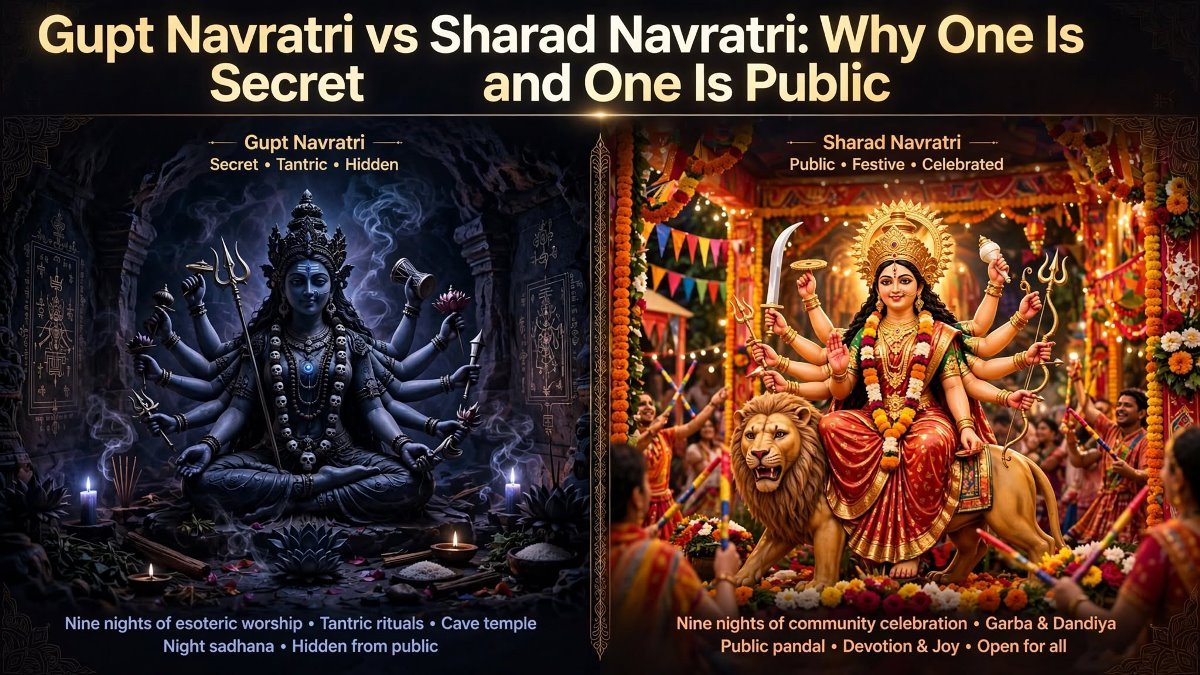
Sharad Navratri, held in autumn, is the Navratri most people know — nine nights of public celebration, Durga Puja pandals, Garba nights, and Ramlila performances, ending in Dussehra. Gupt Navratri occurs twice a year, in Magha and Ashadha, and centers on the ten Mahavidyas, fierce Tantric forms of the Goddess, worshipped quietly by serious practitioners rather than as a community festival. The difference isn’t just visibility — tradition holds that the secrecy itself is functionally part of what makes Gupt Navratri’s practices effective, concentrating a kind of spiritual intensity that public celebration would dilute.
Four Navratris, Not One
Most people, asked how many times a year Navratri happens, will say once, or maybe twice if they know about Chaitra Navratri in spring alongside the more famous autumn one. According to the Devi Bhagavatam, the actual number is four: Chaitra in spring, Sharad in autumn, and two more — Magha and Ashadha — that most Hindu households have never observed and many have never even heard of. Those last two are the Gupt Navratris, and the gap in public awareness between them and Sharad isn’t an accident of history. It’s built into what each one is for.
Why Sharad Navratri Became the Public One
Sharad Navratri’s dominance traces back to a specific moment in the Ramayana. Traditional worship of the Goddess was originally more closely tied to spring, but before his battle with Ravana, Rama is said to have invoked Durga out of season — an “untimely awakening,” or Akal Bodhan — seeking her blessing ahead of a war he needed to win. That invocation is why Sharad Navratri is sometimes called Maha Navratri, the great Navratri, and it’s part of why the autumn observance eventually eclipsed the others in scale and popularity: it carries the weight of Rama’s own story, not just the Goddess’s.
From there, Sharad Navratri became the version of the festival built for community rather than solitude. In Bengal, it takes the form of elaborate Durga Puja pandals, drawing entire neighborhoods out for nine nights. In Gujarat, it’s Garba and Dandiya, danced in circles late into the night. In much of North India, it runs alongside Ramlila performances reenacting the Ramayana, culminating in Dussehra and the burning of Ravana’s effigy. None of this is quiet, and none of it is meant to be — Sharad Navratri was built, almost from its mythological origin, to be witnessed.
It’s worth noting Chaitra Navratri belongs in this same public category, even though it’s smaller in scale than Sharad. Falling in spring and marking the start of the Hindu new year in many regional calendars, Chaitra Navratri is still a household and community observance — fasting, worship of the Navadurga, and celebrations culminating in Ram Navami. Between Chaitra and Sharad, ordinary devotees have two full public opportunities each year to observe Navratri in the way most of India recognizes it. The Gupt Navratris exist entirely outside that public rhythm.
What Makes Gupt Navratri “Secret”
Gupt Navratri occurs in the months of Magha (January–February) and Ashadha (June–July), and where Sharad centers on the nine forms of Durga — the Navadurga — Gupt Navratri centers on the Das Mahavidyas, ten fierce wisdom goddesses: Kali, Tara, Tripura Sundari, Bhuvaneshwari, Chhinnamasta, Bhairavi, Dhumavati, Baglamukhi, Matangi, and Kamala. The Ashadha observance carries an additional specific focus on Varahi, the boar-headed form among the Sapta Matrikas, the seven mother goddesses.
These aren’t gentler, more approachable forms of the divine feminine the way the Navadurga generally are. Each Mahavidya is associated with confronting a different kind of obstacle or illusion rather than a different battle scene — Kali with the dissolution of ego and fear of death, Chhinnamasta with radical self-sacrifice, Dhumavati with loss, widowhood, and the parts of life most festivals avoid looking at directly, Baglamukhi with the paralysis of an enemy’s harmful intentions. Where the Navadurga forms build toward Durga’s outward victory over Mahishasura across nine familiar chapters, the Mahavidyas each sit with something uncomfortable and internal, which is part of why this worship was never going to translate easily into a public street celebration. That’s the practical reason so few people observe Gupt Navratri: it was never built for mass participation in the first place.
One traditional account offers a sense of what the practice is believed capable of. A sage, Rishi Shrungi, is said to have told a troubled woman about the existence of these two hidden Navratris, largely unknown even in her own time, and advised her to direct her devotion toward the Goddess through them. She undertook the sadhana with sincerity, and tradition holds that her circumstances shifted noticeably afterward — including, in this particular telling, her husband turning away from a reckless life and toward responsibility. Stories like this one aren’t offered as historical record so much as illustration: Gupt Navratri’s promise was never about spectacle, but about quiet, specific transformation in a person’s actual circumstances.
Why the Secrecy Itself Matters
Here’s the part that separates Gupt Navratri from simply being “the lesser-known Navratri.” Tradition doesn’t treat the secrecy as incidental — something that happened to stay obscure because it’s niche. It treats the secrecy as functional. Sadhana performed quietly, without announcement, is held to concentrate the practice’s power in a way that public performance would actually undercut. Where Sharad Navratri’s meaning is amplified by being shared — a whole neighborhood dancing together, a whole city watching the same Ramlila — Gupt Navratri’s meaning is held to depend on the opposite: restraint, privacy, and a kind of inward focus that a crowd would interrupt.
There’s a deeper reading of “secret” here too, beyond simply keeping rituals hidden from other people. Some traditions describe the real hidden element as being within the practitioner rather than the practice — that what Gupt Navratri gradually reveals isn’t a concealed ritual so much as concealed dimensions of the seeker’s own consciousness. Read this way, the contrast between the two festivals isn’t really public versus private. It’s external versus internal: Sharad Navratri commemorates a battle against demons outside the self, fought in public, celebrated in public. Gupt Navratri is oriented toward whatever the practitioner needs to face and transform within themselves, which by its nature isn’t something a festival crowd can witness at all — no drum loud enough, no crowd large enough, to make an inward reckoning into a public event.
Two Tracks Within Gupt Navratri Itself
Even within Gupt Navratri, there’s more than one way it’s observed, depending on how deep a practitioner intends to go. Devotees following the more general Navadurga pattern observe the standard nine days, from Pratipada tithi through Navami, much like Sharad or Chaitra Navratri. Tantric sadhaks focused specifically on the Das Mahavidyas often begin a day earlier, starting on Amavasya, the new moon, with the invocation of Kali specifically — a starting point that itself signals how much more intensive this branch of the observance is meant to be.
The more advanced Tantric rituals associated with this period are also generally described as requiring initiation from a qualified guru within an established lineage, rather than being freely practiced from a book or a website. This isn’t gatekeeping for its own sake — Tantric sadhana involving the Mahavidyas is considered powerful enough, in the tradition’s own framing, that approaching it without proper guidance is treated as genuinely unwise rather than simply unconventional. The concern isn’t secrecy for status or exclusivity; it’s closer to the same caution you’d expect around any practice believed to carry real force, whether spiritual or otherwise — something to be handed down carefully rather than picked up casually.
Can an Ordinary Person Observe Gupt Navratri?
Yes, and most sources are clear on this point: you don’t need to be a Tantric initiate to mark the occasion. A simpler observance — fasting for the nine days, performing Kalash Sthapana, offering prayers and a basic aarti to the Goddess, reading about or reciting the names of the Mahavidyas — is open to anyone and is how most people who do observe Gupt Navratri actually approach it. It’s the deeper Tantric sadhana specifically, the mantra work and ritual practice aimed at siddhi, that tradition reserves for initiated, guided practitioners. Devotion at a simpler level was never the part that needed to stay hidden.
Frequently Asked Questions
How many times a year does Navratri actually occur?
Four times: Chaitra in spring, Sharad in autumn, and two Gupt Navratris in Magha (January–February) and Ashadha (June–July).
What’s the main difference between Gupt Navratri and Sharad Navratri?
Sharad Navratri is a large public festival centered on the Navadurga, celebrated with community events like Durga Puja and Garba. Gupt Navratri is a quieter observance centered on the ten Mahavidyas, traditionally practiced privately by Tantric practitioners and dedicated sadhaks.
Why is Gupt Navratri kept secret?
Tradition holds that performing this sadhana quietly, without public display, concentrates its spiritual effect. Some interpretations extend “secret” further, describing it as referring to hidden dimensions of the practitioner’s own consciousness rather than just concealed rituals.
Do I need a guru to observe Gupt Navratri?
Not for a basic observance — fasting, simple worship, and prayer to the Goddess are open to anyone. The more advanced Tantric rituals involving the Mahavidyas specifically are traditionally reserved for those initiated by a qualified guru.
Why is Sharad Navratri called Maha Navratri?
Because of its connection to Rama’s own invocation of Durga before his battle with Ravana — an out-of-season plea for her blessing that gave the autumn observance added mythological weight and helped establish it as the primary, most widely celebrated Navratri.
Are the deities worshipped in Gupt Navratri different from Sharad Navratri?
Yes. Sharad Navratri centers on the nine forms of Durga, the Navadurga. Gupt Navratri centers on the ten Mahavidyas — more fierce, esoteric forms of Shakti — with Ashadha Gupt Navratri additionally focused on the goddess Varahi.
Does Chaitra Navratri count as public or secret?
Public, alongside Sharad. Chaitra Navratri is a household and community observance marking the Hindu new year in many regions, culminating in Ram Navami, and follows the same open, widely celebrated pattern as Sharad Navratri rather than the private pattern of the two Gupt Navratris.
What happens on the first day of each Gupt Navratri?
Devotees following the standard Navadurga pattern begin with Kalash Sthapana on Pratipada, the same as Sharad or Chaitra Navratri. Tantric sadhaks focused on the Das Mahavidyas often start a day earlier, on Amavasya, with the invocation of Kali.
Conclusion
Sharad Navratri and Gupt Navratri aren’t really two versions of the same festival — one loud, one quiet, by coincidence. They’re built around two different ideas of what worship is for. One says the Goddess’s power is best met in public, danced and sung and witnessed by as many people as possible. The other says some of her forms only reveal themselves to whoever’s willing to sit with them alone. Most of Hindu India lives inside the first idea for nine nights each autumn. Very few ever step into the second — and tradition suggests that’s exactly how it’s meant to stay.
