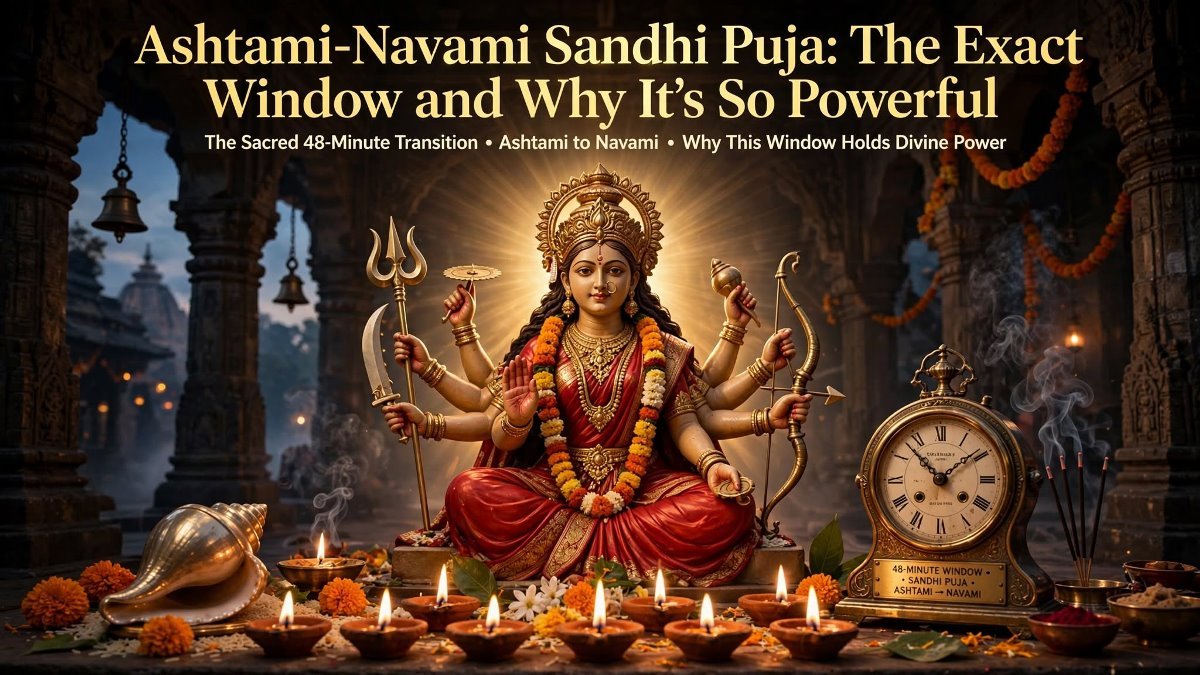
Sandhi Puja is performed during a fixed 48-minute window — the last 24 minutes of Ashtami tithi and the first 24 minutes of Navami tithi — during Sharad Navratri. It commemorates the exact moment tradition holds that Goddess Durga, ambushed from behind by the demons Chanda and Munda, erupted in fury and manifested her fiercest form, Chamunda, to destroy them. Because the window is defined by lunar tithi rather than clock time, it falls at a different hour every year and demands full, present attention the moment it arrives — which is a large part of why devotees treat it as the single most intense 48 minutes of the entire festival.
What “Sandhi” Actually Means: The 48-Minute Mechanism
Sandhi means junction — the point where one thing ends and another begins. In this case, it’s the junction between Ashtami, the eighth day of Navratri, and Navami, the ninth. Specifically, Sandhi Kaal is measured as the final 24 minutes of Ashtami tithi combined with the first 24 minutes of Navami tithi, a total of 48 minutes also described in traditional units as “two Ghatis,” a Ghati being an old measure of time equal to 24 minutes.
This is worth sitting with because it explains why the window moves every year and can’t be pinned to a fixed clock time the way, say, a sunset ritual can. Tithis are lunar-day measurements, and they don’t align neatly with 24-hour solar days — an Ashtami tithi might end at 10 AM one year and 8 PM the next. Sandhi Puja is defined entirely by where that specific junction falls, which means the exact minute of the ritual has to be recalculated from the Panchang every single year, sometimes landing in the middle of the night and sometimes in broad daylight.
The Moment Sandhi Puja Commemorates
The story behind this specific junction centers on an ambush. As Durga fought through her long battle against Mahishasura’s forces, two of his generals, Chanda and Munda, attacked her from behind — a strike considered so dishonorable that it broke the accepted rules of battle even by a demon army’s standards. The attack enraged her instantly and completely. Her face is described as darkening with fury, and from her own forehead, through her opened third eye, emerged Chamunda — a form identified with Kali, dark and terrible, built entirely from the concentrated force of that anger. Chamunda turned on Chanda and Munda and killed them both on the spot.
This is the specific moment Sandhi Puja marks — not a symbolic reference to the goddess’s power in general, but this precise transformation, timed to the precise transition between the two tithis. Several traditions also connect this same fierce episode to what follows it in the wider Durga Saptashati narrative: Chamunda’s confrontation with Raktabija, the demon whose every fallen drop of blood spawned a duplicate of himself, defeated only when Chamunda drank his blood before it could touch the ground. Whether or not that specific battle is read as happening in the same 48 minutes, it’s part of the same unbroken arc of fury that Sandhi Puja is built to honor.
Why This Specific Junction Is Considered So Powerful
Two things are doing the work here, and they reinforce each other. The first is a broader principle in Hindu worship: transitional moments — dawn, dusk, the turn from one lunar phase to another — are consistently treated as spiritually charged thresholds, times when the boundary between ordinary and sacred experience is thinner than usual. Sandhi Kaal is the most concentrated version of that idea within Navratri, a junction not just between two arbitrary points in time but between two named days of the festival itself.
The second is narrative weight. This 48-minute window isn’t associated with a quiet or contemplative moment in the story — it’s the single most explosive point in the entire Durga Saptashati, the instant restraint gives way completely and the goddess’s full destructive capacity is unleashed without hesitation. Devotees who treat this window with such urgency aren’t only responding to abstract timing theory; they’re marking the precise instant a slow-building battle turned decisive.
Add to that the sheer brevity of the thing — 48 minutes, gone the moment it arrives, impossible to reschedule or repeat that year — and you get a ritual that asks for a kind of presence most day-long observances don’t. You can’t drift in and out of Sandhi Puja. Either you’re there for it or the window has already closed.
What Actually Happens During Sandhi Puja
The ritual centers on light and number. Devotees light 108 lamps and offer 108 lotus flowers to the goddess — a detail that itself echoes back into the mythology, since 108 lotuses are said to be what the gods once offered Durga in their own desperate plea for her help before the battle against Mahishasura began. Alongside the lamps and flowers, priests recite verses from the Devi Mahatmya, the same Durga Saptashati text at the center of the wider festival, specifically invoking Chamunda in her fierce form. In Bengal, where Durga Puja reaches its most elaborate public expression, the dhak drums build to their loudest and most insistent rhythm through exactly this window, timed to peak alongside the ritual itself.
Historically, animal sacrifice marked this specific moment in many traditional observances, understood as a symbolic offering matching the intensity of the goddess’s own destruction of evil in the story. In contemporary practice, this has been very widely replaced with symbolic substitutes — offerings of vegetables, sweets, or other items cut or presented in a way that preserves the ritual gesture without the sacrifice itself, and many pandals and households today observe Sandhi Puja entirely through light, flowers, and recitation.
Some traditions extend the worship further within this same period, invoking the Ashtanayikas — eight forms of the goddess including Brahmani, Vaishnavi, Varahi, and Chamunda herself — alongside the sixty-four Yoginis considered her attendant powers. Not every household or pandal includes this fuller invocation, but where it’s practiced, it reinforces the same underlying idea: that this window calls on the goddess’s power in its most multiplied, concentrated form, not just a single image of her.
Two related rituals tend to cluster around the same general period of Ashtami, even though they aren’t Sandhi Puja itself: Astra Puja, the worship of Durga’s weapons, and Kumari Puja, in which a young, pre-pubescent girl is worshipped as a living embodiment of the goddess. Neither is confined to the 48-minute window the way Sandhi Puja is, but both add to why Ashtami as a whole is treated as one of the festival’s most intensely ritual-heavy days.
How Observance Differs by Region
The scale of Sandhi Puja varies considerably depending on where it’s observed. In West Bengal and Bangladesh, where Durga Puja reaches its most elaborate public form, Sandhi Puja is often the single most crowded moment of the entire pandal season — priests perform it with theatrical intensity, drummers build to a peak, and the surrounding crowd falls into a kind of collective hush broken only by the dhak. In much of North India, where Navratri centers more on fasting, Ramlila performances, and Kanya Pujan, Sandhi Puja tends to be observed more quietly, often within temples or individual households rather than as a mass public event. In the South, where Navratri takes a different shape entirely around Golu displays and Saraswati Puja on the later days, Sandhi Puja specifically is less commonly a household-level tradition, though it’s still recognized and observed within Shakta-focused temples. None of these differences change what the ritual is — only how visibly and how publicly it gets marked.
Sandhi Puja 2026: What to Expect
Sharad Navratri 2026 places Durga Ashtami around October 18–19, with the Ashtami tithi running into the morning of October 19 before giving way to Navami the same day. Based on the most consistent calculations available, the Sandhi Kaal window is expected to fall in the mid-to-late morning on October 19 — several sources converge on a window somewhere close to 10:30 to 11:15 AM, though a couple of others differ meaningfully on both the date and the exact hour.
That spread is worth being upfront about rather than papering over: Panchang-based timings this precise are genuinely sensitive to which calculation method and which reference location a given source uses, and the fully finalized, minute-accurate muhurat for 2026 typically isn’t locked in until closer to the festival itself. Treat mid-October as a safe general expectation, and confirm the exact minute-level window against a current Panchang for your city in the days just before Navratri — the same way you’d double-check any tithi-based timing rather than relying on a figure calculated months in advance.
Can You Perform Sandhi Puja at Home?
Yes — it doesn’t require a public pandal or a priest, though many households do coordinate with one for the exact timing. At home, the ritual can be kept simple: light your lamps (108 if that’s practical, fewer if it isn’t — devotion matters more than the exact count for a home observance), offer flowers to an image of Durga or Chamunda, and recite whatever portion of the Devi Mahatmya or Durga mantras you’re able to during the window itself. What matters most, according to the tradition built around this ritual, is being present and attentive for those 48 minutes specifically, not the scale of the offering.
Frequently Asked Questions
How long does Sandhi Puja last?
Exactly 48 minutes — the last 24 minutes of Ashtami tithi and the first 24 minutes of Navami tithi, traditionally described as two Ghatis.
Why does the Sandhi Puja time change every year?
Because it’s defined by lunar tithi rather than a fixed clock time. Since tithis don’t align with 24-hour solar days, the exact hour of the Ashtami-Navami junction shifts from year to year and must be recalculated from the Panchang annually.
What does Sandhi Puja commemorate?
The moment Goddess Durga, attacked from behind by the demons Chanda and Munda, transformed into her fierce form Chamunda and destroyed them — considered one of the most decisive turning points in the Durga Saptashati.
Why are 108 lamps and 108 lotus flowers used?
The number echoes the mythology itself — 108 lotus flowers are said to be what the gods offered Durga before her battle with Mahishasura, and the tradition carries that same number forward into the ritual.
Is animal sacrifice still part of Sandhi Puja today?
It was historically part of many traditional observances, but contemporary practice has largely shifted to symbolic substitutes, and many households and pandals today observe the ritual entirely through light, flowers, and recitation.
Can Sandhi Puja be performed without a priest?
Yes. A simplified home version — lighting lamps, offering flowers, and reciting available verses during the window — is considered a complete and meaningful observance, with presence and attentiveness mattering more than ritual scale.
Does Sandhi Puja look the same everywhere in India?
No. It’s most elaborate and publicly visible in West Bengal and Bangladesh, where it’s often the most crowded moment of the entire Durga Puja pandal season. In North India it tends to be a quieter temple or household ritual, and in South India it’s mainly observed within Shakta-focused temples rather than as a widespread household tradition.
Conclusion
Most of Navratri unfolds across whole days, giving devotees room to arrive late, step away, and come back. Sandhi Puja offers none of that room, and that’s precisely the point. Forty-eight minutes, fixed by the moon rather than the clock, marking the exact instant a goddess’s restraint gave way to something unstoppable — it’s a ritual built entirely around the idea that some moments don’t wait for you to be ready. You either show up for them, or you read about them afterward.
