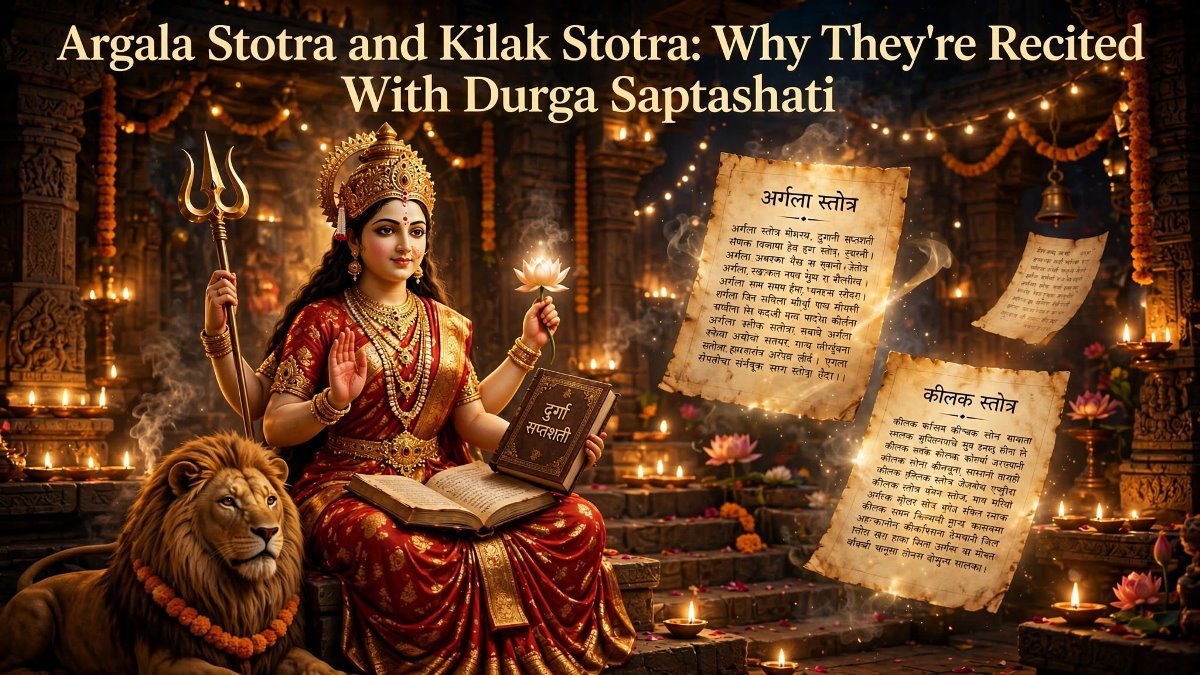
Durga Saptashati is traditionally never read on its own. It’s preceded by three short preparatory texts — Devi Kavacham, Argala Stotram, and Kilaka Stotram — recited in that order, together known as the Trayangam. Argala Stotra is a direct petition, asking the Goddess for specific boons before the main recitation begins. Kilaka Stotra works differently: it addresses a “lock” tradition says Shiva placed on the Saptashati’s deeper meaning, and reciting it with understanding is what’s said to release the text’s full power. Skip them, and tradition holds you can still read all 700 verses — you just won’t get everything they’re capable of giving you.
The Three-Part Preparation Before Chandi Path Begins
Durga Saptashati, also called the Devi Mahatmyam or Chandi Path, is 700 verses across thirteen chapters from the Markandeya Purana, describing the Goddess’s battles against Madhu-Kaitabha, Mahishasura, and Shumbha-Nishumbha. It’s the central text of Navratri worship, and in its complete, traditional form, it’s bookended by auxiliary texts — but three specific ones always come first, in a fixed sequence: Devi Kavacham, then Argala Stotram, then Kilaka Stotram, and only after all three does the reciter begin Chapter One.
Each of the three does something different, and none of them overlaps with the others. Kavacham is protective — an armor recited to shield the practitioner’s own body and mind before approaching a text this powerful. It works through a similar structure to other kavacha stotras: assigning different aspects and names of the Goddess to guard different parts of the reciter’s body, so that nothing is left exposed before engaging with a text of this intensity. Argala is a petition — a direct, repeated ask for specific things the reciter wants. Kilaka is neither protection nor request; it’s closer to a key, addressing why the Saptashati’s mantras work at all and what needs to be understood before they’ll actually work for you. Argala and Kilaka are the two most commonly discussed of the three, and they’re worth understanding on their own terms.
What Comes After the Trayangam
The three preliminaries aren’t quite the whole preparation. Once Kavacham, Argala, and Kilaka are complete, many traditions also recite a short nine-syllable mantra, the Navakshari, immediately before opening to Chapter One — a final, compact invocation that some practitioners treat as the actual ignition point of the recitation, with everything before it as preparation and everything after it as the working itself. On the other end of the text, after all thirteen chapters and 700 verses are complete, tradition adds closing portions as well, including the Devi Suktam and a set of texts known as the Rahasya, or “secret” portions — the Murti Rahasya, Vaikritika Rahasya, and Pradhanika Rahasya — which explore the philosophical and symbolic dimensions of the Goddess described in the main text. Argala and Kilaka sit at the entrance to all of this, but they’re part of a larger architecture built around the Saptashati on both sides, not just a two-item checklist before the main event.
Argala Stotra: Asking Before You Begin
Argala means bolt or latch — the kind of bar that holds a door shut until it’s drawn back. The stotra’s traditional viniyoga (its ritual attribution) names Vishnu as its sage and Mahalakshmi as its presiding deity, composed in the same Anushtup meter used across most of the Saptashati’s auxiliary texts.
Structurally, Argala Stotra moves through the Goddess’s many names and victories — Chamunda, Jayanti, Mangala, Kali, Bhadrakali, Durga — praising her as the slayer of Madhu-Kaitabha, Mahishasura, Dhumralochana, Raktabija, Chanda-Munda, and Shumbha-Nishumbha in turn. After nearly every verse of praise comes the same refrain, one of the most recognizable lines in all of Shakta worship: “rupam dehi, jayam dehi, yasho dehi, dvisho jahi” — grant me beauty of form, grant me victory, grant me fame, and destroy my enemies. The stotra goes on to ask for health, prosperity, learning, joy, and general well-being in the same direct, repeated structure.
This is why the “bolt” in Argala’s name is usually read as being drawn back rather than shut — the stotra functions as the request that opens access to what follows, rather than a barrier itself. It closes with its own striking claim: that reciting Argala Stotra with devotion is held in equal regard to reciting the Saptashati itself, and that whoever completes it before beginning the greater text obtains boons otherwise difficult to attain. It’s also common enough on its own — many devotees recite Argala Stotra independently, outside the full Chandi Path sequence, specifically to ask for victory or success in a particular undertaking.
Kilaka Stotra: The Lock Shiva Placed on the Text
Kilaka means peg, pin, or nail — specifically the kind used to fasten something shut. Where Argala is outward-facing, asking the Goddess directly for things, Kilaka turns inward, addressing the reciter rather than the deity.
Tradition holds that Lord Shiva himself placed a kilaka — a kind of seal — over the deeper meaning of the Devi Mahatmyam’s mantras, so that the words could be recited endlessly without their full effect ever landing unless the reciter first understood what the Kilaka Stotra itself explains. The stotra is short, running a little over a dozen verses in most printed editions, but it makes an unusually direct claim for a preparatory text: that reciting the Saptashati a hundred times over, without first grasping the Kilaka’s meaning, still won’t produce the siddhi — the spiritual attainment — that the text is capable of granting.
What makes this more than a formality is the reasoning behind it. The lock isn’t there to keep devotees out; it’s described as a safeguard, keeping this scale of spiritual power from being casually or carelessly accessed by someone reciting the words without the right inner orientation. Kilaka doesn’t ask for anything the way Argala does — it explains, in effect, what kind of approach actually opens the door Argala has already asked to walk through.
Why the Order Matters
Recited in sequence, the logic of Kavach-Argala-Kilaka builds in a specific direction. Kavach comes first because you protect yourself before approaching something this potent — the same reason you wouldn’t handle a live wire without insulating your hands first. Argala comes second because, once protected, the natural next step is to actually state your intention: to name what you’re here for, in the Goddess’s own presence, before the deeper work begins. Kilaka comes last, immediately before the main text, because it’s the final check — a reminder that intention and protection alone aren’t enough without the right understanding, and that understanding is what actually releases what the previous two steps set up.
By the time a reciter reaches the first verse of Chapter One, they’ve been shielded, they’ve made their request known, and they’ve been told plainly what’s required to receive it. Only then does the Devi Mahatmyam itself begin.
What Happens If You Skip Them?
In practical terms, nothing stops anyone from opening straight to Chapter One and reading all 700 verses without any of the three preliminaries — the text itself doesn’t refuse to be read that way. But tradition is fairly consistent on what’s lost in doing so: the Saptashati’s own auxiliary texts describe the preliminaries as what makes the recitation phala-da, fruit-bearing, rather than just words spoken correctly. Reciting without them isn’t treated as wrong so much as incomplete — closer to attending an important meeting without having sent word ahead that you were coming, or without the credentials that would actually get you through the door once you arrive.
For anyone reciting Durga Saptashati during Navratri with a specific outcome in mind — health, success, protection, the resolution of a real difficulty — this is exactly why the three preliminaries aren’t treated as optional extras tacked onto the beginning. They’re presented, in the text’s own internal logic, as the actual mechanism by which the recitation works at all. It’s a distinction worth sitting with: most sacred texts ask for correct pronunciation and sincere intention as the bar for a recitation to count. The Saptashati’s own tradition sets a higher one, treating the preparation itself as inseparable from the result.
How to Recite Them
The sequence is generally performed sitting facing east or north, before an image or yantra of the Goddess, ideally after bathing and lighting a lamp. Kavacham is read first for protection, Argala Stotram second to state intention, and Kilaka Stotram third, immediately before beginning Chapter One of the Saptashati itself. This is most commonly done during Navratri, particularly on Ashtami and Navami, though the full sequence can be performed on any day the Saptashati is being read in its complete form, not only during the festival period.
Frequently Asked Questions
What is the difference between Argala Stotra and Kilaka Stotra?
Argala is a direct petition to the Goddess for specific boons like victory, fame, and prosperity. Kilaka is different in kind — it explains the understanding needed to unlock the Saptashati’s full power, addressing the reciter rather than making requests of the deity.
In what order should Kavach, Argala, and Kilaka be recited?
The traditional sequence is Devi Kavacham first, Argala Stotram second, and Kilaka Stotram third, immediately followed by the thirteen chapters of Durga Saptashati.
Can Argala Stotra be recited on its own, outside the full Saptashati sequence?
Yes. Many devotees recite it independently for victory or success in a specific undertaking, separate from a full Chandi Path recitation.
What does the name “Kilaka” actually mean?
A peg, pin, or nail — specifically the kind used to fasten a door or lock shut, which the stotra uses as a metaphor for how the Saptashati’s deeper meaning is said to be sealed until properly understood.
Is it wrong to read Durga Saptashati without the three preliminary texts?
It isn’t treated as forbidden, but tradition holds the recitation is incomplete without them — the preliminaries are described as what makes the recitation fruitful, not optional decoration before the “real” text begins.
When is the best time to recite the full sequence?
Most commonly during Navratri, especially on Ashtami and Navami, though the complete Trayangam and Saptashati sequence can be performed on any day.
Do Argala and Kilaka Stotra come from the same source as Durga Saptashati itself?
Kilaka Stotram is generally placed within the Markandeya Purana corpus alongside the Saptashati itself, which is part of why it’s treated as carrying particular scriptural weight. Argala Stotram’s viniyoga names Vishnu as its sage and Mahalakshmi as its deity, marking it as a closely associated but separately attributed text within the same worship tradition.
Is it necessary to understand the Sanskrit while reciting Kilaka Stotra, or is chanting it enough?
The stotra’s own emphasis is specifically on understanding, not just correct pronunciation — its central claim is that reciting the Saptashati without grasping the Kilaka’s meaning limits what the recitation can achieve. Reading a translation alongside the Sanskrit, at least the first several times, is a common and practical way to meet that requirement.
Conclusion
It’s easy to treat Argala and Kilaka as a kind of ritual throat-clearing before the “real” text of Durga Saptashati begins, but the tradition around them argues almost the opposite: that the 700 verses everyone comes for don’t fully work without what comes first. Argala makes sure you’ve actually said what you’re there for. Kilaka makes sure you understand what it takes to actually receive it. Between the two, the Saptashati stops being just a text to read correctly, and becomes one you’ve been properly let into.
