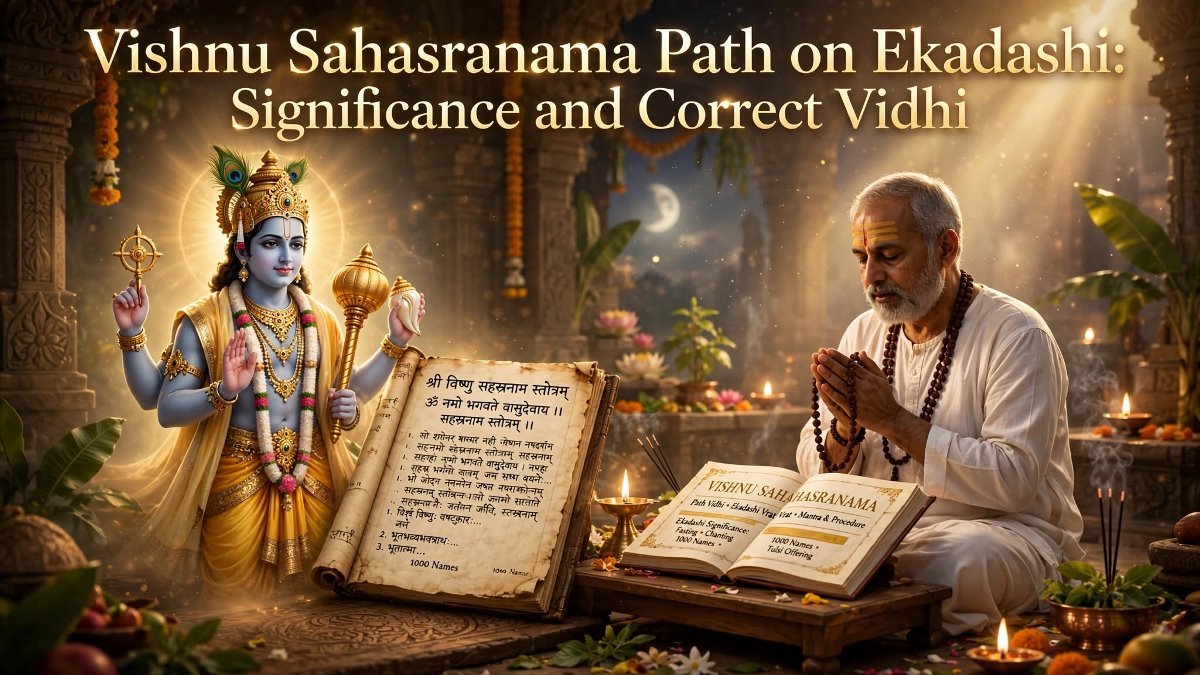
Most devotees know the Vishnu Sahasranama as a general-purpose devotional text, something recited on any auspicious morning for peace and protection. Fewer know that it has its own specific Ekadashi, the exact day, by name, on which it was first spoken aloud. That day is still observed every year, which means reciting these thousand names on Ekadashi isn’t just fitting because the fast already belongs to Vishnu. It’s closer to returning to the scene of the hymn’s own birth, a moment serious enough that Krishna himself stood by to witness it.
Where It Was First Spoken: Bhishma’s Bed of Arrows
The setting is the aftermath of the Kurukshetra war, in the Anushasana Parva of the Mahabharata. Bhishma Pitamaha, grandsire to both the Kauravas and the Pandavas, lay mortally wounded on a bed made entirely of the arrows that had felled him, kept alive only by a boon from his father, King Shantanu, that let him choose the exact moment of his own death. Rather than leave immediately, Bhishma chose to wait for Uttarayana, the sun’s northward turn, considered the more auspicious direction in which to depart the body, holding on through weeks of that same battlefield lying still on his bed of arrows.
Krishna, aware of how much hard-won wisdom would be lost the moment Bhishma finally let go, urged the newly crowned Yudhishthira to sit with the dying warrior and ask him everything he still needed to know before it was too late. Yudhishthira came burdened with more than administrative questions. He had just won a kingdom by killing his own family members, teachers, and elders, and the guilt of it sat on him visibly, heavily enough that some tellings describe him as barely able to take joy in the throne he’d just secured. Among the questions he put to Bhishma were some of the largest anyone can ask: who is the single greatest deity in existence, what is the highest dharma a person can follow, and is there one name, one word, simple enough to recite that could free a person from every kind of suffering.
Bhishma’s answer, delivered in Krishna’s own presence and recorded as it was spoken by the sage Vyasa, was the thousand names of Vishnu. Rather than a single word, he offered a thousand, each one a different facet of the same answer, insisting that reciting them with devotion was itself the shortest real path out of exactly the kind of suffering Yudhishthira was carrying. Several tellings describe Yudhishthira finding genuine relief from his grief in the act of hearing them, which is part of why the text has always been associated with consolation as much as with worship.
The Day That Carries Its Name: Bhishma Ekadashi
The specific day this took place was Magha Shukla Ekadashi, the eleventh lunar day of the bright fortnight in the Magha month, and that date is still observed today under a name that honors exactly what happened on it: Bhishma Ekadashi. In 2026, it falls on January 29. Temples across Tamil Nadu, Andhra Pradesh, and Karnataka mark the day with sahasranama archana, group chanting, and all-night bhajans, treating it less like an ordinary Ekadashi and more like the hymn’s own anniversary, drawing devotees who might otherwise only encounter the text in passing on other days of the year.
This is really the fuller answer to why Vishnu Sahasranama and Ekadashi belong together so naturally. It isn’t only that Ekadashi is already Vishnu’s day, making any Vishnu-focused recitation appropriate. It’s that this exact combination, an Ekadashi and these exact thousand names, already happened once, in a moment serious enough that Krishna himself stood by to witness it. Reciting the Sahasranama on any Ekadashi carries a trace of that original scene; reciting it on Bhishma Ekadashi itself is treated as returning to it directly, which is why many households specifically save their most complete, unhurried recitation of the year for that single day.
A Charming Side Legend: How the Words Survived
One devotional legend, less widely known than the main story but still fondly retold, adds a small mystical footnote to how the text survived at all. It holds that Sahadeva, the youngest Pandava and known for his quiet wisdom, later sat with a crystal, a spatika, in the very spot where Bhishma had spoken, and through deep meditation on Shiva managed to draw the original sound vibrations back out of the stone so that Vyasa could transcribe them properly. Whether taken literally or simply as a poetic way of saying that something this important couldn’t be allowed to fade from memory, the story is a favorite among those who’ve studied the text closely, often traced back to the teachings of a respected 20th-century Shankaracharya.
What the Thousand Names Are Actually Doing
The obvious philosophical puzzle sits right at the center of the text: if the Supreme is genuinely formless and beyond definition, how can a thousand specific names possibly describe him? Tradition’s answer is that the names were never meant to define or limit him, only to point toward his countless manifestations, one name for each way his presence shows up in the world, from Keshava for his beautiful hair to Hari for his role as remover of suffering to Narayana for his presence as the shelter of all beings. A thousand names isn’t a complete inventory. It’s an acknowledgment that any complete inventory would need to be infinite, and a thousand is simply where human language agreed to stop, a deliberately incomplete list standing in for something no list could ever finish.
The text itself is built from roughly a hundred and forty verses in a tight, chantable meter, structured so the names can be recited continuously rather than read as isolated words. Its most famous commentary comes from Adi Shankaracharya, written, according to tradition, almost as a test set by his own teacher Govindapada before allowing him to begin his life’s work, a detail that underlines just how seriously this particular text has always been treated even by history’s most demanding scholars. Later commentators, working in nearly every major Indian language, have continued adding their own layers of interpretation to the same thousand names ever since, without any single reading being treated as the final word on what they mean.
The Shortcuts Built Into the Text Itself
What’s easy to miss is that the Sahasranama anticipates its own difficulty. Not every devotee can recite a thousand names daily, and the text’s closing Phalashruti section, the part describing the fruits of recitation, offers two built-in shortcuts rather than leaving anyone without an option. It states that the single name Vasudeva alone carries the same merit as chanting the entire thousand. Separately, tradition holds that reciting “Sri Rama, Rama, Rama” three times carries that same complete merit, since Rama is himself accepted as a full incarnation of the same Vishnu the thousand names describe. Neither shortcut is treated as a lesser, watered-down version. Both are presented as genuinely equivalent, for exactly the moments when the full recitation simply isn’t possible.
Correct Vidhi for Reciting It on Ekadashi
Brahma Muhurta, the hour or so before sunrise, is considered the ideal time, though any early morning after bathing is acceptable. Devotees typically sit facing east with the spine straight, beginning with the traditional obstacle-clearing verse “Shuklambaradharam Vishnum,” a meditation commonly recited before many stotras, followed by “Om Namo Bhagavate Vasudevaya” repeated three times as the specific invocation that opens the Sahasranama practice itself. A small altar with a Vishnu image or a Tulsi plant nearby, a ghee lamp lit before beginning, and a comfortable, uninterrupted seat are the only real requirements beyond the words themselves.
On Ekadashi specifically, this recitation is usually woven into the day’s existing observance rather than treated as a separate ritual: after the morning bath and sankalp for the fast, before or alongside the main Vishnu puja, is a natural point to begin. Beginners are encouraged to start with a smaller portion, the first ten or first hundred and eight names, building toward the complete thousand over time rather than attempting the full text cold, since the meter and pronunciation take real practice to get comfortable with. Listening attentively to someone else’s recitation, known as shravana bhakti, is considered a fully valid alternative for anyone not yet able to chant the complete text themselves, and many households simply play a trusted recording through the morning as their own form of participation.
Frequently Asked Questions
Is this practice restricted to any particular caste, gender, or tradition?
No. Every serious source on the text is explicit that it carries no caste or gender restriction, and it’s recited widely across Hindu traditions well beyond those who identify specifically as Vaishnava.
Do I need to understand Sanskrit for it to work?
Most devotees don’t have full command of Sanskrit, and tradition holds that sincere recitation still carries its effect regardless, though reading a translation alongside the practice deepens the experience for many.
What if I can’t finish all thousand names in one sitting?
This is exactly what the built-in shortcuts, the name Vasudeva or the triple repetition of Rama, are for. Partial recitation, done consistently, is also considered valuable in its own right rather than incomplete.
Does reciting it on Ekadashi carry more merit than on an ordinary day?
Tradition treats Ekadashi, and Bhishma Ekadashi most of all, as an especially fitting occasion, though the practice is recommended and beneficial on any day, with Fridays and Brahma Muhurta mornings also commonly cited as auspicious.
Is listening to someone else recite it as good as chanting it myself?
Yes. Listening with genuine attention and devotion is treated as a complete and valid form of the practice, particularly for those still learning the pronunciation.
Why does the text include two different “shortcut” equivalents instead of just one?
Tradition doesn’t explain this as redundancy so much as generosity, offering more than one accessible path for whichever name or phrase resonates most with a given devotee, since both the name Vasudeva and the triple repetition of Rama are treated as equally complete on their own terms.
Can I recite Vishnu Sahasranama on a day other than Ekadashi and still get the same benefit?
Yes. While Ekadashi, and Bhishma Ekadashi in particular, are considered especially fitting, the tradition presents daily recitation, on any day at all, as the fuller and more transformative practice, with Ekadashi simply marking an especially auspicious occasion within that ongoing habit.
A Final Word
It’s worth remembering who this was actually given to. Not a sage in quiet contemplation, but a king freshly crowned over the graves of his own family, unable to find peace in the victory he’d just won. Bhishma didn’t hand him a philosophy to study. He handed him something to say, over and over, on the exact day that’s still marked in his honor today. Every Ekadashi recitation since has been, in some small way, the same offer extended again: not an explanation for the grief, but somewhere to put it.
That’s arguably the detail worth carrying away from the whole story more than any single name in the list. A dying man, using the last of his own time, chose to spend it giving someone else a way back to peace rather than settling his own remaining business. Whatever else the thousand names accomplish, they were first spoken as an act of care for one grieving man, and every recitation since has simply kept that same gesture moving forward.
