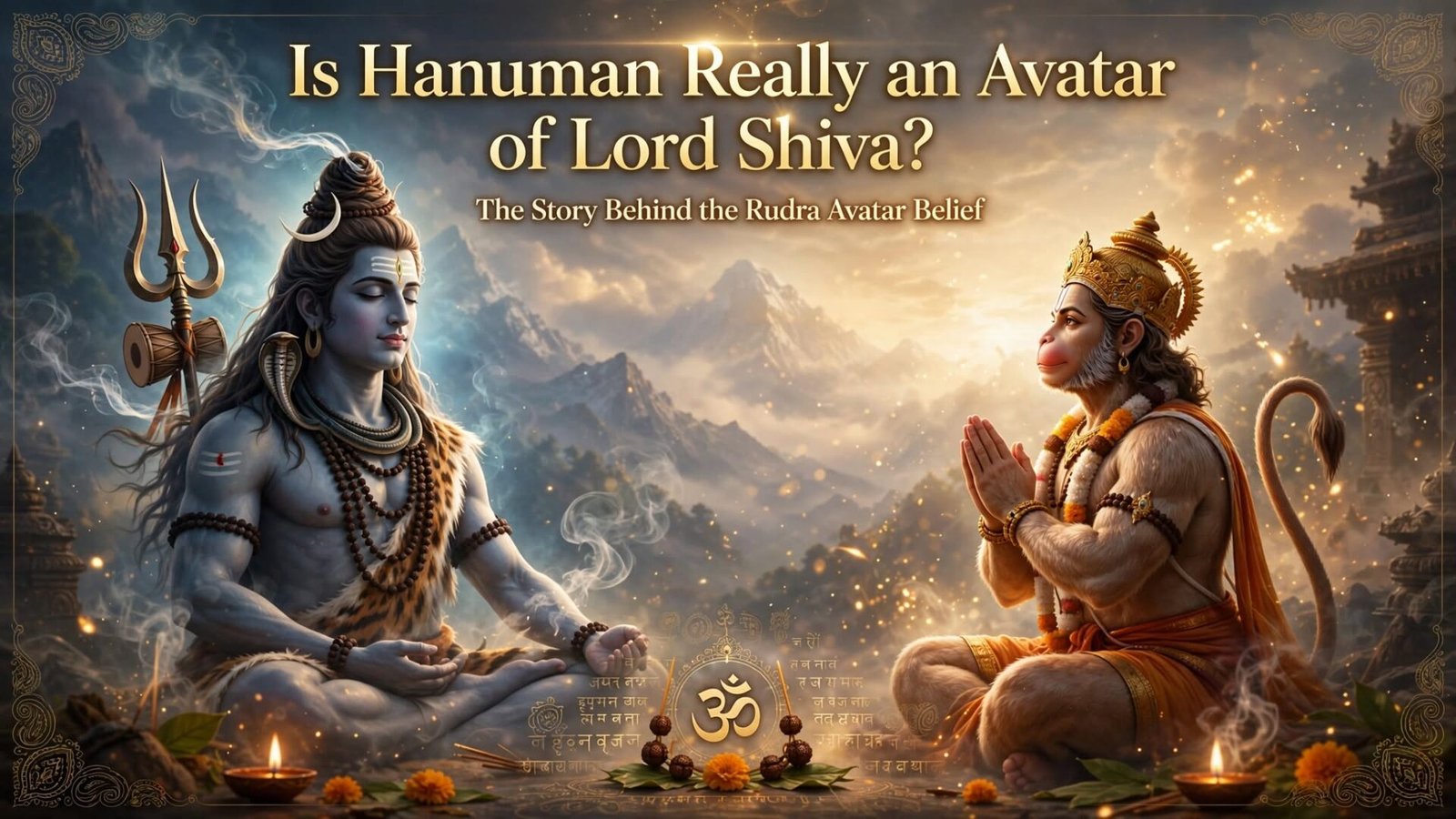
Ask ten devotees whether Hanuman is Shiva himself, and you’ll likely get ten confident answers — and not all of them will agree. Millions of Hindus grow up believing Hanuman is the 11th Rudra, a direct incarnation of Mahadev sent to serve Rama. Just as many grow up knowing him purely as Vayuputra, the son of the Wind God, with no Shiva connection at all. Both groups are drawing on real scripture. Neither is simply wrong.
This piece lays out the actual story behind the “Rudra Avatar” belief, the specific Puranas that support it, why an equally large tradition disagrees, and why the disagreement itself says something interesting about how Hanuman came to be loved the way he is.
What “Rudra Avatar” Actually Means
Rudra is one of Shiva’s oldest names, going back to the Vedas, where he appears as a fierce, untamed force associated with storms, transformation, and destruction that clears the way for renewal. Later tradition organized this fierce aspect into eleven distinct forms known as the Ekadasha Rudra — eleven Rudras, each a manifestation of the same underlying energy.
Hanuman’s popular title, the “11th Rudra,” refers to a belief that the eleventh of these Rudra forms chose to take a full birth on earth in order to serve Lord Rama during his mission against Ravana. That’s a specific and fairly bold theological claim: not merely that Hanuman carries a piece of Shiva’s power, but that he is, in this reading, Shiva incarnate walking the earth as a vanara.
It matters which side of Shiva this is. The Shiva most people picture in meditation, matted hair still, eyes half-closed, is not really the aspect being invoked here. Rudra is the untamed, storm-force side of that same being, capable of destruction as easily as protection. When devotees call Hanuman “Sankat Mochan,” the remover of every difficulty, they’re describing exactly the kind of ferocious, no-hesitation intervention that Rudra was always associated with, long before Hanuman existed to embody it.
The Story: How Shiva Became Hanuman
The most common telling starts at the moment Vishnu agrees to be born as Rama to end Ravana’s tyranny. According to this version, Brahma and the assembled gods realized Rama’s mission would need help no ordinary being could provide, and they turned to Shiva, asking him to take birth as well. Rather than simply blessing the mission from afar, Shiva agreed — and by several accounts, he wanted to. Becoming Hanuman meant he would get to serve Rama directly, as the most devoted of devotees, rather than watch the story unfold from Kailash.
Anjana, a devout worshipper of Shiva married to the vanara chief Kesari, had spent years in penance praying for a son. Pleased with her devotion, Shiva promised that his own energy would take birth as her child. What happens next is where the story becomes genuinely beautiful: several tellings connect Hanuman’s conception to the very same ritual that produced Rama himself. King Dashratha was performing the Putrakameshti Yajna in Ayodhya, and the sacred kheer produced by that fire — the same kheer his queens would eat to conceive Rama, Lakshmana, Bharata, and Shatrughna — had a portion carried away by Vayu, the Wind God, who delivered it to Anjana. In this telling, Hanuman and the four princes of Ayodhya trace their origin to the same sacred fire, which is part of why Hanuman’s devotion to Rama is described less as loyalty between strangers and more as a bond that existed before either of them was born.
Vayu is the one who physically delivers this divine offering, which is exactly why Hanuman carries Vayu’s own gifts — speed, breath, and lightness — alongside whatever came from Shiva. Some tellings add that Anjana was a celestial being under a curse, required to live on earth and bear this one divine child before she could return to her original form; once Hanuman was born, she was freed. Either way, the child born of this convergence — Shiva’s energy, Vayu’s delivery, and Anjana’s penance — was Hanuman.
Anjana is said to have performed her penance on a mountaintop for twelve long years before Shiva responded, living on nothing but air and fallen leaves, which is itself part of why her devotion is held up as a model alongside her son’s. When the child was finally born, he arrived with a reddish, radiant complexion, and the forest is said to have grown unusually still around the birth, as though even the wind paused to notice its own portion of the newborn’s strength. Kesari, overjoyed, raised him alongside Anjana, and it was the sun god Surya who later became young Hanuman’s teacher, instructing him in the Vedas and the shastras even as the boy’s uncontainable energy kept testing everyone around him.
The Scriptural Basis: Which Texts Say So
This isn’t a belief invented by folklore alone. The clearest textual support comes from within the Shiva Purana itself, particularly its Shatarudriya Samhita section, which frames Hanuman as an embodiment of Rudra’s own bhakti, shakti, and jnana — devotion, strength, and wisdom respectively. The Skanda Purana’s Kashi Khanda tells much the same story of Anjana’s penance and Shiva’s promise. The Narada Purana goes further still, with verses that explicitly reject the idea that Hanuman belongs to only one lineage — insisting instead that he carries the combined essence of both Hari (Vishnu) and Shankara (Shiva) at once, which is arguably the closest any scripture comes to settling the debate by simply refusing to choose a side.
It’s worth being honest about what this textual support actually looks like: the Puranas were composed and expanded over many centuries by different communities, and the sections identifying Hanuman with Shiva most strongly tend to belong to material associated with Shaiva tradition specifically, rather than appearing uniformly across every scripture that mentions him. The Vayu Purana, unsurprisingly given its name, leans the other way entirely, anchoring Hanuman firmly to Vayu rather than Shiva. None of this makes any version “less scriptural” than another — it simply reflects how India’s major devotional traditions each preserved and expanded the stories that mattered most to their own worship, long before anyone tried to reconcile them into a single account.
Why Not Everyone Agrees: The Vaishnava View
Here’s the part most retellings leave out. In Vaishnava tradition, Hanuman generally isn’t connected to Shiva at all. He’s understood purely as the son and incarnation of Vayu — full stop. And this isn’t a minor, quiet alternative; it comes with its own rich mythology that rivals the Rudra Avatar story in scope.
According to this Vaishnava reading, Vayu himself took three separate incarnations across three different ages specifically to serve Vishnu each time he descended to earth: as Hanuman in the Treta Yuga, serving Rama; as Bhima in the Dvapara Yuga, serving Krishna during the events of the Mahabharata; and, remarkably, as the 13th-century philosopher Madhvacharya, who founded the Dvaita school of Vedanta. In this telling, Hanuman’s strength and loyalty have nothing to do with Shiva whatsoever — they belong entirely to Vayu’s own character, expressed the same way across three different eras.
This three-incarnation idea isn’t a minor footnote either. Madhva tradition treats it as central enough to have its own name, Vayu-stuti, a hymn of praise recited specifically in honor of Vayu across all three of his forms. Followers of this school will point out that the common thread across Hanuman, Bhima, and Madhvacharya isn’t devotion to Shiva at all, but sheer, unmatched physical and intellectual strength placed entirely in service of Vishnu’s cause in each age — a pattern they consider proof enough of Vayu’s singular authorship, without needing Shiva in the picture.
There’s also a historical wrinkle worth knowing. In Valmiki’s own Ramayana, the earliest and most foundational telling of the story, Hanuman is introduced simply as Vayu’s son and a wise, capable vanara minister — with no Rudra Avatar backstory attached at all. Scholarship on Hanuman’s cult suggests the specific idea of Hanuman as Shiva’s avatar became widespread later, gaining real momentum through the bhakti movements of the medieval period, particularly from the 17th century onward, when Hanuman was increasingly reimagined as a divine being in his own right rather than only a devoted helper. That doesn’t make the belief less meaningful to the people who hold it today — it simply means the theology, like most living religious traditions, grew and layered over time rather than arriving fully formed on day one.
Why the Belief Endures Anyway
Textual disagreements aside, it’s easy to see why the Rudra Avatar idea took hold so firmly and refuses to let go. The symbolic fit is almost too good. Both Shiva and Hanuman are Brahmacharis, lifelong celibates associated with total mastery over the senses. Both represent a very particular combination that’s hard to find elsewhere in Hindu iconography: overwhelming physical power paired with deep yogic stillness. Both are the deities people turn to specifically when they’re afraid — of evil spirits, of enemies, of their own weakness.
And there’s a deeper theological appeal underneath the symbolism. If Shiva really did become Hanuman, then the greatest devotee of Vishnu’s own avatar is, quite literally, Shiva himself — which quietly resolves any sense of competition between Shaiva and Vaishnava devotion into a single figure who embodies total loyalty to both traditions at once. It’s not hard to see why that idea, once it took hold, became impossible to let go of.
Some devotees also point to a moment from Hanuman’s childhood that has nothing to do with his birth story, yet keeps surfacing in this same conversation. As an infant, mistaking the rising sun for a piece of ripe fruit, Hanuman is said to have leapt up to seize it. Indra, alarmed, struck the child down with his thunderbolt, injuring his jaw so badly that Vayu, grief-stricken, withdrew all air from the world in protest, leaving every living being gasping. It was Shiva who intervened directly to revive the child and calm Vayu, restoring breath to the universe. Whatever one makes of the birth story, this later episode shows Shiva stepping in personally to save Hanuman’s life, which devotees who favor the Rudra Avatar belief often cite as further proof of a bond too close to be coincidental.
The belief also shows up in worship practice, not just texts. At the Kaviyoor Mahadevar Temple in Kerala, Hanuman has his own shrine inside a Shiva temple. At the Ramanathaswamy Temple in Rameswaram, one of the most significant Shiva sites in the country, Hanuman is worshipped alongside Shiva as a matter of course, not exception. Devotees who follow Vedic astrology often seek out the Ekadash Mukhi, or 11-faced, Rudraksha specifically because of Hanuman’s identity as the 11th Rudra — treating the bead as a physical link between the two deities’ energy.
Frequently Asked Questions
Is the belief that Hanuman is Shiva’s avatar accepted by all Hindus?
No. It’s a strong and widely held belief, especially in Shaiva tradition, but Vaishnava tradition generally holds that Hanuman is Vayu’s son and incarnation, without a Shiva connection.
What exactly does “Rudra Avatar” mean?
It means Hanuman is regarded as the earthly incarnation of the 11th of Shiva’s eleven Rudra forms — not merely someone blessed by Shiva, but Shiva himself in another body.
If Hanuman is Shiva’s avatar, why is he also called Vayuputra?
Because Vayu is the one who physically carried Shiva’s energy to Anjana and delivered it to her. Different traditions place the emphasis differently — some treat Vayu as the true source, others as the carrier of Shiva’s essence — which is exactly why both titles exist side by side.
Does this belief mean Hanuman and Shiva should be worshipped together?
Many devotees do exactly that, and several temples are built around this pairing, but it isn’t a requirement. Worshipping Hanuman purely as Rama’s devoted servant is equally traditional and equally complete.
Does this connect to Hanuman Jayanti?
Yes — Hanuman Jayanti, which marks his birth, is often described in the same texts and retellings that discuss his Rudra Avatar identity, since the festival is fundamentally a celebration of that birth story.
Is the Vaishnava view considered less authentic than the Shaiva one?
No. Both are grounded in long-standing scripture and living tradition. The difference reflects which devotional community preserved and emphasized which texts, not a question of one version being more “correct” than the other.
A Final Word
The honest answer to “is Hanuman really an avatar of Shiva” is that it depends entirely on which tradition you’re standing in — and that’s not a gap in the mythology, it’s the mythology working exactly as it always has. Living traditions rarely settle into one tidy version, and Hanuman’s story is a particularly good example of two enormous devotional worlds, Shaiva and Vaishnava, both finding a way to claim him without diminishing what he means to the other. Whether you think of him as Shiva walking the earth, Vayu’s son carrying out his own destiny, or both at once, the qualities that make Hanuman worth worshipping were never really in question.
