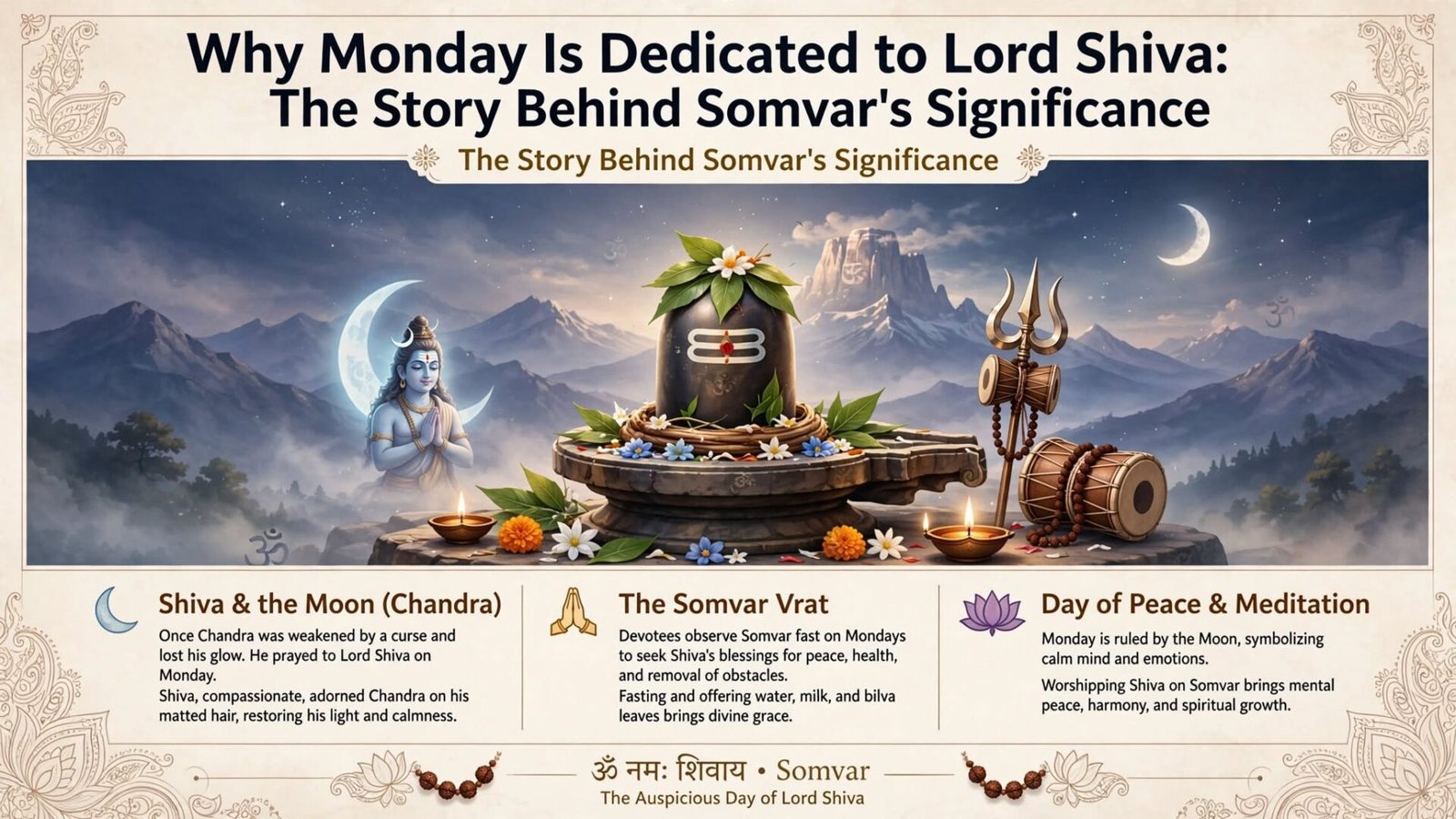
Ask why Monday belongs to Shiva and most people will simply say “because it does” — Somvar means Shiv-vaar, the day of Shiva, and that’s treated as self-evident. It isn’t, actually. The word Somvar has nothing to do with Shiva at its root. Untangling why Shiva ended up owning a day named after someone else entirely turns out to be one of the more satisfying stories in the whole Shiva Purana.
Where the Name Comes From: Somvar Is Actually the Moon’s Day
“Som” is another name for Soma, who is also known as Chandra, the Moon god. “Var” simply means day. Somvar, in its most literal sense, is not Shiva’s day at all — it’s the Moon’s day, exactly as “Sunday” belongs to the Sun in the same seven-day system.
The entire week, in fact, is built this way. Each of the seven days is named for one of the Navagraha, the nine celestial bodies of Vedic astrology: Sunday for Surya the Sun, Tuesday for Mangal or Mars, Wednesday for Budh or Mercury, Thursday for Brihaspati or Jupiter, Friday for Shukra or Venus, and Saturday for Shani. Monday is the odd one out in popular practice, because unlike Tuesday’s clear tie to Hanuman-adjacent Mangal worship or Saturday’s tie to Shani, Somvar’s original owner, the Moon, has almost entirely receded behind the deity who rescued him. So the real question isn’t why Shiva owns Monday. It’s why the Moon’s own day became so closely identified with Shiva that most devotees today don’t even think of Chandra when the word comes up. The answer is a single, very specific act of rescue.
The Story: Chandra Dev’s Curse and Shiva’s Crescent
Chandra, the Moon god, was married to twenty-seven wives — the Nakshatras, the lunar constellations personified as daughters of the sage-king Daksha. Among them, Chandra grew visibly and unapologetically devoted to one wife above all the rest, Rohini, spending his time with her while neglecting the other twenty-six almost entirely.
All twenty-seven wives lived with Chandra, but only Rohini received his time, his attention, and by every account, his open affection, while the other twenty-six were left to watch from a distance. It wasn’t a single slight but a sustained, years-long pattern, and eventually the neglected wives went to their father together, in tears, asking him to intervene on their behalf. Daksha warned Chandra repeatedly to treat all his wives with equal regard, and when the warnings changed nothing, his patience ran out. Daksha cursed Chandra to lose his light entirely, night by night, until nothing remained.
What had been a full, radiant moon began to shrink visibly with each passing day, and as it shrank, the effects rippled outward through the whole of creation. Crops that depended on the night’s light struggled to ripen. Medicinal herbs, believed to draw their potency from moonlight, weakened along with it. The tides that the Moon governs fell out of rhythm, and the oceans grew unpredictable. Sages who tracked the sky in growing alarm realized this wasn’t an ordinary eclipse or a passing phase; the Moon was dying, visibly, night after night, in front of the entire world, and no one, gods included, had the standing to simply undo a curse that Daksha had rightfully pronounced.
Terrified and desperate, Chandra turned to the one deity capable of intervening in a curse this severe: Shiva. He traveled to Prabhas Patan on the Gujarat coast and undertook intense penance, praying without pause. Moved by his devotion, Shiva agreed to help — though even Shiva could not undo Daksha’s curse outright, since a curse honestly given has to run its course. What he could do instead was change what that course meant. Shiva placed Chandra on his own head, nestled in his matted locks, and declared that rather than fading away permanently, Chandra would now wax and wane in an endless cycle — disappearing gradually each month only to be reborn in full a few weeks later, protected and renewed by Shiva’s own presence. That cycle is the one still governing the lunar calendar today, visible every single month in the waxing and waning moon.
Because Shiva was the one who stepped in when the Moon was, quite literally, dying, and because he continues to wear Chandra on his head as a permanent mark of that protection, the day named for the Moon came to be seen as belonging just as much to the one who saved him. Over centuries, devotion to Shiva on this day gradually outgrew devotion to Chandra himself, until Somvar became known first and foremost as Shiva’s day.
Chandrashekhara and Somnath: Titles Born From This Story
This single story is the direct source of two of Shiva’s most recognizable titles. “Chandrashekhara,” meaning “one who wears the moon as a crest,” refers precisely to this moment — it’s why so many depictions of Shiva show a crescent moon resting in his hair. “Somnath,” meaning “Lord of Soma,” refers to the same event from the Moon’s side of the story, and it’s the reason one of the twelve Jyotirlingas, located at Prabhas Patan in Gujarat, carries that exact name. Tradition holds that the Somnath temple stands at the very site where Chandra performed his penance and was freed from the worst of Daksha’s curse, making it one of the very few major temples whose name is a direct memorial to a single mythological event rather than a general title of the deity.
Somnath’s place in this story is also why it’s counted as the very first among the twelve Jyotirlingas, ahead of even Kashi Vishwanath or Kedarnath in the traditional listing. The temple has been destroyed and rebuilt more times than almost any other shrine in India, sacked repeatedly over the centuries and reconstructed each time by different rulers and communities, and devotees often point to that endurance as its own quiet echo of the original story: something nearly extinguished, again and again, that keeps returning to full light regardless.
Why the Whole Year’s Mondays Matter, Not Just Sawan’s
Because this connection between Shiva and Monday comes from Chandra’s story rather than from anything tied specifically to the monsoon or to Shravan, it applies to every single Monday of the year, not only the handful that fall inside Sawan. Year-round Monday fasting for Shiva, observed by millions of devotees with no connection to the Sawan season at all, rests entirely on this foundation. Sawan Somvar simply layers an especially auspicious month on top of an already significant day.
There’s also a compounding effect worth knowing about: when Pradosh Kaal, the twilight period around the thirteenth day of each lunar fortnight, happens to fall on a Monday, it’s specially named Som Pradosh, and considered a particularly powerful window for Shiva worship, since two independently auspicious timings align at once.
The wishes devotees traditionally bring to a regular Monday are also somewhat distinct from what’s asked during Sawan itself. Since Chandra is understood in Vedic thought to govern the mind and emotions, and Monday is his day even after Shiva’s intervention, it’s considered an especially fitting time to pray for mental steadiness, emotional balance, and peace within the family — separate from the specific marriage-focused wishes tied to vrats like Solah Somvar.
This is also why Monday carries particular weight in Vedic astrology for anyone whose birth chart shows a weak or afflicted Moon, a placement associated with anxiety, restlessness, or a wavering sense of direction. Since the same Chandra who once nearly vanished now sits protected on Shiva’s own head, worshipping Shiva on his day is treated as a way of appealing to the one who already knows what it means to rescue an unsteady mind and hold it in place. Astrologers will often recommend a Monday fast specifically, rather than any other day of the week, to someone going through exactly that kind of instability.
Keeping a Simple Monday Vrat, Any Time of Year
A regular Somvar vrat is meant to be far less elaborate than the sixteen-week Solah Somvar vow or a full Sawan-month commitment. Most devotees simply bathe in the morning, offer plain water or milk over a Shivling or picture of Shiva, and chant “Om Namah Shivaya” a few times before starting the day. Those observing a stricter version keep a single evening meal, usually fruit, milk, or a light sattvik dish, and skip grains until the fast ends. There’s no sankalp required and no minimum number of weeks; a person can keep it for one Monday, a few months, or a lifetime, and can start or pause it as their circumstances allow. Because the vrat rests on Chandra’s own story of being restored gradually rather than instantly, many devotees treat it as fitting practice for exactly that kind of patience — a small, repeatable act rather than a single dramatic one.
A Common Mix-Up: Somvar, Som Pradosh, and Sawan Somvar
These three terms get blended together constantly, so it’s worth keeping them straight. A regular Somvar vrat is any Monday fast for Shiva, observed year-round with no fixed count or season attached. Som Pradosh is more specific: it only occurs when the Pradosh tithi lands on a Monday, which happens roughly once or twice a year rather than every week. Sawan Somvar refers specifically to the Mondays falling inside the Shravan month itself, when the general Monday-Shiva connection combines with the added weight of Sawan being Shiva’s own month.
Frequently Asked Questions
Is Monday fasting only meant for Shiva, or do other deities share the day?
Monday is most strongly associated with Shiva and, through him, with Chandra, though some traditions also connect the day loosely to the Moon’s broader astrological influence in a person’s chart.
Do I need to have taken a formal vow to fast on a regular Monday?
No. Unlike Solah Somvar, which requires a sankalp to begin, a simple weekly Monday fast for Shiva can be started or stopped freely, with no fixed commitment attached.
What’s the real difference between Som Pradosh and a normal Somvar?
A normal Somvar happens every week without exception. Som Pradosh only occurs on the rarer occasions when the lunar Pradosh period specifically falls on a Monday, and is considered more potent because of that overlap.
Why is the Moon connected to the mind in Hindu thought?
In Vedic astrology, Chandra is held to govern “mann,” the mind and emotional nature, which is part of why Monday worship is so often directed toward mental peace and emotional steadiness rather than material requests.
Is wearing white or light colors on Monday actually required?
It’s a common practice, since white and light shades are associated with both the Moon and with Shiva’s own simplicity, but it’s a convention rather than a strict rule of the vrat itself.
Why is Somnath considered the first Jyotirlinga if Kashi and Kedarnath are older pilgrimage sites?
The ranking follows traditional listings tied to the order in which the Jyotirlingas are described in scripture, not the age of the physical structures, and Somnath’s direct link to Chandra’s own worship of Shiva gives it a distinct claim to that position.
A Final Word
The day was never really handed to Shiva by name — it was earned, the moment he chose to catch a dying moon rather than let a father’s anger run its full, permanent course. Every waxing and waning cycle since has been a quiet monthly reminder of that rescue, and every Monday, devotees across India have simply followed Chandra’s example: turning to the same protector, on the same day, whenever something in their own life feels like it’s fading and needs to be held onto a little longer.
It’s worth noticing, too, that the story never promises Chandra his full light back permanently. He still wanes every month, disappears entirely on Amavasya, and has to build his way back to fullness each time. Shiva didn’t erase the curse; he simply made sure it was never the end of the story. For a day so many people turn to during their own low points, that detail tends to land harder than the rest of the mythology combined.
