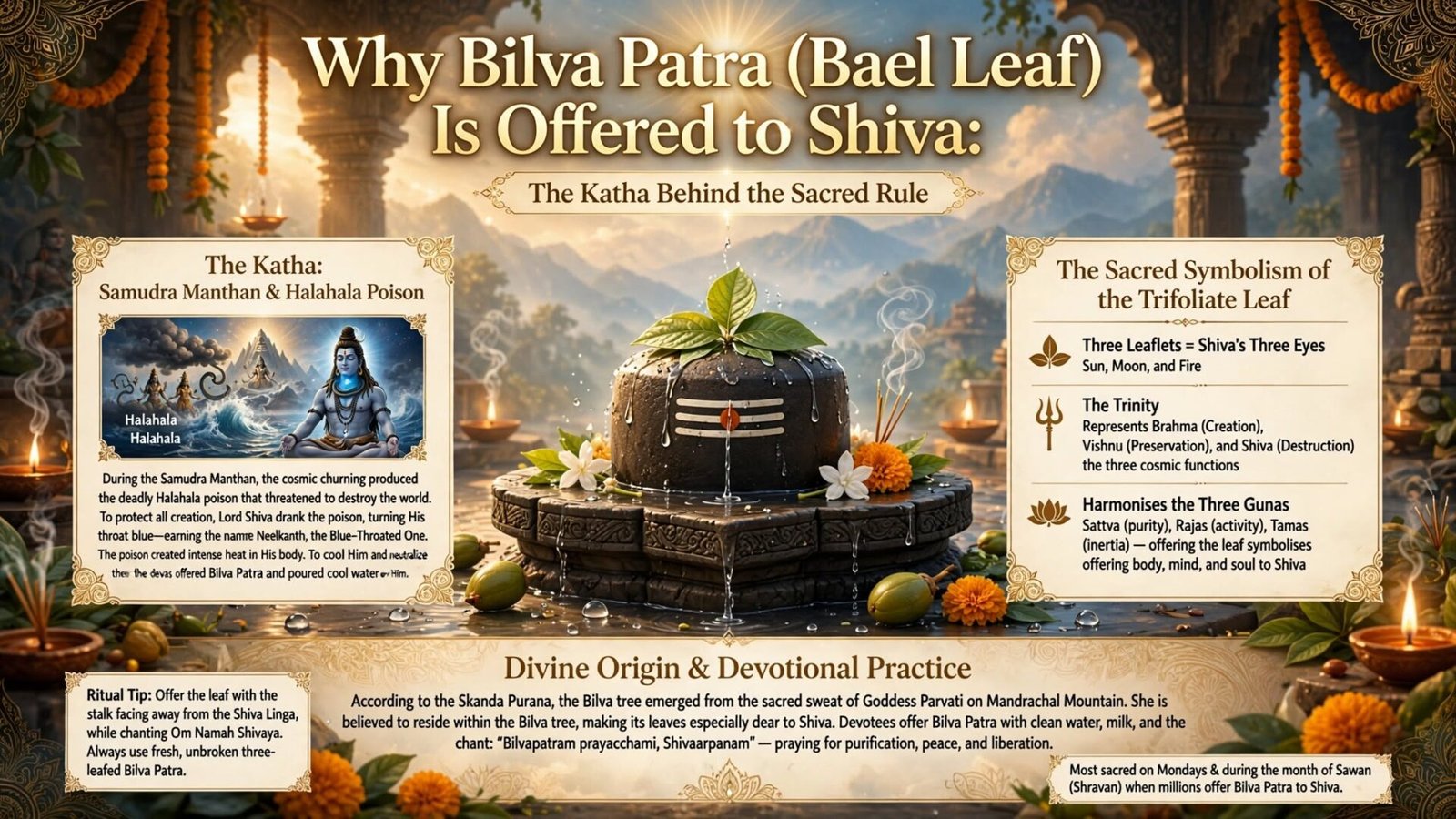
Walk into any Shiva temple and you’ll see devotees offering flowers, fruit, sweets, incense, elaborate abhishek with milk and honey — and then, almost always, a single, ordinary-looking three-part leaf laid on top of everything else. Bilva Patra, the bael or wood-apple leaf, isn’t the most expensive offering a devotee can bring, and it isn’t the rarest. Scripture treats it as the one that matters most anyway. This is the story of why, and the specific rules that come with it.
What Makes Bilva Patra Different From Any Other Offering
Shiva carries the title “Ashutosh,” the one who is pleased quickly and easily, and Bilva Patra is the clearest proof devotees point to. Tradition holds that when every other offering is unavailable, a single bel leaf given with sincere devotion is enough on its own — no flowers, no fruit, no elaborate ritual required. The leaf itself is trifoliate, three leaflets joined at a single stalk, and that structure is the starting point for nearly everything that makes it significant.
The Shiva Purana counts Bilva Patra among six items considered essential to a complete Shiva puja, alongside water, milk, sandalwood, akshat, and flowers — and of that list, it’s the leaf that scripture keeps returning to as the one substitute for everything else, never the reverse. No other single item on that list is described as sufficient entirely on its own.
Botanically, Bilva is Aegle marmelos, also known as wood apple, and it’s a serious presence in Ayurveda quite apart from its religious use — its leaves, bark, and fruit are used in traditional treatments for digestive complaints, diabetes, and heart conditions. Few plants carry this much weight in both a temple and a pharmacy at the same time.
Where the Tree Itself Came From
Different traditions trace the bilva tree’s own origin differently, which is fairly common for a plant this sacred. One telling holds that it sprang from Goddess Parvati’s own perspiration, falling to the earth during her intense penance on Mandrachal mountain. Another, recited in the verses many devotees chant while making the offering, holds that the tree was born from Goddess Lakshmi’s own heart, making it dear to Mahadev by that connection alone. Some devotees reconcile the two by pointing out that the tree is considered to house Parvati’s presence in nearly every part of it — the roots, the trunk, the branches, and the leaves are each associated with one of her forms.
There’s also a link back to the story of the Samudra Manthan, the churning of the cosmic ocean, when Shiva swallowed the deadly Halahala poison to save creation. Some tellings hold that the Devas offered him bilva leaves alongside water in that same moment, to help cool the burning in his throat — which is one of the reasons bilva leaves are so tightly bound to the ritual of pouring water and milk over the Shivling, not just placed beside it as decoration.
The Katha: The Hunter Who Worshipped Without Knowing It
The story devotees tell most often to explain the leaf’s power has nothing to do with elaborate ritual at all. It’s about a hunter named Lubdhaka, who went into the forest one day and returned home empty-handed as night began to fall.
Afraid of the wild animals that came out after dark, he climbed the nearest tree to wait out the night, bow still in hand. The tree happened to be a bilva, and beneath its branches, hidden in the darkness and completely unknown to him, sat a Shivling. To stay alert through the long night and keep himself from dozing off and falling, he kept plucking leaves from the branches around him and dropping them absentmindedly to the ground below — leaf after leaf, landing directly on the Shivling he couldn’t even see.
As the night wore on, a doe passed beneath the tree. Lubdhaka raised his bow, desperate for food after a day of failed hunting, but the doe, sensing the danger, pleaded with him: she had young fawns waiting for her and needed time to feed and settle them before she could offer herself. Moved by something he didn’t fully understand himself, Lubdhaka let her go, on her promise to return. As the night continued, more animals are said to have passed the same way, each asking for the same mercy, each granted it, each promising to come back — and, in the story’s telling, each one did return before dawn, true to their word, transformed by whatever had passed between them and the hunter that night.
By sunrise, Lubdhaka realized what he had done without ever intending to. He had fasted through the entire night, since he’d caught nothing. He had stayed awake till dawn, unable to sleep in the tree. And he had dropped bilva leaf after bilva leaf onto a Shivling he never knew was there, one for nearly every hour of darkness. Without meaning to observe a single formal rule of worship, he had completed the three central disciplines of a proper Shivratri vigil — fasting, staying awake through the night, and offering bel patra — purely by accident. Shiva, the story goes, was pleased regardless of intention, and granted the hunter liberation at the end of his life, the same reward promised to devotees who keep the vigil with full deliberate devotion.
Devotees who tell this story point to one detail above all others: the leaves that fell were not offered with any prayer, any awareness, or any faith. They fell because a frightened man needed something to do with his hands. And it was still enough. That’s the reputation bilva patra has carried ever since — not that it requires perfect ritual to work, but that it works even when the person offering it has no idea what they’re doing.
What the Three Leaflets Symbolize
The tri-foliate shape of the leaf is read several different ways across different traditions, and most devotees are happy to hold more than one meaning at once rather than settle on a single answer. Most commonly, the three leaflets are seen as Shiva’s three eyes, Trinetra, joined together as a single unit. Others read the same three sections as the Trimurti — Brahma, Vishnu, and Mahesh — folded into one leaf. A third, more philosophical reading ties the three leaflets to the three gunas that govern all of creation and human nature: sattva, rajas, and tamas, with the act of offering the leaf symbolizing a devotee’s wish to move beyond all three toward the formless divine underneath them.
A related reading extends the same three-part logic to a human life rather than to the cosmos, treating the three leaflets as youth, middle age, and old age — the entire arc a person moves through — offered together as a way of surrendering all three stages, past, present, and still to come, in a single gesture rather than piecemeal.
The Correct Way to Pluck and Offer Bilva Patra
Several specific rules travel with this offering, more than with almost any other item used in Shiva worship. Scripture holds that the leaves shouldn’t be plucked on Mondays, Chaturdashi, Ashtami, or Amavasya, along with Sankranti days — all days already considered especially sacred to Shiva in their own right, when the tree is traditionally left undisturbed. Devotees who want fresh leaves for a Monday puja are advised to collect them the evening before, typically on Sunday, since the leaf is believed to hold its spiritual potency even a day after being plucked.
Whole, undamaged leaves matter more than freshness alone. A torn leaf, one with insect holes, or one missing a leaflet is considered unfit to offer, no matter how recently it was picked. Devotees are also advised never to strip a branch bare or break it off entirely — leaves should be plucked one at a time, gently, with a short prayer asking the tree’s permission before taking anything from it, since the tree itself is treated as worthy of the same respect as the deity it serves. Dusk is generally preferred to daytime for the actual plucking, since collecting leaves in harsh daylight is considered less respectful to the tree than doing so in the quieter hours around evening.
Some devotees go a step further before the offering itself, using a wooden stylus to write “Om” on the smoother upper surface of the leaf with a paste of sandalwood or saffron mixed with Gangajal — a small, optional addition considered to intensify the offering rather than a requirement for it to count.
Orientation matters too: the stalk end of the leaf is placed facing the Shivling, with the leaf’s tip pointing back toward the devotee making the offering. Any odd number is considered auspicious for how many leaves to offer at once — three, five, eleven, twenty-one, fifty-one, or a hundred and one, scaling with how much time and devotion a person has to give that day.
Perhaps the most distinctive rule of all is what happens after the puja ends. Unlike flowers, which are considered spent the moment they’re offered and are never reused, most traditions hold that bilva patra can be gathered up, washed carefully, and offered again if fresh leaves aren’t available for the next puja — a rule some devotees trace directly to the Skanda Purana. It’s one of the only offerings in the entire practice of Shiva worship exempt from the usual rule that only fresh, once-used items belong on the altar.
Frequently Asked Questions
Can I offer bilva patra on any day, or only during Sawan?
Any day, any month. It’s especially emphasized during Sawan and on Maha Shivratri, but the leaf itself carries no seasonal restriction — only specific tithis and Mondays restrict when it can be freshly plucked.
Do I need to wash the leaf before offering it?
Yes, freshly plucked leaves are typically rinsed with clean water or Gangajal before being placed on the Shivling, partly as an act of purification and partly practical cleanliness.
Why can bilva patra be reused when flowers can’t?
Most traditions hold that the leaf is inherently pure and closely tied to Parvati’s own presence, which is considered enough to keep it fit for worship even after one use, provided it’s washed carefully beforehand.
Is there a mantra to recite while offering it?
Many devotees recite the Panchakshari mantra, Om Namah Shivaya, with each leaf offered, and some add a short verse asking the bilva tree’s own permission before plucking it in the first place.
Can anyone offer bilva patra, or are there restrictions on who can?
Any sincere devotee can offer it. Unlike some other items used in Shiva worship, no specific caste, age, or gender restriction is attached to this particular offering.
Is it true that just touching the bilva tree carries spiritual benefit?
Many devotees believe so — simply seeing or touching the tree is said to help clear away negativity, quite apart from actually plucking a leaf from it or completing a full puja.
Does the number of leaves I offer actually matter, or is one enough?
Scripture is explicit that one leaf offered with real devotion is sufficient. The larger counts — eleven, twenty-one, a hundred and one — are considered to intensify the offering, not to replace the basic requirement, which even a single leaf fulfills.
A Final Word
What makes this leaf trusted the way it is has very little to do with ritual perfection. The story devotees return to again and again is about a man who fasted by accident, stayed awake because he was afraid, and dropped leaves onto a Shivling he never even saw — and it was enough. Every rule that’s grown up around bilva patra since then, the days to avoid, the way it’s placed, the numbers considered auspicious, sits on top of that one basic idea: the leaf was never really about getting the ritual exactly right. It was about showing up, even without knowing it.
That’s also why devotees who forget a rule, pluck a leaf on the wrong day by mistake, or can’t get to a temple at all are told the same thing every time: bring whatever leaf you have, however you have it, and trust that the same story that freed a frightened hunter in a tree has room for an ordinary mistake too.
