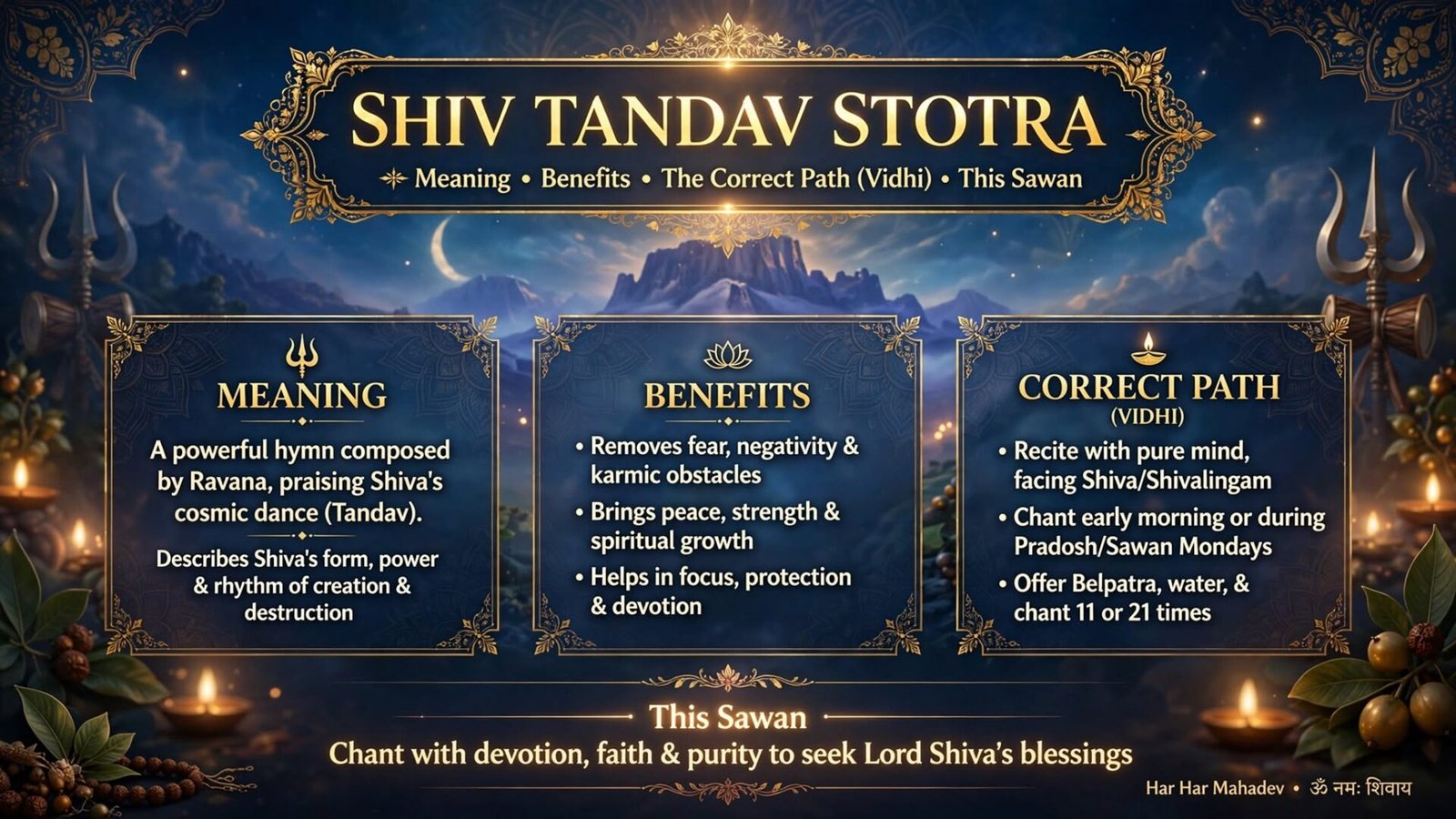
The most feared antagonist in the Ramayana is also credited with one of the most revered hymns to Shiva ever composed — and he didn’t write it in a temple, at peace, surrounded by devotees. He wrote it in agony, with his hand pinned beneath a mountain, unable to move. That contradiction is exactly why the Shiv Tandav Stotra has survived for as long as it has.
Who Wrote It, and Why That’s Surprising
Ravana, the ten-headed king of Lanka, is remembered almost entirely as Rama’s adversary, but within Shaiva tradition he holds a very different reputation: a serious scholar of the Vedas, a gifted veena player, and one of Shiva’s most devoted worshippers. Both things are true about the same person, and the Shiv Tandav Stotra sits at the exact point where his devotion and his ego collide.
The Story: Trapped Beneath Kailash
According to the Shiva Purana, Ravana was returning to Lanka in the Pushpaka Vimana, the flying chariot he had taken from his half-brother Kubera, when the chariot suddenly refused to pass over Mount Kailash. Some tellings add that Ravana met Nandi, Shiva’s attendant, at this point, and mocked his appearance — an insult Nandi answered with a curse that vanaras would one day be the instrument of Ravana’s destruction, a detail that later readers of the Ramayana recognize as a quiet piece of foreshadowing for exactly how the story ends.
Blocked and furious, Ravana decided he would simply move the mountain himself. He wedged his many arms beneath Kailash and began to lift it, and as the mountain shook, Parvati reached for Shiva in alarm. Shiva, unbothered, pressed his big toe down on the mountain and pinned Ravana’s hand beneath its full weight. The pain was so extreme that Ravana’s scream is said to have echoed through all three worlds — and it’s this specific cry, “raav,” that gave him the name Ravana, replacing his original name, Dashanana, the ten-faced one, for the rest of recorded myth.
What happened next is the part devotees return to. Rather than curse Shiva back or rage against the pain, Ravana began to sing — composing, entirely on the spot, verse after verse in praise of the very deity who had just crushed his hand into a mountainside. Some tellings say he continued for fourteen days, others for far longer, and legend holds that in that state he produced far more than what survives today, as many as a thousand verses, of which only a portion, most commonly counted as seventeen, was preserved as the stotra chanted now. Moved by the sincerity underneath the pain, Shiva released him and, rather than leaving him with only an apology, gifted him the Chandrahasa, a celestial sword that would remain one of Ravana’s signature weapons for the rest of his life.
What the Verses Actually Describe
The stotra opens by painting Shiva mid-dance rather than at rest: the Ganga tumbling out of his matted, forest-thick hair, a garland of serpents coiled high around his neck, and the damaru drum driving the rhythm of the Tandava itself, its beat rendered almost onomatopoeically in the Sanskrit. Verse after verse adds another physical detail to the same moving image — the crescent moon resting in his locks, described in one line through the old poetic image of the moon as the beloved companion of the Chakora bird; the fire blazing at his third eye; the ash covering his body; the tiger skin at his waist.
The tone shifts noticeably in the later verses. The physical description gives way to something closer to confession. Ravana, the same figure who had just tried to relocate an entire mountain out of sheer confidence, starts asking when he will finally be worthy of real devotion, when his mind will be still enough to deserve Shiva’s presence rather than merely demand it. The stotra’s most quoted line comes right at the end, where after everything, all his power, all his scholarship, all the boons he had already received, Ravana simply asks: when will I be happy? It’s a strikingly unresolved note to end on, and it’s part of why the hymn reads as something closer to a real confrontation with the self than a straightforward hymn of praise.
Why the Rhythm Itself Matters
Every line of the stotra runs to sixteen syllables, built from a tightly alternating pattern of short and long sounds that gives the whole hymn a driving, almost percussive quality when chanted correctly. This isn’t decorative. The rhythm is constructed to physically echo the sound of the damaru drum that the verses themselves describe, so that reciting the stotra becomes, in a small way, an act of performing the very dance it’s describing. Devotees who’ve heard it chanted properly, even without understanding a word of Sanskrit, often describe a physical reaction to the sound alone, which is exactly the effect the meter was built to produce.
Benefits of Chanting
Devotees associate the stotra most strongly with fearlessness and mental strength, given the sheer intensity of both its imagery and its rhythm. It’s also widely chanted for mental clarity and the clearing of negative energy, and some traditions specifically recommend it to anyone working on their speech or public confidence, since successfully reciting a hymn this rhythmically demanding is itself considered a form of discipline. It’s especially popular during Sawan and on Mahashivratri, though nothing about the hymn restricts it to those occasions alone.
Correct Path Vidhi: How and When to Chant This Sawan
Pradosh Kaal, the hour on either side of sunset, is considered the single most powerful window to recite the stotra, since tradition holds this was the time of day Ravana himself was chanting when Shiva finally responded. That said, scripture places no formal restriction on who can chant it or when — it can be recited at home in front of an image of Shiva just as validly as in a temple, by anyone, without needing a special initiation first.
Pronunciation is the real barrier for most beginners, not eligibility. The meter is famously difficult, and mispronouncing it doesn’t carry some feared spiritual penalty, but it does mean most devotees are better served learning it gradually alongside a correctly chanted audio recording rather than attempting it cold from text alone. Reciting even a handful of verses correctly and consistently is considered more valuable than rushing through all seventeen imperfectly. Many devotees pair it with their regular Sawan Somvar puja, reciting it after the abhishek and before the aarti, though it stands perfectly well as its own independent practice too.
Frequently Asked Questions
Is this stotra only meant for advanced or experienced devotees?
No. Scripture places no eligibility requirement on who can chant it. The difficulty is purely one of pronunciation and practice, not permission.
Can women chant the Shiv Tandav Stotra?
Yes, without restriction. Nothing in the associated scripture limits this particular stotra by gender.
Did Ravana really compose 1,008 verses?
That’s the number tradition attributes to what he composed in the moment, though only a small portion, most commonly counted as seventeen verses, survives as the stotra recited today.
How is this different from other Shiva stotras like the Rudrashtakam?
The Rudrashtakam is calmer and more contemplative in tone and rhythm. The Shiv Tandav Stotra is deliberately fast and forceful, built to mirror Shiva’s fierce dancing form rather than his meditative stillness.
Is it acceptable to just listen to a recording instead of chanting it myself?
Yes. Listening with attention and devotion is considered a valid and common way to connect with the stotra, especially while still learning the correct pronunciation.
A Final Word
What makes this hymn endure isn’t really the mythology around Ravana’s strength, or even the sword he walked away with. It’s that final, unresolved question sitting at the end of it — when will I be happy — asked by someone who had already acquired more power, knowledge, and divine favor than almost anyone else in the story. Devotees who return to these verses generation after generation aren’t chasing Ravana’s strength. They’re recognizing his honesty, and hoping the same surrender that freed him might do something for whatever has them pinned down too.
