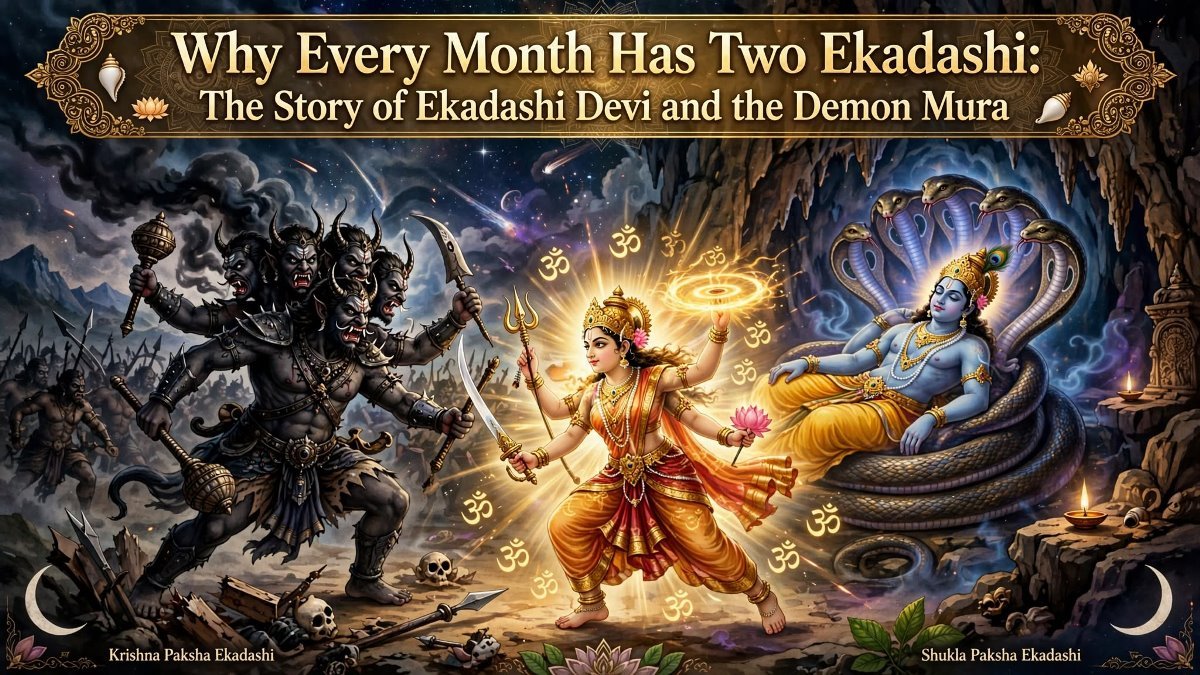
Twenty-four times a year, sometimes twenty-six, the same question comes up for anyone new to Ekadashi: why does this fast happen twice every single month rather than once? The honest answer has two layers to it. One is a simple matter of how the lunar calendar is built. The other is a genuinely dramatic story about a sleeping god, a demon who chose the worst possible moment to attack, and a goddess born from the encounter who still carries the name of the day itself, thousands of years later, every time a devotee sits down to fast in her honor.
The Simple Answer: How the Lunar Month Is Built
Every Hindu lunar month divides into two fortnights, or pakshas: Shukla Paksha, the waxing half where the moon grows from new to full, and Krishna Paksha, the waning half where it shrinks back down toward darkness. Each of these fortnights contains fifteen tithis, or lunar days, numbered and named the same way in both halves, from Pratipada, the first day, through to Purnima or Amavasya, the fifteenth. The eleventh of these fifteen tithis, in either fortnight, is Ekadashi.
Structurally, this means Ekadashi isn’t unusual in occurring twice a month. Every tithi does, by definition, once during the waxing half and once during the waning half, whether it’s Ekadashi, Chaturthi, or Ashtami. What’s unusual is that this particular eleventh day, alone among all thirty tithis in a full month, ended up with its own name, its own personality, and its own scripture-length origin story, while the rest remained simple calendar labels used mainly to schedule other festivals around them.
The Deeper Answer: Why This Particular Tithi Became a Goddess
That elevation didn’t happen gradually or by general consensus. According to the Padma Purana, one specific tithi earned its exalted status through one specific event: a moment when the eleventh lunar day itself, personified as a goddess, stepped in to save Vishnu’s life while he slept. Every other tithi in the month remained exactly what it started as, a numbered marker on the calendar. This one became something closer to a rescue that never stopped being remembered.
The Katha: How Ekadashi Devi Was Born to Save a Sleeping God
In the Satya Yuga, a demon named Mura, descended from the fearsome Talajangha, grew powerful enough to defeat Indra and the assembled gods outright, seizing heaven for himself and installing his own replacements for Indra, Agni, and Vayu in their place. The gods, driven out and humiliated, went looking for help and eventually found their way to Vishnu.
Vishnu agreed to confront Mura directly, and the battle that followed was long by any measure, fought at Mura’s own capital of Chandravati and dragging on, by some accounts, for a thousand celestial years. The demon’s army fell by the hundreds under Vishnu’s own hand alone, yet Mura himself kept fighting, first with weapons and then, once those were exhausted, with his bare hands, refusing to yield even as everything around him collapsed. Eventually Vishnu, worn down by the sheer length of the fight rather than by any real threat to himself, withdrew to rest in a cave near Badrikashram known as Himavati, settling into a deep yogic sleep to recover his strength.
Mura, rather than accept the lull as a pause in hostilities, saw his opportunity and followed him into the cave, intending to kill the sleeping god where he lay defenseless. It’s worth pausing on how calculated this was: not a battlefield encounter between two opponents facing each other openly, but a demon slipping quietly into a resting place to end things while his enemy couldn’t even see him coming.
What emerged to stop him wasn’t Vishnu waking in time. From Vishnu’s own body, without him rousing at all, a radiant female form took shape, fully formed and already armed, born directly out of his own protective energy at the exact moment he needed it. Mura, startled to find himself facing an unexpected opponent instead of an easy kill, fought her anyway, and lost badly and quickly. She shattered his weapons, destroyed his chariot, and when he came at her with his bare hands in desperation, ended the fight outright.
Vishnu woke to find the demon already dead and a glowing, still-unnamed goddess bowing before him. Pleased and curious in equal measure, he asked who she was. She answered simply that she had emerged from his own body to protect him, asking for nothing beyond having done her duty. Moved by both her power and her humility, Vishnu named her Ekadashi, after the very tithi on which she had appeared, and granted her the boon she is still remembered for today: that anyone who fasted on her day, worshipped Vishnu, and heard her story would be freed of their sins and carried, eventually, to his own abode.
What the Demon Himself Is Said to Represent
Beyond the events of the story itself, several traditions read Mura as something more than a single hostile figure from Satya Yuga. His name is sometimes connected to a state of delusion and ego, the kind of inertia and self-satisfaction that grows strongest in exactly the moments a person feels safest and most at rest, which is precisely when Mura chose to strike. Fasting on the day tied to his defeat is, in this reading, less about commemorating an ancient battle and more about practicing the same vigilance in one’s own life: recognizing that laziness, appetite, and unchecked ego tend to attack quietly, in comfortable moments, rather than announcing themselves in advance. Ekadashi Devi’s sudden, unasked-for appearance at exactly the right second is treated as a model for that same kind of readiness, arriving before the threat is even consciously noticed.
The Blessing That Applies to Both Fortnights
Here’s the detail that actually answers the original question. Vishnu’s boon wasn’t written for one single date on one particular month’s calendar. It was granted to the eleventh tithi itself, as a category, wherever and whenever it fell. Since that same numbered day already occurred twice in every lunar month by the ordinary mechanics of the calendar, once waxing, once waning, the blessing simply attached itself to both without needing a separate origin story for each. This is why the Shukla Paksha and Krishna Paksha versions of Ekadashi are treated as carrying equal spiritual weight in the Padma Purana, even though each month’s two occurrences often go by entirely different names and carry entirely different attached legends of their own, from Nirjala’s brutal single-day intensity in summer to Devshayani’s role opening the four months of Chaturmas.
In effect, the goddess’s boon functions less like a one-time grant and more like a standing rule written into the calendar itself: wherever the eleventh tithi falls, the same protection and the same merit are available, regardless of which month, which season, or which of the two fortnights a devotee happens to be observing it in.
Kings Who Built Their Lives Around This Rule
Royal devotion to Ekadashi runs through Puranic literature almost as a genre of its own, and one king in particular, Mandhata, shows up in more than one telling. In one account from the Brahmanda Purana, Mandhata approaches the sage Vashishtha directly, asking for the single fast that would benefit him most, and is taught the specific glories of Amalaki Ekadashi in response, a story that goes on to describe a hunter who achieved liberation through that very same observance despite a lifetime spent killing animals for his living. In a separate tradition recorded in the Skanda Purana, Mandhata’s own kingdom is struck by famine, and it’s Ekadashi observance, on the advice of sages, that’s credited with finally bringing back the rains and restoring prosperity to his land after other remedies had failed.
He isn’t alone in this pattern. King Ambarisha is remembered for keeping a full year of continuous Ekadashi fasts with such sincerity that even a curse from the notoriously short-tempered sage Durvasa couldn’t touch him, an episode still cited as the clearest scriptural proof of how seriously this vow is meant to be taken. Other Puranic listings name a whole roster of kings, Sagara, Kakutstha, Muchukunda, and Dhundhumara among them, said to have attained liberation itself through nothing more elaborate than consistent Ekadashi observance across their reigns. Between figures like Mandhata and Ambarisha, Ekadashi observance reads less like a rule imposed on ordinary devotees and more like a practice that ancient rulers themselves treated as essential to their own fate, regardless of how much earthly power they already held.
Frequently Asked Questions
Are the Shukla Paksha and Krishna Paksha Ekadashis in the same month equally important?
Yes. The Padma Purana treats both as carrying identical spiritual merit, since the original boon was granted to the tithi itself rather than to one specific fortnight’s occurrence of it.
What happens to the count during a leap month, or Adhik Maas?
An extra lunar month occasionally added to keep the lunar and solar calendars aligned brings two additional Ekadashis with it, Padmini and Parama, bringing some years to twenty-six total instead of the usual twenty-four.
Is the Mura story the only origin story for Ekadashi?
It’s the most detailed and most frequently cited, appearing at length in the Padma Purana, though individual Ekadashis across the year often carry their own separate legends layered on top of this shared foundation.
Why are grains specifically avoided on this day, given the story behind it?
Scripture holds that grains carry a particular impurity on this tithi, tied loosely to the same demon the day was created to defeat, and avoiding them is treated as part of honoring the discipline Ekadashi Devi herself represents.
Does the Mura story mean Ekadashi is only meant for Vaishnavas?
No. While the story and the boon are rooted firmly in Vaishnava tradition, the fast itself is observed across Hindu communities broadly, well beyond those who identify specifically as Vishnu devotees.
Is the goddess Ekadashi worshipped separately from Vishnu, or only alongside him?
She’s generally honored alongside Vishnu rather than as a wholly separate deity with her own independent temples, understood as an extension of his own energy rather than a distinct figure operating apart from him.
Which Ekadashi in the year specifically marks her original appearance?
That occurrence, in the waning fortnight of the Margashirsha month, is kept as Utpanna Ekadashi, literally “the origin,” and is treated as the anniversary of the very event described in this story.
A Final Word
Strip away the battle and the thousand celestial years, and what’s really being described is a god who got tired, went to rest, and was protected not by his own strength in that moment but by something that had been part of him all along, surfacing exactly when it was needed. Every month, twice, in both directions the moon moves, that same protection is offered to anyone willing to fast for it. The twice-a-month rhythm turns out to be less about the calendar than about making sure nobody has to wait too long before the next chance comes around.
It’s also worth noticing what the goddess didn’t ask for, once the fight was over. No throne, no temple built in her name, no separate worship apart from the god she had just saved. Only that anyone who showed the same discipline she had, on the same day she appeared, would be freed of whatever they were carrying. Twice a month, for as long as the story has been told, that offer has simply stood open, waiting for whoever decides to take it.
