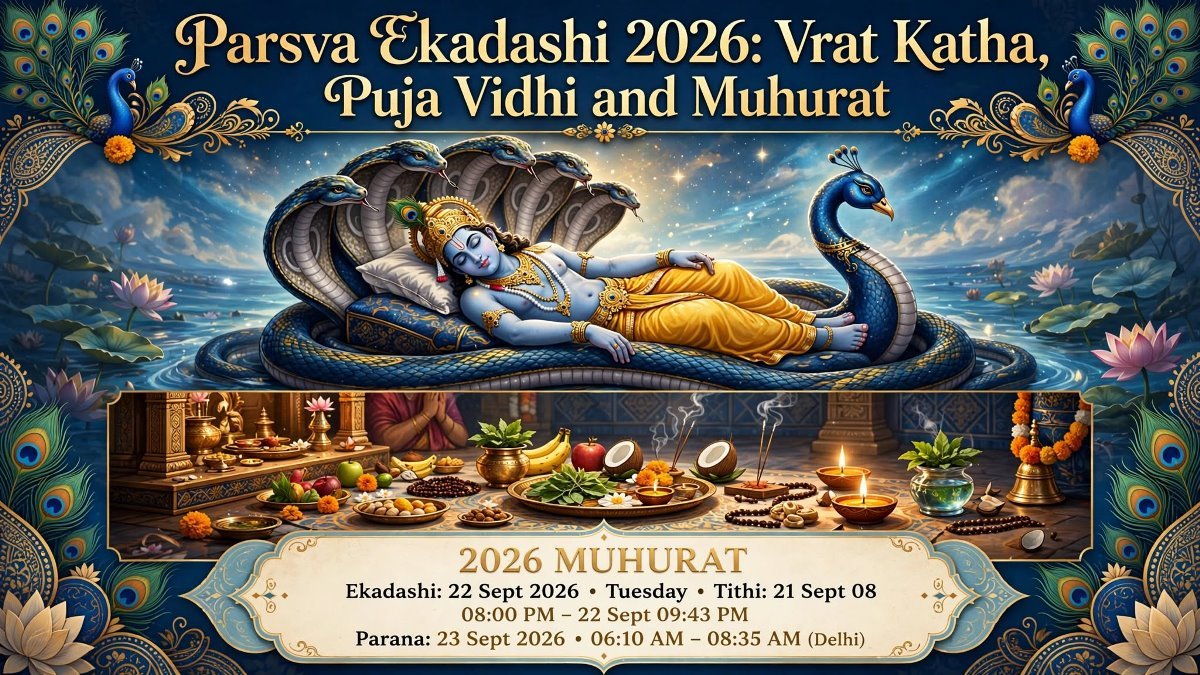
Once every year, in the middle of Lord Vishnu’s four-month cosmic sleep, tradition holds that he does something devotees find genuinely touching in its simplicity: he turns over. Parsva Ekadashi marks that exact moment, and it comes bundled with one of the most famous stories in the entire Vishnu Purana canon, the tale of a king who gave away three worlds and still had nothing left to lose. Here’s the date, the katha, and the correct way to observe it in 2026, along with why scripture treats this particular Ekadashi as carrying more weight than most others on the calendar.
Date and Muhurat: When to Fast and When to Break It
Parsva Ekadashi falls on Tuesday, September 22, 2026. The Ekadashi Tithi begins the previous evening, on September 21, and continues through the day on the 22nd, which is why devotees observe the fast on the 22nd itself. Parana, the breaking of the fast, takes place the following morning, September 23, generally in a window between roughly 6:45 AM and 10:50 AM, though exact local timing can shift slightly by city, so it’s worth checking a local Panchang for your specific location closer to the date.
This particular Ekadashi falls within the Bhadrapada month, in the Shukla Paksha, or waxing fortnight, placing it firmly inside Chaturmas alongside several other major observances of the season, including Ganesh Chaturthi earlier in the same fortnight and the approach of Pitru Paksha not long after. Devotees who are already following a Chaturmas vow of some kind, whether around diet, travel, or daily worship, generally treat this Ekadashi as a natural continuation of that same discipline rather than something separate from it.
This Ekadashi carries an unusual number of regional names for a single day: Parsva Ekadashi, Parivartini Ekadashi, Vamana Ekadashi, Jayanti Ekadashi, Padma Ekadashi, Jaljhilini or Jal Jhulni Ekadashi, and Dol Gyaras, depending on which part of the country you’re in. Nearly all of them point back to the same underlying story and the same turning point in Vishnu’s yearly sleep.
Why It’s Called the “Turning” Ekadashi
“Parsva” simply means side in Sanskrit, and “Parivartini” means turning. Both names describe the same belief: that Lord Vishnu, who enters Yoga Nidra for the four months of Chaturmas starting around Devshayani Ekadashi in July, shifts from lying on his left side to his right side on this specific day, roughly midway through that long sleep. It’s treated as a genuine turning point in the cosmic year, not just a poetic image, which is why worship performed on this exact day is considered unusually potent compared to an ordinary Ekadashi.
The Vrat Katha: Vamana, Bali, and Three Steps That Measured the Universe
The story tied to this Ekadashi goes back to King Bali, a demon king so devoted, so generous, and so relentless in his religious observances that he eventually grew powerful enough to defeat Indra and take control of the three worlds, heaven included. The gods, displaced and afraid, turned to Vishnu for help.
Rather than confront Bali with force, a king known for genuine virtue despite his asura lineage, Vishnu chose a quieter approach. He took birth as Vamana, a Brahmin boy of unusually small stature, and arrived at a grand yajna Bali was hosting, one where the king had vowed to grant any request made of him that day. Bali’s guru, Shukracharya, sensed something was wrong the moment he saw the dwarf Brahmin and warned his student not to promise this particular guest anything. Bali, true to the generosity that had built his reputation in the first place, refused to turn away someone asking for so little. Vamana requested only three paces of land, measured by his own small footsteps.
The moment Bali agreed and poured the ceremonial water to confirm the promise, Vamana began to grow. His first step covered the entire earth. His second covered the heavens above it. Standing there as a being now vast enough to span all creation, he had nowhere left to place a third step, and Bali, understanding exactly what was happening and refusing to break his word even now, knelt and offered his own head. Vishnu placed his final step there, gently pushing Bali down to Patal Lok, the realm beneath the earth.
What happened next is the part devotees hold onto. Rather than simply defeating Bali and moving on, Vishnu was so moved by the king’s unwavering honesty and devotion, even in total defeat, that he granted him rule over Patal Lok with full honor and dignity, and promised to remain with him there personally. In some tellings, Vishnu explains that one part of him would stay by Bali’s side in the netherworld while the rest of him continued the cosmic sleep on Sheshnaga in the ocean of milk, present in both places at once. This same King Bali is who many South Indian households remember every year during Onam, when he is believed to return briefly from Patal Lok to visit the people who once loved him as their ruler.
The detail many retellings linger on is what Vishnu is said to have promised Bali directly: that he would personally guard the gates of Patal Lok, standing watch over the very king he had just defeated, as though the victory itself had created an obligation rather than closing the matter. It’s an unusually tender ending for a story that begins with cosmic conquest, and it’s often cited as proof that in this particular myth, humility outweighs the defeat that provoked it.
Why This Particular Ekadashi Outranks the Rest
Scripture treats Parsva Ekadashi as unusually weighty among the twenty-four Ekadashis observed each year, largely because it falls squarely inside Chaturmas, the period already considered the most spiritually charged stretch of the calendar. The Brahma Vaivarta Purana, where Krishna narrates this katha, states plainly that simply listening to the story with sincere devotion carries merit equivalent to performing a thousand Ashwamedha Yagnas, one of the most elaborate and prestigious sacrificial rites in the entire Vedic tradition. Few other Ekadashis make a claim quite that specific or quite that large.
This same significance is echoed in the Bhavishya Purana, in a section specifically devoted to the merits of observances undertaken during Chaturmas, which treats Parsva Ekadashi as one of the anchor points of the entire four-month period rather than simply one Ekadashi among many. Some traditions hold that observing this particular Ekadashi with full sincerity carries enough weight to make up for a missed or incomplete observance elsewhere earlier in the year, which is part of why it draws such devoted attention even among households that don’t keep every Ekadashi fast.
Puja Vidhi: How to Observe the Fast
Preparation begins the night before, on Dashami. Devotees eat only one simple meal that evening and traditionally sleep on the floor rather than a bed, treating the night as the start of the discipline rather than the fast itself. On Ekadashi morning, after an early bath, a sankalp is taken, a spoken statement of intent naming the fast and the wish behind it, along with a choice between a strict nirjala fast without water, a milder version allowing water and milk-based foods, or a phalahar fast built around fruit. Grains, rice, and beans are avoided entirely for the day regardless of which version of the fast a devotee chooses.
The day is spent worshipping Vamana specifically, often with the mantra “Om Vamanaya Namah,” alongside retelling or listening to the katha itself. Since Parsva Ekadashi falls in Bhadrapada, curd is considered an especially auspicious offering this month, unlike some earlier months in Chaturmas where dairy offerings follow different conventions, and many devotees donate curd mixed with rice, along with a small amount of silver, to a Brahmin or someone in need as part of the day’s observance. Staying awake through the night, a practice known as jagran, is considered an important part of this particular Ekadashi’s discipline, distinct from some others where it’s optional, often filled with bhajans, kirtan, or continued recitation of Vishnu’s names.
Parana the next morning has its own specific rule: the fast must be broken within Dwadashi tithi, but not during a narrow window called Hari Vasara, the final portion of Dwadashi, which is considered unsuitable for breaking a fast regardless of how hungry the wait has made you. Morning, shortly after sunrise, is considered the ideal time overall.
Frequently Asked Questions
Is Parsva Ekadashi more important than a regular monthly Ekadashi?
Scripture treats it as considerably more significant, largely because of its position inside Chaturmas and the specific merit described in the Brahma Vaivarta Purana, though every Ekadashi is considered worth observing in its own right.
Can elderly devotees or pregnant women observe a lighter version of the fast?
Yes. The milder version, allowing water, milk, and fruit, is considered a completely valid way to observe the vrat for anyone whose health doesn’t permit a stricter nirjala fast.
What happens if I can’t manage to stay awake through the entire night?
Partial observance is accepted. Devotees who can’t manage a full night’s jagran are still encouraged to spend as much of the evening as possible in prayer or listening to the katha rather than treating the night as an all-or-nothing requirement.
Are there specific temples associated with this Ekadashi?
Yes. The Trivikrama Temple in Tirunavaya, Kerala, and the Ulagalantha Perumal Temple in Kanchipuram, Tamil Nadu, are both built specifically around the Vamana-Trivikrama form and see significant observances on this day.
Does this Ekadashi connect to Onam in any way?
Yes. The King Bali of this story is the same figure celebrated during Onam in Kerala, when he is believed to make his annual return to visit the land he once ruled.
Why is curd specifically recommended as an offering this month?
Bhadrapada is treated differently from some of the earlier Chaturmas months when it comes to dairy, and curd is considered both a suitable food for the fast itself and an especially auspicious item to donate, unlike months where dairy offerings are approached more cautiously.
Is there a difference between how Vaishnavas and other Hindus observe this particular Ekadashi?
Vaishnava households, for whom every Ekadashi carries special weight as a matter of daily practice, often treat Parsva Ekadashi with particular seriousness given its direct connection to the Vamana avatar, though the fast itself is open to and observed by devotees across Hindu traditions generally.
A Final Word
What tends to stay with people about this story isn’t really the spectacle of a god growing large enough to step across the sky. It’s the moment right before that, when a king who had already lost his entire kingdom in the space of two footsteps still had nothing to offer for the third except his own head, and gave it anyway rather than break his word. Vishnu’s decision to stay with him afterward, even from the netherworld, reads less like a consolation prize and more like an answer to a fairly simple question: what happens to a person’s devotion after they’ve lost everything it was ever supposed to earn them.
Every rule attached to this Ekadashi, the exact minute Parana opens, the specific offering of curd and silver, the discipline of staying awake through the night, sits on top of that same basic question. Devotees fasting on September 22 aren’t just marking a date on the calendar or a turn in Vishnu’s sleep. They’re spending a day with a story that asks what’s actually left of a person once every material thing they built has been measured, claimed, and given away.
