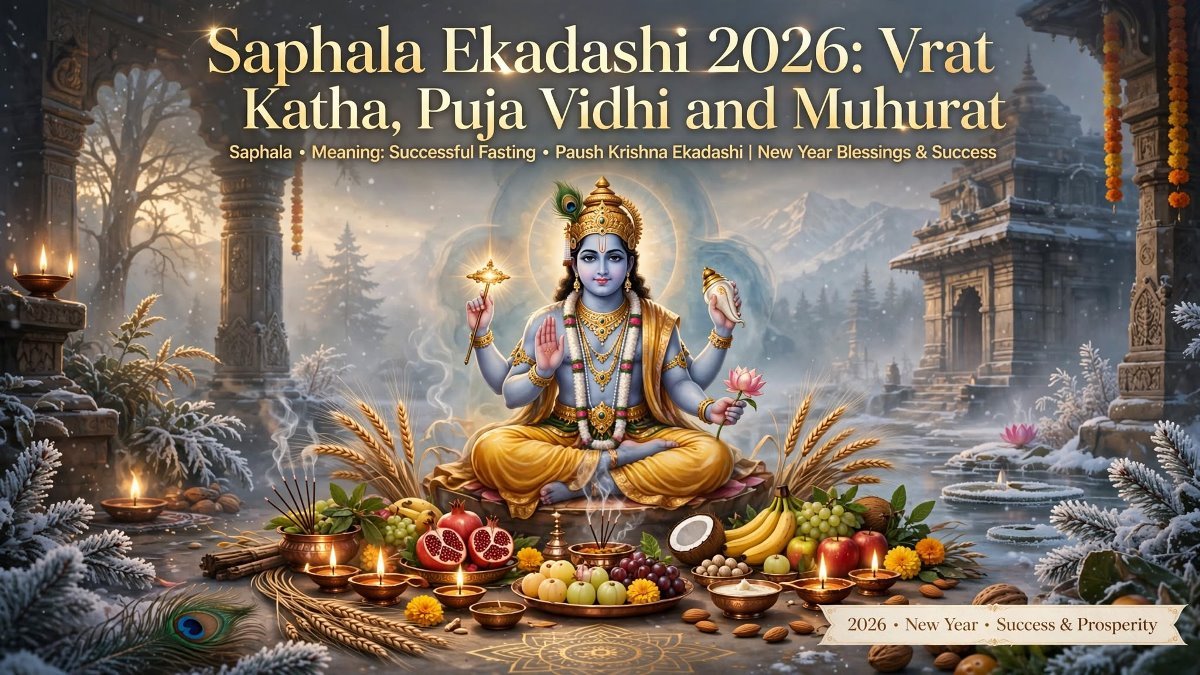
If you’ve been searching for a December 2026 date for Saphala Ekadashi, here’s the direct answer: there isn’t one. According to Panchang calculations, no Saphala Ekadashi falls anywhere within the Gregorian calendar year 2026. This isn’t an error — it’s a known effect of Adhik Maas (an extra intercalary lunar month, also called Purushottam Maas), which occurred in the Hindu calendar in June 2026 this year. When Adhik Maas is inserted, it pushes every subsequent month’s tithi later, and in years like this one, an entire named Ekadashi can end up skipped from the Gregorian calendar year entirely, only to resurface — sometimes twice — the following year.
Here’s what that means in practical terms for anyone tracking this vrat:
- The most recent Saphala Ekadashi was observed on Monday, December 15, 2025.
- The next one falls on Saturday, January 2, 2027.
- Because of the same calendar adjustment, 2027 actually gets two Saphala Ekadashi observances — the second falling on Thursday, December 23, 2027.
If you’re reading this anytime in 2026 and want to observe Saphala Ekadashi specifically, your practical options are to mark the December 2025 date if you’re looking back, or plan ahead for January 2, 2027. Everything else about this vrat — the story, the puja method, and the rules — stays exactly the same regardless of which year you observe it in, so the rest of this guide applies fully to either date.
A Quick Word on Why Adhik Maas Causes This
The Hindu calendar is lunisolar — months follow the moon, but the year is still expected to track the sun and the seasons. A purely lunar year runs about eleven days shorter than a solar year, and left uncorrected, festivals would slowly drift across the seasons over a few decades. To prevent that drift, the calendar inserts an extra month roughly once every 32-33 months. This inserted month is called Adhik Maas or Purushottam Maas, and 2026 happens to be one of those years, with the extra month falling in June. The knock-on effect is that every month after it lands about thirty days later relative to the Gregorian calendar than it would in a regular year — which is exactly why Pausha month’s Krishna Paksha Ekadashi, normally expected in December, gets nudged into the following January instead, and 2026 ends up with no Saphala Ekadashi of its own.
Quick Facts: Saphala Ekadashi (Nearest Observances)
| Detail | December 2025 | January 2027 |
|---|---|---|
| Vrat Date | Monday, December 15, 2025 | Saturday, January 2, 2027 |
| Ekadashi Tithi Begins | — | 2:54 AM, January 2, 2027 |
| Ekadashi Tithi Ends | — | 4:38 AM, January 3, 2027 |
| Parana Date | Tuesday, December 16, 2025 | Sunday, January 3, 2027 |
| Parana Time | Check local Panchang | 1:28 PM – 3:31 PM* |
*Parana timing varies by city based on local sunrise and Hari Vasara. This particular window falls in the afternoon rather than the more typical early-morning slot, so it’s worth double-checking against your city’s Panchang closer to the date.
Significance of Saphala Ekadashi
Saphala Ekadashi is observed on the eleventh lunar day (Ekadashi) of the Krishna Paksha (waning moon fortnight) in the Hindu month of Pausha, which generally falls in December or January. The name comes from the Sanskrit word “saphala,” meaning fruitful or successful — and this Ekadashi is specifically associated with turning effort into results, whether in career, business, relationships, or personal goals that have stalled.
Unlike Ekadashis associated with liberation from sin or ancestral debt, Saphala Ekadashi’s core promise is more immediate: it rewards persistence and devotion, even when that devotion is imperfect or, as the vrat katha shows, entirely unintentional. This makes it a popular observance among people going through a rough patch professionally or financially, or anyone who feels their efforts haven’t been “paying off.”
According to the Puranas, Lord Krishna described this Ekadashi to Yudhishthira as carrying more merit than performing a hundred Rajasuya Yajnas or a thousand Ashwamedha Yajnas — an enormous claim by the standards of Vedic ritual, and one that reflects how highly this particular vrat is regarded.
Saphala Ekadashi Vrat Katha: The Story of Lumpaka
The story begins with King Mahishmata, a righteous ruler of a city called Champavati (also referred to as Champakanagara in some tellings). He had four sons, and the eldest, Lumpaka, grew up to be everything his father was not. Lumpaka drank, gambled, kept company with prostitutes, pursued married women, disrespected Brahmins and Vishnu devotees, and eventually turned to outright theft.
King Mahishmata tolerated this for as long as he could, but when Lumpaka’s behavior began to embarrass the throne and harm the kingdom’s people, the king had him banished from the city. Rather than reform, Lumpaka retreated to the forest and became a hunter and highway robber, killing animals for food and ambushing travelers for their belongings. He made his home under a large tree at the edge of the forest, sleeping rough and living entirely outside any moral or religious structure.
As it happened, that same tree stood in a spot sacred to Lord Vishnu, and unknown to Lumpaka, pilgrims and devotees would occasionally leave offerings near its roots. One particular night — the night of Saphala Ekadashi in the month of Pausha — turned bitterly cold. Lumpaka, weakened by hunger and half-frozen, found himself unable to hunt, unable to eat anything he could find, and too uncomfortable from the cold to sleep at all. He spent the entire night awake beneath that same tree, shivering, without a single bite of food passing his lips.
Without realizing it, Lumpaka had just completed the two central requirements of Ekadashi vrat: a full day’s fast and a night spent awake in vigil, on the exact day sacred to Vishnu, at the foot of a tree already tied to Vishnu’s presence. Scripture is emphatic on this point — the merit of Ekadashi accrues even when the fast happens by accident, provided the day and the abstinence align. Lord Vishnu, pleased by devotion regardless of whether it was consciously offered, blessed Lumpaka that very night.
The change showed itself the next morning. Lumpaka woke with a clarity and calm he hadn’t felt in years. The urge toward cruelty and theft that had defined his adult life seemed to have lifted along with the night’s cold. He made his way back to Champavati and, for the first time since his banishment, sought out his father not to take something, but to apologize.
King Mahishmata, seeing the genuine change in his son, welcomed him back without hesitation and restored his position as heir. Lumpaka went on to marry, have a son of his own, and rule the kingdom with the same fairness his father once had. In old age, having handed the throne to his son, he retired to a life of devotion and, upon his death, is said to have been welcomed directly into Lord Vishnu’s abode — a complete reversal from the man who once lived as an outlaw beneath a tree.
Saphala Ekadashi Puja Vidhi (Step-by-Step)
1. Begin preparations on Dashami: On the tenth tithi, the day before Ekadashi, eat a light sattvic meal before sunset, and avoid food after dark to prepare the body for the fast.
2. Rise early and bathe: On Ekadashi morning, wake before sunrise. Bathing in a river or natural water source is traditionally preferred; at home, bathing water can be mixed with a little Ganga jal if available.
3. Take Sankalp: Formally resolve to observe the Saphala Ekadashi vrat, choosing the level of fasting suited to your health — full nirjala, phalahar (fruits and milk only), or ekbhukta (a single sattvic meal).
4. Set up worship space: Place an image or idol of Lord Vishnu, or a Shaligram Shila if available, on a clean altar. Decorate with fresh flowers and tulsi leaves, which hold special importance in all Vishnu worship.
5. Offer puja items: Offer coconut, betel leaves and nuts, incense, and a ghee diya. Where possible, perform abhishek with panchamrit and water.
6. Chant and listen to the katha: Recite Vishnu’s names or the Vishnu Sahasranama, and read or listen to the story of Lumpaka as part of the day’s worship — reciting the katha is considered part of the ritual itself, not a separate activity.
7. Observe the fast through the day: Abstain from grains, lentils, onion, and garlic. Keep the mind on the day’s purpose and avoid conflict, gossip, or unnecessary speech.
8. Stay awake through the night: A night of jagran (vigil), ideally spent in kirtan or reading scripture, mirrors what Lumpaka experienced involuntarily and is treated as central to the vrat’s benefit.
9. Break the fast correctly the next morning: Perform Parana only after sunrise and after Hari Vasara has ended, ideally accompanied by charity to Brahmins or those in need.
Saphala Ekadashi Vrat Rules: Dos and Don’ts
Do:
- Take a clear sankalp specifying your fasting type before sunrise
- Offer tulsi leaves and fresh flowers to Vishnu
- Recite or listen to the Lumpaka katha during the day
- Give charity — food, clothing, or money — on the day of Parana
- Keep the mind calm and avoid arguments or harsh words
Avoid:
- Grains, pulses, onion, and garlic
- Alcohol, tobacco, and non-vegetarian food
- Daytime sleep
- Breaking the fast before sunrise or during Hari Vasara
- Starting the fast without a clear sankalp
As with all Ekadashi vrats, elderly people, pregnant women, and those managing chronic health conditions are generally advised to observe a modified fast rather than a strict waterless one.
Benefits of Observing Saphala Ekadashi
Scripture associates sincere observance of Saphala Ekadashi with:
- Success in ventures that have been stalled or repeatedly unsuccessful
- Relief from accumulated bad luck or a run of failures
- Clearing of past sins and karmic obstacles
- Inner peace and clarity, mirroring Lumpaka’s transformation overnight
- Merit described as exceeding that of major Vedic yajnas, according to Krishna’s account to Yudhishthira
Frequently Asked Questions
Why is there no Saphala Ekadashi in 2026?
Adhik Maas (an extra lunar month) occurred in the Hindu calendar in June 2026, shifting the timing of later months. As a result, the Pausha Krishna Paksha Ekadashi that would normally be called Saphala Ekadashi doesn’t fall within the January–December 2026 window at all — the most recent one was in December 2025, and the next is in January 2027.
When was the last Saphala Ekadashi?
Monday, December 15, 2025.
When is the next Saphala Ekadashi?
Saturday, January 2, 2027, with a second occurrence that same year on Thursday, December 23, 2027, due to the same calendar adjustment.
What is the Saphala Ekadashi vrat katha about?
It tells the story of Lumpaka, an exiled prince who lived as a bandit and unknowingly observed the fast and night-vigil of Saphala Ekadashi while sheltering under a tree, earning Lord Vishnu’s blessing and a complete change of heart.
Does an unintentional fast still count on Ekadashi?
According to this vrat katha specifically, yes — Lumpaka’s transformation happened without him realizing he was observing anything sacred, which is central to why this story is told the way it is.
What should I eat to break a Saphala Ekadashi fast?
Simple sattvic food — fruit, milk-based dishes, or a light grain-free meal — is traditional, with a full meal permitted once the correct Parana window has passed.
Conclusion
Saphala Ekadashi 2026 is, in the most literal sense, the Ekadashi that isn’t — at least not within this particular calendar year. But that gap is temporary and well-documented, not a gray area: the last observance was December 15, 2025, and the next is January 2, 2027. What doesn’t change with the calendar is the story at the heart of this vrat — that even Lumpaka, who wanted nothing to do with devotion, received its full benefit the moment circumstance lined up with sincerity. Whichever date you end up marking, that’s the part of Saphala Ekadashi worth carrying forward.
