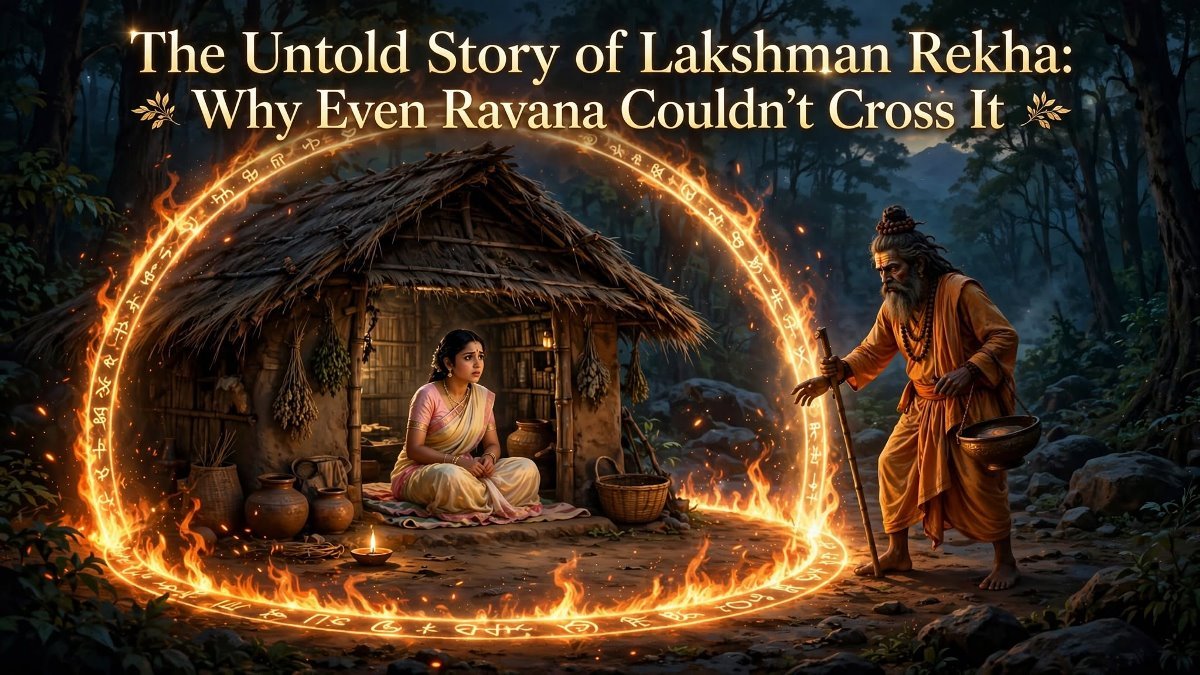
The popular story holds that Lakshmana drew a protective line around Sita’s forest dwelling, charged with the power to burn anyone who crossed it with harmful intent — which is why Ravana, unable to force his way in, had to trick Sita into stepping across it voluntarily instead. The genuinely untold part is that this scene doesn’t appear anywhere in Valmiki’s original Sanskrit Ramayana, nor in the Aranya Kanda of Tulsidas’s Ramcharitmanas. Scholars trace its popularization to two regional retellings written well over a thousand years after Valmiki — and Tulsidas himself only ever refers to it once, in passing, several books later.
The Story Everyone Knows
Sita, living with Rama and Lakshmana in exile at Panchavati, spots a golden deer moving through the trees and asks Rama to catch it for her — not realizing it’s Maricha, a rakshasa sent by Ravana in disguise specifically to lure Rama away. Rama gives chase, eventually striking the deer with an arrow. As Maricha dies, he drops the disguise just long enough to cry out in a perfect imitation of Rama’s voice: “Lakshmana! Sita!” — a desperate, calculated trick aimed at whoever is left behind at the hermitage.
Sita hears it and panics, certain Rama is in danger, and begs Lakshmana to go to him immediately. Lakshmana refuses at first — he knows Rama is capable of handling far worse than a deer, and suspects a trap. What finally breaks his resolve isn’t logic, it’s Sita’s words: in her fear, she accuses him of wanting Rama dead so that he can have her for himself, or of being under secret instructions from his own family to let harm come to his brother. It’s a brutal thing to say to a man who has spent years in exile purely out of loyalty, and it works. Wounded, Lakshmana leaves to find Rama.
Before he goes, though, he draws a line in the earth around the dwelling and tells Sita plainly: stay inside it, no matter what happens, no matter who calls or what you hear, and nothing will be able to touch you.
Ravana, who has been waiting for exactly this moment, arrives soon after disguised as a wandering mendicant asking for alms. He cannot get past the boundary Lakshmana left behind, so instead he leans on something he knows Sita won’t refuse: the duty of hospitality. A holy man asking for food at the doorstep cannot be turned away, and — in the version of the story most people have grown up with — he insists that alms must be given freely, by a giver who steps forward on her own, not passed across a line like an afterthought. Sita, unable to reconcile turning away a guest with her own sense of dharma, steps out to place the offering in his hands. The instant she crosses, Ravana drops the disguise, seizes her, and carries her off to Lanka on his Pushpaka Vimana.
Why Ravana Couldn’t Simply Force His Way Across
This is the detail that makes the story more than just a plot device: in every telling where the line appears, Ravana’s problem is never a lack of trying. According to the legend, the boundary was charged with a protective power — some versions describe it as burning to ash anyone besides Rama, Sita, or Lakshmana who tried to cross with ill intent — and Ravana, for all his strength and shape-shifting, finds himself genuinely unable to step over it by force. He tests it, feels its power, and backs off rather than risk destruction.
That single limitation is why the rest of the plan exists at all. If the line could simply be walked through, there would be no need for a disguise, no need for the alms request, no need to manipulate Sita’s own sense of duty against her. The entire abduction hinges on getting her to cross voluntarily, because forcing the issue was never on the table. Some retellings even use this to make a pointed comparison: a boundary powered by dharma and devotion could stop the king of Lanka cold, when Ravana’s armies couldn’t be stopped by almost anyone else in the three worlds.
The Dharmic Trick Behind the Trick
What makes Ravana’s plan work isn’t just that Sita is trusting — it’s that he weaponizes a specific rule of dharma against her. In the Radhey Shyam Ramayana, a well-known Hindi retelling, Ravana doesn’t simply ask for alms; when Sita offers to place the food across the boundary, he refuses to accept it that way, insisting that true charity requires the giver to step forward of their own free will rather than pass an offering across a line like a transaction. It’s a rule Sita herself would recognize as legitimate — dana, or charitable giving, is supposed to come from the giver approaching the receiver, not the other way around — and Ravana uses her own honesty about the custom to get exactly the crossing he needs.
Seen this way, the abduction isn’t really a failure of the line’s power at all. The Rekha does precisely what it was built to do: it keeps out anyone trying to force their way in. What it was never designed to survive is someone using Sita’s own values as the lever instead.
The Untold Part: It Isn’t in Valmiki’s Ramayana
Here’s what most retellings never mention: the scene above — the line itself, drawn in the dirt, with the power to burn intruders — does not appear in Valmiki’s Ramayana, the oldest surviving version of the epic. It isn’t in the Aranya Kanda, where this episode takes place, and it isn’t in the embedded retelling of the Rama story found in the Vana Parva of the Mahabharata either, where the sage Markandeya narrates the same abduction to Yudhishthira without any mention of a protective boundary.
It’s also absent from Tulsidas’s Ramcharitmanas at the point where you’d expect it. In his version of the Aranya Kanda, Lakshmana doesn’t draw a line at all — he instead asks the Digpalas, the guardian deities of the cardinal directions, along with the spirits of the forest, to watch over Sita in his absence. No rekha, no ash, no ultimatum drawn in the soil.
In Valmiki’s account, the scene plays out with far less machinery: Lakshmana leaves after Sita’s harsh words wound him into silence, and Ravana, disguised as an ascetic, simply approaches and takes her, with no barrier standing between them at all.
Then Where Did It Come From?
If it isn’t in the earliest or most authoritative versions, the Lakshman Rekha had to come from somewhere — and scholars who’ve compared the many regional Ramayanas trace its popularization to two specific vernacular retellings composed centuries after Valmiki: the Krittivasa Ramayana, written in Bengali by the fifteenth-century poet Krittibas Ojha, and the Ranganatha Ramayana, composed in Telugu by the poet Ranganatha (also known as Gona Budda Reddy) sometime between 1300 and 1310 CE.
These regional tellings were never meant to replace Valmiki’s Sanskrit original — they were devotional retellings for audiences who mostly couldn’t read Sanskrit, and like most oral and vernacular traditions, they embellished, dramatized, and added scenes that carried moral or emotional weight for their own time and audience. The Lakshman Rekha, with its clean visual of a line that can’t be crossed by force but can be crossed by trust, was exactly the kind of addition that traveled well — memorable, easy to picture, and useful as a teaching device long after the specific text that introduced it was forgotten by most people telling the story.
The One Line Tulsidas Did Write
Here’s the detail that complicates a simple “Tulsidas didn’t know about it” conclusion: he did write about it — just not where the abduction happens. Several books later, in the Lanka Kanda, Ravana’s wife Mandodari rebukes him for his boasting about his own strength and valor, pointing out that a man who couldn’t even cross a small line drawn by Rama’s younger brother has no business claiming to be unbeatable.
That single reference tells us the Rekha legend was already circulating widely enough by Tulsidas’s time (the sixteenth century) that he could use it as an offhand insult without needing to explain it — even though he chose not to dramatize the scene itself back in the Aranya Kanda. It’s a small but telling sign of how a folk addition can become common cultural knowledge long before, or even without, being written into the main narrative.
Where the Line Is Said to Have Been Drawn
Local tradition places the Lakshman Rekha at Panchavati, in the Dandakaranya forest — a site now identified with the city of Nashik in Maharashtra. Panchavati remains a pilgrimage destination today, with several spots associated with different moments of the exile years, and the supposed site of the hermitage is among the more visited stops for travelers tracing the Ramayana’s geography through modern India.
Why the Story Has Lasted, For Better and Worse
Whatever its textual origins, the Lakshman Rekha has become one of the most durable metaphors in Indian language and public life. “Crossing the Lakshman Rekha” is common shorthand — used everywhere from family arguments to constitutional commentary about the boundary between the judiciary and the legislature — for violating a line that everyone understands shouldn’t be crossed.
It’s also fair to note, and several modern commentators have pointed this out, that the phrase has historically been used to police women’s behavior and mobility specifically — “even Sita had a Lakshman Rekha” is a line many Indian women have heard growing up, often in contexts that have little to do with the original story’s themes of protection and dharma. That the metaphor can carry both meanings — a boundary that protects, and a boundary used to restrict — is itself part of why the story keeps getting retold and re-examined generations after two regional poets first gave it its shape.
Frequently Asked Questions
Is the Lakshman Rekha real, according to scripture?
It doesn’t appear in Valmiki’s Ramayana, the oldest surviving version of the epic, or in Tulsidas’s Ramcharitmanas at the point in the story where the abduction happens. It’s a later addition popularized through regional retellings.
Which text first introduced the Lakshman Rekha?
Scholars trace its popularization to the fifteenth-century Bengali Krittivasa Ramayana and the Telugu Ranganatha Ramayana, composed around 1300–1310 CE — both written centuries after Valmiki’s original.
Does Tulsidas mention it at all?
Only in passing. In the Lanka Kanda, Mandodari references Ravana’s failure to cross Lakshmana’s line while rebuking him, even though Tulsidas never dramatizes the line being drawn earlier in the story.
Why couldn’t Ravana just force his way across the line?
According to the legend, the boundary carried a protective power that would burn anyone attempting to cross it with harmful intent — which is why Ravana had to trick Sita into crossing on her own rather than forcing his way in.
Where was the Lakshman Rekha supposedly drawn?
Local tradition places it at Panchavati in the Dandaka forest, now part of Nashik, Maharashtra — a site still visited by pilgrims tracing Rama’s years in exile.
Why does this story matter if it isn’t in the original text?
Because cultural memory doesn’t only run through the oldest manuscript — regional and oral retellings have shaped how most people actually encounter these epics, and the Lakshman Rekha is one of the clearest examples of a later addition becoming more culturally powerful than anything in the source material.
Conclusion
The Lakshman Rekha earns its place in the story not because Valmiki wrote it, but because it captured something people needed a story to say: that some boundaries hold because of what they mean, not because of what enforces them, and that the only way past a line like that is to get invited across — never to break it. Two regional poets, working in Bengal and Andhra centuries after the Sanskrit original, gave that idea a shape simple enough to survive every retelling since. Whether or not it belongs to Valmiki, it clearly belongs to everyone who has told this story since.
