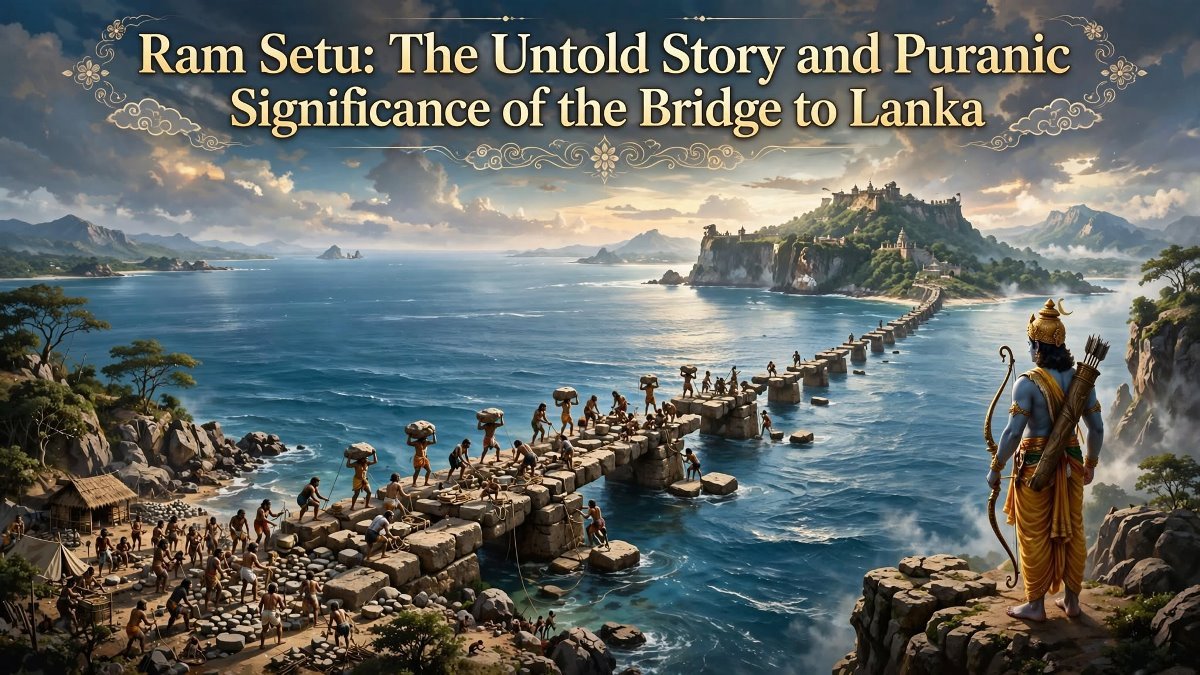
Ram Setu, also known as Adam’s Bridge or Nala Setu, is a 48-kilometre chain of limestone shoals between Rameswaram on India’s coast and Mannar Island off Sri Lanka. The Ramayana describes it as built by Rama’s vanara army under the engineer Nala, son of Vishwakarma, after the sea god advised Rama that Nala alone could raise stones that would hold together across the water. Mainstream geology treats the formation as a natural former land connection between India and Sri Lanka; a 2024 satellite mapping study by ISRO added the most detailed picture yet of its structure, while at least one geologist has pointed to anomalies he believes suggest reinforcement. The site has also been the center of one of modern India’s more heated legal and political controversies.
How Rama’s Army Built a Bridge Across the Ocean
After Sita’s abduction, Rama’s vanara army reached the southern tip of India and faced an ocean with no way across. Rama first tried diplomacy: he sat on the shore and prayed to Samudra, the sea god, for three days and nights, asking for safe passage. When nothing happened, Rama’s patience broke, and he reached for his Brahmastra, threatening to dry up the ocean entirely.
Only then did Samudra appear, apologizing and offering a way forward instead of destruction: in the ranks of Rama’s own army stood Nala, son of the divine architect Vishwakarma, blessed such that any stone he placed would hold rather than sink. Rama, arrow already loosed by that point, redirected the shot toward the Drumakulya region, inhabited by bandits, drying it into what is today the Marwar desert of Rajasthan — and turned to Nala to begin the real work.
What followed was, by Valmiki’s own account, an engineering effort as much as a miracle. The vanara army spent five days hauling enormous rocks, boulders, and entire trees into the water, with Nala directing their placement so the bridge held together across the strait. Valmiki devotes an entire sarga of 85 shlokas in the Yuddha Kanda to describing this construction in detail — a length and specificity that suggests it was treated as a significant feat of engineering within the narrative, not a passing miracle glossed over in a line or two.
The Squirrel That Still Gets a Statue Today
The best-loved detail from this episode is the squirrel: while the vanara army carried boulders, a small squirrel is said to have dipped itself in the sea, rolled in the sand, and shaken the grains loose into the gaps between the stones, doing what little it could. Some versions of the story have the other vanaras mocking its efforts as useless next to their own boulders. Rama, moved instead of amused, picked the squirrel up and stroked its back — and the three stripes still visible on the back of the Indian palm squirrel today are said to be his fingermarks.
It’s worth being honest that this particular scene’s textual home is genuinely disputed. Some sources attribute it directly to Valmiki’s Ramayana; others trace it instead to later tellings such as the Ramcharitmanas or regional versions like the Ranganatha Ramayana, placing it in the same category as other beloved additions that entered the tradition after the original Sanskrit text. Either way, the story has only grown in prominence — a statue honoring the squirrel was installed on Angad Tila near the new Ram Mandir in Ayodhya, giving one of the epic’s smallest characters a permanent place beside its most sacred new pilgrimage site.
Puranic and Classical References Beyond Valmiki
Ram Setu’s significance was never confined to a single text. The Mahabharata references the continued protection of “Nala Setu” under Rama’s command, and Kalidasa’s classical Sanskrit epic Raghuvamsha describes the same bridge of mountains built across the sea. The Skanda Purana, Vishnu Purana, Agni Purana, and Brahma Purana each refer to its construction as well, treating it not as a regional legend but as an event woven into the broader Puranic account of Vishnu’s avatars and their deeds. That kind of repetition, across texts composed in different centuries and regions, is part of why Ram Setu carries weight in Hindu tradition well beyond its role as a plot device in one telling of the Rama story.
Why Rameswaram Itself Is Sacred
The Indian end of the bridge isn’t just a geographic starting point — it’s the site of one of Hinduism’s most significant temples. Before crossing to Lanka, Rama is said to have installed and worshipped a Shiva lingam at Rameswaram, seeking Shiva’s blessing ahead of the war and atoning in advance for the killing of Ravana, who despite his deeds was born a Brahmin sage’s son. That lingam is enshrined today as the Ramanathaswamy Temple, home to one of the twelve Jyotirlingas and one of the four Char Dham pilgrimage sites in India. It means the bridge to Lanka begins at a site devotees visit for its own sake, independent of the story of the crossing itself.
What the Landform Actually Is Today
Strip away the narrative and Ram Setu is a real, mapped physical structure: a 48-kilometre chain of limestone shoals running from Dhanushkodi on Pamban Island (Rameswaram) to Talaimannar on Mannar Island, separating the Gulf of Mannar from the Palk Strait. Long-standing geological theory holds that Sri Lanka was once connected to the Indian mainland by this same land bridge, separated by rising sea levels roughly 125,000 years ago, with sand and coral gradually building up over the submerged connection.
Natural Formation or Human-Built? What the Science Actually Shows
This is where belief and geology have spent two decades talking past each other, and it’s worth laying out what’s actually been found rather than what’s been claimed on either side.
In July 2024, scientists from ISRO’s Jodhpur and Hyderabad remote sensing centres, led by Giribabu Dandabathula, produced the first fully detailed underwater map of the structure using laser data from NASA’s ICESat-2 satellite, published in the peer-reviewed journal Scientific Reports. The study confirmed the bridge as a continuous submarine ridge running the full distance between the two islands, with roughly 99.98% of it now submerged in shallow water, and identified eleven narrow channels that let water pass between the Gulf of Mannar and the Palk Strait — channels the researchers believe have helped protect the structure from wave erosion over time. The study describes the formation as consistent with a former land connection between India and Sri Lanka, now mostly underwater.
That’s the mainstream scientific picture. It isn’t the only voice, though: Dr. Badrinarayanan, a former director of the Geological Survey of India, conducted his own underwater study and found layers of loose sand sitting beneath the limestone shoals — unusual, since coral doesn’t typically grow on loose sand in the first place. He has suggested this could indicate the base was artificially reinforced at some point, a finding he and others consider suggestive rather than conclusive. It’s a genuine anomaly worth being aware of, even though it hasn’t been confirmed or widely replicated.
What hasn’t held up, for the record, is the idea that NASA itself ever confirmed the bridge was man-made. A widely circulated 2002 astronaut photograph of the shoals was repeatedly shared online as “NASA proof” of an artificial structure; NASA has explicitly stated that satellite and astronaut photography cannot determine the age, geological substructure, or human versus natural origin of a formation like this one. The photo showed what was already visible from the ground — a chain of shoals — not an answer to how it got there.
The 2007 Controversy That Made It National News
Ram Setu’s other major moment in the spotlight had nothing to do with satellites. In the mid-2000s, the Indian government proposed the Sethusamudram Shipping Canal Project, intended to cut a channel through the shoals so ships could pass between India’s east and west coasts without sailing around Sri Lanka, saving hundreds of nautical miles. Religious groups petitioned against it, and the case reached the Supreme Court.
In 2007, the Archaeological Survey of India filed an affidavit arguing that mythological texts, including the Ramayana, could not be treated as historical records proving the existence of the events or characters they describe — effectively arguing there was no archaeological basis for treating the shoals as a built structure. The reaction was immediate and intense: public protests, political statements from multiple parties, and enough pressure that the affidavit was withdrawn and two ASI officials were suspended over how it had been handled. The moment became genuinely political, drawing sharply different statements from leaders across India’s political spectrum, including a widely quoted, deliberately provocative remark from then Tamil Nadu Chief Minister M. Karunanidhi questioning Rama’s existence entirely — a comment that is still referenced in Indian political debate today.
Where Things Stand Now
The original canal alignment that would have cut directly through the shoals has not gone ahead. In 2018, the central government told the Supreme Court it intended to pursue an alternative route for the Sethusamudram project specifically so the Ram Setu formation would not be affected, citing both cultural heritage and the site’s broader significance. Separately, the ASI’s central advisory board approved an underwater sediment-sampling study, to be carried out with the National Institute of Oceanography, aimed at dating the formation directly — though as of the most recent reporting available, the detailed satellite mapping work has advanced further than that sediment study.
Public fascination hasn’t faded either, for better and worse: in early 2025, a video claiming to show scuba divers exploring submerged remains of the bridge went viral, and was subsequently confirmed to be entirely AI-generated. No such diving expedition has actually taken place — a reminder that the real story here is still being pieced together through satellite data and sediment cores, not dramatic footage.
Frequently Asked Questions
Who actually built Ram Setu, according to the Ramayana?
Rama’s vanara army built it under the engineering direction of Nala, son of Vishwakarma, using rocks, boulders, and trees, over five days, after the sea god advised that Nala’s stones would hold together across the water.
Is the squirrel story from Valmiki’s original Ramayana?
This is genuinely disputed. Some sources place it in Valmiki’s text; others attribute it to later retellings like the Ramcharitmanas or regional Ramayanas, similar to other well-loved scenes added after the original Sanskrit epic.
Is Ram Setu scientifically proven to be man-made?
No single study has settled this. Mainstream geology treats it as a natural former land bridge, and a 2024 ISRO satellite mapping study is consistent with that view, though one geologist has pointed to sand-layer anomalies he believes suggest reinforcement.
Did NASA confirm Ram Setu is artificial?
No. NASA has explicitly stated its satellite photography cannot determine the age, substructure, or natural versus human origin of the formation, despite viral claims to the contrary.
Is the Sethusamudram Canal project still going ahead through Ram Setu?
The alignment that would have cut through the shoals has been set aside. In 2018, the government committed to Supreme Court to pursue an alternative route that leaves Ram Setu untouched.
Why is Rameswaram significant beyond being the bridge’s starting point?
Rama is said to have installed and worshipped a Shiva lingam there before the war with Ravana, now enshrined as the Ramanathaswamy Temple — one of the twelve Jyotirlingas and one of India’s four Char Dham sites.
Conclusion
Ram Setu occupies a strange and rare position: it’s a structure you can see from a plane, described in at least six major Sanskrit texts across a thousand years, fought over in the Supreme Court, and mapped by a satellite built for measuring ice. Whatever conclusion the ongoing sediment studies eventually reach, the bridge has already done something unusual for a story this old — it kept showing up in the news, one satellite pass and one court affidavit at a time, long after most ancient engineering feats stopped being argued about at all.
