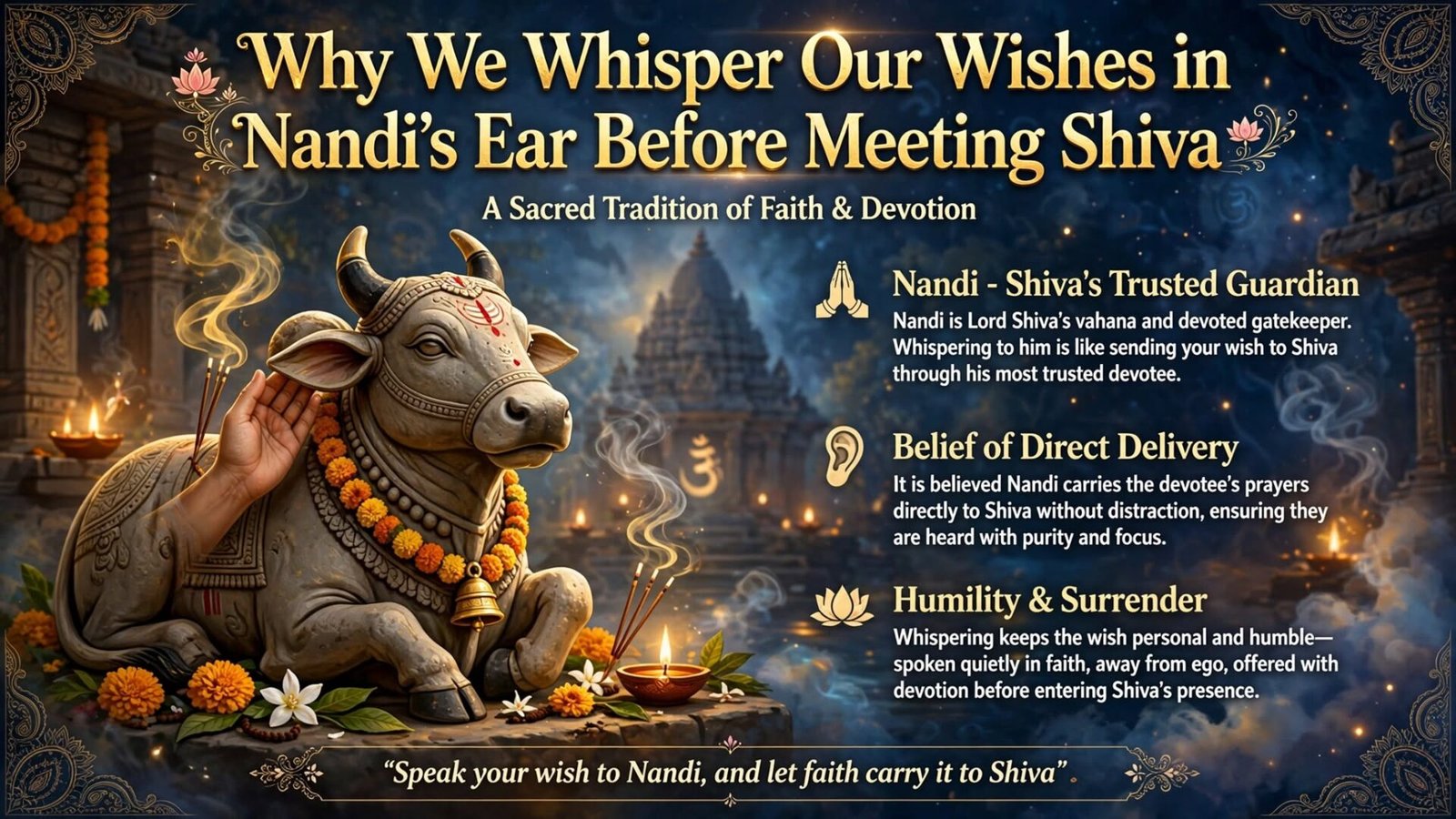
Walk up to almost any Shiva temple and you’ll see it before you even reach the sanctum: someone leaning close to the large stone bull seated at the entrance, cupping a hand near its ear, murmuring something too quiet to overhear. Nobody explains it to first-timers. It’s just understood that you speak to Nandi before you speak to Shiva. The reason behind it turns out to be a specific story, not just an unexplained habit that stuck.
Who Nandi Is, Before He’s Anyone’s Secret-Keeper
Nandi’s own origin story starts with a sage named Shilada, who performed such intense penance seeking a child free from death and disease that Shiva himself intervened, granting him a son who emerged from a sacrificial fire in the form of a divine calf. That calf grew into Nandi, who became so completely devoted to Shiva through his own life that he was eventually made chief of Shiva’s ganas, the attendant spirits of Kailash, and the permanent gatekeeper standing between the outside world and Shiva’s own presence.
There’s a reason the gatekeeper took the specific form of a bull rather than any other creature. In Hindu tradition, the bull is closely identified with Dharma itself, often depicted standing on four legs representing truth, purity, compassion, and charity, the four pillars said to hold up righteousness in a given age. Tradition holds that the bull loses one leg with each declining yuga, standing firmly on all four in the Satya Yuga and reduced to a single leg by the time of Kali Yuga, the current age, as those pillars erode one by one. Nandi, as a bull granted directly by Shiva and placed permanently at his side, is understood to embody that same steadfastness in a single, undiminished form, which is part of why he’s trusted as more than a mere attendant. A gatekeeper who represents dharma itself is exactly the kind of figure whose word could be relied on to reach Shiva honestly, without distortion.
That gatekeeper role is why Nandi’s idol sits exactly where it does in every Shiva temple: directly facing the Shivling, positioned so that anyone approaching the sanctum has to pass him first. He isn’t decoration at the entrance. He’s the one who decides, symbolically at least, who gets through.
The Katha: Why Prayers Started Passing Through Nandi at All
According to the Shiva Purana, there was a period when Shiva withdrew into meditation so deep and so prolonged that even the gods and great sages found themselves unable to reach him. Urgent matters arose that genuinely needed his attention, but no one dared disturb a penance of that intensity directly, fearing the consequences of interrupting Mahadev mid-tapasya. Days passed, then longer, with the gods growing more anxious as whatever crisis they faced remained unresolved, and every attempt at a direct approach dissolving into hesitation the moment they drew close enough to see how deep the trance actually was. Eventually, in desperation, the gods turned to the one being they knew was permitted to stand closest to Shiva without penalty: Nandi himself.
Nandi carried their plea forward and succeeded where direct approach had failed, rousing Shiva from his trance and delivering the message that needed to reach him. Pleased with Nandi’s role in the matter rather than annoyed by the interruption, Shiva is said to have made the arrangement permanent: rather than have every devotee risk disturbing his meditation directly, wishes and prayers could instead be spoken to Nandi, who would carry them faithfully onward. From that point forward, Nandi was understood not merely as a gatekeeper who decided who could pass, but as an accepted channel in his own right, someone a devotee could confide in even when Shiva himself was unreachable.
This is also why the tradition insists the whisper actually be quiet, almost private, rather than announced. The entire premise of the story is that Nandi succeeded precisely because he approached with restraint and devotion rather than noise, and devotees whispering today are, knowingly or not, repeating that same careful approach.
Where This Plays Out at Scale
Some of India’s largest Nandi statues make this positioning impossible to miss. The monolithic Nandi at Lepakshi in Andhra Pradesh, carved from a single block of granite, sits in the open rather than inside a sanctum, still oriented toward the temple’s Shiva shrine. The Nandi at Chamundi Hills in Mysuru, similarly carved from one piece of stone, has become a pilgrimage stop in its own right, with devotees climbing hundreds of steps partly to reach him before continuing to the Shiva and Devi shrines above. Even the Brihadeeswarar Temple in Thanjavur, built on an imperial scale, keeps the same basic geometry as the smallest neighborhood shrine: Nandi facing the lingam directly, positioned as the first stop rather than an afterthought. The scale changes from temple to temple. The arrangement itself never does.
Jeevatma and Paramatma: The Deeper Symbolism
Beyond the story itself, Shaiva philosophy reads the whole scene as a small, physical diagram of something much larger. Nandi is understood to represent the Jeevatma, the individual soul, fixed permanently in the direction of Shiva, the Paramatma, or universal soul, never once looking away. Whispering into his ear isn’t really believed to work like a phone call being forwarded. It’s closer to an act of alignment: positioning your own wish in the exact same unwavering direction Nandi has held his gaze for as long as he’s existed, trusting that the wish reaches its destination the same way his devotion always has.
Seen this way, the practice isn’t only about getting a request delivered. It’s a small, physical rehearsal of the kind of undistracted focus devotees hope to eventually hold themselves, using Nandi’s posture as the model. Some teachers go further still, suggesting that the whisper is never really meant for Nandi at all in the end, but for the part of the devotee’s own mind capable of the same stillness Nandi embodies — that the statue is simply a reminder of a capacity for focus that already exists somewhere inside the person doing the whispering, waiting to be pointed in the right direction.
Why a Whisper, Specifically
Vedic thought treats sound, or Nada, as something with its own vibration and consequence, not simply a container for meaning. A whispered prayer is understood to carry a different kind of energy than the same words spoken aloud or thought silently, more concentrated for being deliberately quiet and directed at a single point. Mantra traditions across Hindu practice generally hold that the way something is voiced changes what it does, which is part of why so much emphasis is placed elsewhere on exact pronunciation and rhythm in Sanskrit recitation. A whisper aimed at one specific, physical ear works on the same underlying logic, concentrating attention and sound into the smallest possible target rather than releasing it outward into open air.
There’s also a simpler, more human logic sitting underneath the philosophy: most people find it easier to voice a genuinely private hope, a fear, or a confession in a murmur meant for one listener than to state it plainly in open air. Nandi, solid and present and never once judging what he hears, gives that private confession somewhere physical to land.
How It’s Actually Done
Most devotees approach Nandi before entering the main sanctum, not after, cupping a hand near one ear without actually touching the statue itself. Many begin by quietly saying “Om” before speaking the wish, treating the syllable as the doorway the rest of the prayer walks through. Some traditions specifically favor the right ear over the left, with a handful of tellings holding that Nandi’s left ear doesn’t function the same way as his right, though this detail varies by region and isn’t treated as a strict rule everywhere. The wish itself is kept brief and specific, spoken once rather than repeated, and devotees then move on to the main darshan of the Shivling as they normally would, treating the whisper as a preface to the visit rather than a replacement for it.
Timing tends to matter less than posture and sincerity. Devotees do this on an ordinary weekday visit just as readily as during Sawan or on Mahashivratri, and no priest or intermediary is needed to perform it correctly, unlike more elaborate rituals elsewhere in the same temple. It’s one of the few acts of worship in the entire practice of Shiva devotion that requires nothing beyond a person, a whisper, and a willingness to actually name what they came to ask for.
Frequently Asked Questions
Does it actually matter which ear I use?
Some regional traditions prefer the right ear specifically, but this varies, and most devotees simply choose whichever feels natural without treating it as a strict requirement.
Should I touch the Nandi statue while whispering?
Most temple custom discourages touching the statue itself during this particular act; a cupped hand held close to the ear without contact is the more common approach.
Can I ask Nandi for anything, or only certain kinds of wishes?
There’s no formal restriction on subject matter. Devotees whisper everything from health concerns to personal confessions to specific requests, and the practice is treated as flexible rather than limited to one category of prayer.
Is this practice actually mentioned in scripture, or is it just folk custom?
The underlying story, Nandi serving as intermediary when Shiva was unreachable in meditation, is traced to the Shiva Purana, though the specific whispering gesture as practiced today has also grown through centuries of temple custom layered on top of that original story.
Do other deities have a similar messenger figure devotees confide in?
Yes, in a looser sense. Hanuman is often treated similarly as an approachable intermediary for reaching Rama, and several other temple traditions have their own gatekeeper figures, though Nandi’s role is among the most consistently observed across Shiva temples specifically.
Why is Nandi specifically a bull and not some other animal?
The bull carries its own deep association with Dharma in Hindu tradition, standing for steadfastness and moral firmness, which made it a fitting form for a gatekeeper whose word could be trusted absolutely.
Is it disrespectful to whisper a small or trivial wish rather than something serious?
No. Devotees bring everything from major life concerns to small daily worries to Nandi, and tradition treats the size of the wish as far less important than the sincerity behind it.
A Final Word
Whatever a person believes about whether Nandi literally relays anything anywhere, the practice does something simpler and harder to dismiss: it forces a devotee to actually put a wish into words, quietly, clearly, and specifically, before walking in to face the deity themselves. Long before it’s a question of divine logistics, whispering to Nandi is a moment of having to know, and say, exactly what you came to ask for.
