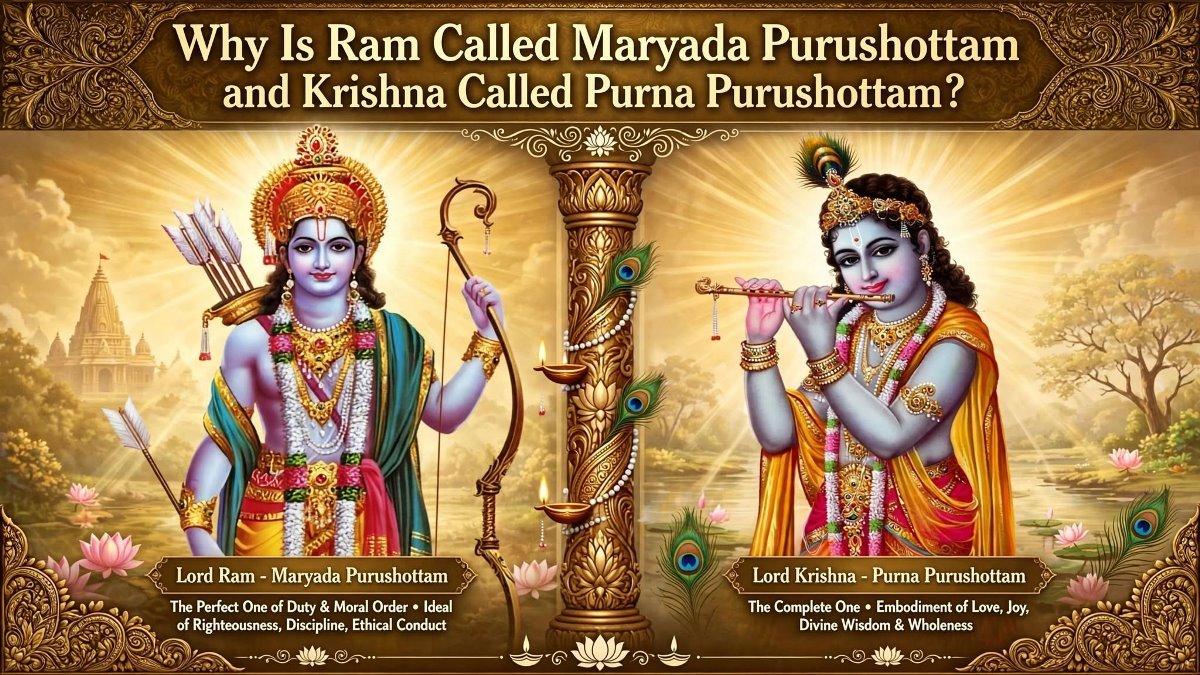
Rama is called Maryada Purushottam — the supreme being who lived entirely within maryada, the limits of duty, propriety, and social dharma — because he never deviated from what was expected of him as a son, husband, king, or warrior, whatever the personal cost. Krishna is popularly called Purna Purushottam, the “complete” or “whole” supreme being, because he acted with the full freedom of the divine, sometimes setting aside convention entirely when a deeper purpose demanded it. Worth knowing upfront: the older, more precise Sanskrit pairing for this contrast is actually Maryada Purushottama and Leela Purushottama — “Purna Purushottam” is the popular way the same idea gets expressed today, tied to Krishna’s separate, widely accepted status as a purna avatar.
What “Purushottam” Actually Means
Purushottama comes from purusha (person, or the animating soul) and uttama (highest, supreme) — literally, “the Supreme Person.” It’s one of Vishnu’s own names, listed as the twenty-fourth name in the Vishnu Sahasranama found in the Mahabharata. Krishna himself defines the term directly in the Bhagavad Gita’s fifteenth chapter, fittingly titled Purushottama Yoga: he describes himself as beyond both kshara, the perishable material world, and akshara, the imperishable individual soul — superior to both, and therefore celebrated as Purushottama in ordinary speech and in the Vedas alike.
So both Rama and Krishna, as avatars of the same Vishnu, carry this title. What differs is the word placed in front of it, and that word is doing most of the actual explaining.
Maryada Purushottam: The Man Who Never Broke a Rule
Maryada means limit, boundary, or the proper order of things — the codes of conduct expected of a son, a husband, a king, a warrior. Rama’s entire life reads as a demonstration of never once stepping outside those limits, regardless of what it cost him personally.
When King Dasharatha, under pressure from Kaikeyi, exiled Rama to the forest for fourteen years on the eve of his own coronation, Rama didn’t argue his case, invoke his rights as the eldest son, or point out the unfairness of it. He accepted the order the same day and left. When Shurpanakha propositioned him in the forest, he didn’t dismiss her cruelly or indulge her — he stayed courteous, explained he was already married, and let his brother handle the escalation. As a king, he held himself to a public standard so strict that he ultimately gave up his own wife’s company over the doubts of a single citizen, a decision that has troubled readers for centuries but that Rama himself treated as an inseparable part of what a king’s word requires.
A common way this gets summarized in devotional tradition is “Ek Vachan, Ek Baan, Ek Patni” — one word, one arrow, one wife. Rama spoke a promise once and never needed to repeat it. He was said to need only a single arrow to hit any target. And he remained devoted to Sita alone, never taking another wife even after her long absence — at a time and in a culture where a king doing so would have raised no objection at all. Maryada Purushottam, in short, is what it looks like when a being with every capability chooses total restraint as its expression of divinity.
Purna Purushottam: The Divine Without a Cage
Purna means complete, full, whole. Where Rama’s story is defined by what he never did, Krishna’s is defined by how freely he moved between doing and not doing, depending on what the moment actually required rather than what convention expected.
As a child, he stole butter and got away with it through sheer charm. As a young man, he danced the Raas Leela with the gopis of Vrindavan, a scene devotional tradition reads as divine love transcending ordinary social and marital boundaries rather than literal impropriety. On the battlefield at Kurukshetra, he counseled Arjuna to fight and kill his own teachers and grandfather — overriding the very family loyalty and reverence for elders that would ordinarily be considered non-negotiable dharma — because a larger dharma was at stake. He guided the death of Bhishma through Shikhandi and orchestrated the ambiguous half-truth that led to Dronacharya’s death, both departures from a strictly fair fight. He is even said to have broken his own vow to stay unarmed during the war, charging at Bhishma directly when the moment called for it, only to be stopped by Arjuna.
None of this is framed in tradition as Krishna failing to live up to a standard. It’s framed as Krishna showing that the letter of convention and the deeper purpose of dharma aren’t always the same thing — and that a being who is truly complete, purna, has the standing to choose the second over the first when it matters. The Govardhan episode makes the same point in a gentler register: when the cowherds of Vrindavan prepared their usual offering to Indra, the rain god, Krishna redirected their worship toward Govardhan Hill instead, arguing that gratitude belonged to the land and cattle that actually sustained them. An angered Indra sent torrential rain to punish the village, and Krishna lifted the entire hill on one finger to shelter everyone beneath it — not just a display of strength, but Krishna overturning an entire community’s inherited ritual practice on his own authority, and being proven right for it.
The Precise Sanskrit Term Is Actually “Leela Purushottama”
Here’s the detail most casual explanations skip: the classical pairing that contrasts with Maryada Purushottama isn’t Purna Purushottama at all — it’s Leela Purushottama, from leela, meaning divine play. The contrast in the original framing isn’t “limited” versus “complete,” it’s “bound by limits” versus “moving through divine play,” which is a meaningfully different idea. Maryada describes how Rama conducted himself; leela describes how Krishna did — not because he was somehow more whole, but because his avatar was expressed through spontaneous divine sport rather than rule-bound restraint.
“Purna Purushottam” has nevertheless become the far more common way people refer to this same contrast today, and it isn’t simply a mistake — it connects to Krishna’s separate and widely held status as a purna avatara, a “complete” incarnation in which the divine appears in full, as opposed to avatars understood to carry only a partial measure of that fullness. Because that idea already existed alongside Krishna’s name, “Purna Purushottam” and “Leela Purushottam” ended up used almost interchangeably in popular speech, even though only one of them is the older technical term.
The Kalas Framework: Fourteen Against Sixteen
One traditional explanation some texts and commentators offer for the “completeness” gap goes by kalas — divine qualities or emanations, the same framework used to describe the moon’s sixteen phases of fullness. In this accounting, Rama is described as manifesting fourteen kalas, while Krishna manifests all sixteen, the two extra being paripurna (total, all-encompassing knowledge) and swarupavasthit (abiding fully in his own true form, without concealment).
The idea some commentators draw from this isn’t that Rama was less divine, but that he chose, or was born into circumstances requiring him, to hold two of his own qualities back — living, doubting, grieving, and struggling within human limitation almost the entire way through, since revealing his full nature openly would have undercut the very point of the exile-and-restoration story he was living out. Krishna, by contrast, let his full nature show from very early in his life, openly performing feats no ordinary child could.
Does This Actually Mean Krishna Is “Greater” Than Rama?
This is where it’s worth being careful, because a real and long-standing disagreement exists here, not just a popular misconception. Many devotional traditions do treat the maryada/leela contrast as simply describing two different modes of the same completeness, not a ranking — insisting that Rama and Krishna are both fully purna, both fully Purushottama, and that the only real difference is the kind of leela each one chose to perform for the world watching. From that view, calling Krishna “more complete” than Rama misreads a difference in style as a difference in degree.
Other strands of devotional thought, particularly within traditions centered specifically on Krishna, do place him a step higher — some hold him to be Svayam Bhagavan, the original source from which even Vishnu and his other avatars, including Rama, ultimately proceed. This view draws heavily on a single verse from the Bhagavata Purana (1.3.28), which lists Vishnu’s avatars and then adds that Krishna is “svayam bhagavan” — the Lord himself, not merely a portion or expansion of him the way other avatars are described. Traditions following Chaitanya Mahaprabhu and the Gaudiya Vaishnava lineage lean on this verse heavily, treating it as scriptural confirmation that Krishna occupies a category of his own.
Other major Vaishnava schools — including the Sri Vaishnava tradition associated with Ramanuja, and most communities for whom Rama is the primary object of devotion — read the same relationship differently, holding Rama and Krishna as equally complete, equally original expressions of the one Vishnu, with no verse anywhere ranking one beneath the other. Both positions are sincerely held across different schools of Vaishnava thought, and neither is simply “the” Hindu answer — which is part of why this question keeps generating fresh discussion centuries later rather than settling into one accepted response.
What This Distinction Actually Teaches
Set the ranking question aside, and the more useful reading is that Rama and Krishna model two different, equally complete answers to the same question: how does one live rightly? Rama’s answer is that you hold the line even when holding it hurts — that discipline itself, followed all the way through, is its own form of divinity. Krishna’s answer is that dharma sometimes requires seeing past the rule to the reason for the rule, and having the freedom and the wisdom to act on that reason instead. Most devotional traditions don’t ask people to pick one avatar as more worth following than the other — they treat Rama’s restraint and Krishna’s freedom as two lessons meant to be held together, not two competing verdicts on who was the better god.
Frequently Asked Questions
What does Maryada Purushottam literally mean?
“Supreme being who lives within limits” — maryada means boundary or proper conduct, and Purushottama means Supreme Person, one of Vishnu’s names.
What does Purna Purushottam literally mean?
“Complete Supreme Being” — purna means whole or complete. It’s the popular term used for Krishna, though the older technical pairing with Maryada Purushottama is actually Leela Purushottama.
Is Krishna considered a more complete avatar than Rama?
This depends on the tradition. Many hold both as equally complete manifestations of Vishnu, differing only in the style of their leela. Some Krishna-centered traditions place him higher still, as the original source of all avatars.
Where does the term Purushottama come from?
It appears as a name of Vishnu in the Vishnu Sahasranama within the Mahabharata, and Krishna defines it directly in the Bhagavad Gita’s fifteenth chapter, Purushottama Yoga.
What are the “16 kalas” associated with Krishna?
A traditional framework describing sixteen divine qualities Krishna is said to fully manifest, compared to fourteen commonly attributed to Rama, the two additional ones being total knowledge and abiding openly in his true form.
Does this distinction appear in the Ramayana or Mahabharata themselves?
The underlying ideas — Rama’s restraint and Krishna’s freedom of action — are drawn directly from both epics. The specific epithets themselves developed more through later devotional and commentarial tradition than as a formal title used within the original texts.
Conclusion
Rama and Krishna answer the same question about how to live rightly from two directions that only look opposite at first glance. One holds every line without exception; the other knows exactly when a line has stopped serving its purpose and sets it aside. Whether tradition calls the second quality purna or leela, the point being made is the same either way — completeness, in the end, isn’t only about how tightly you hold the rules. Sometimes it’s about knowing, with total clarity, when not to.
