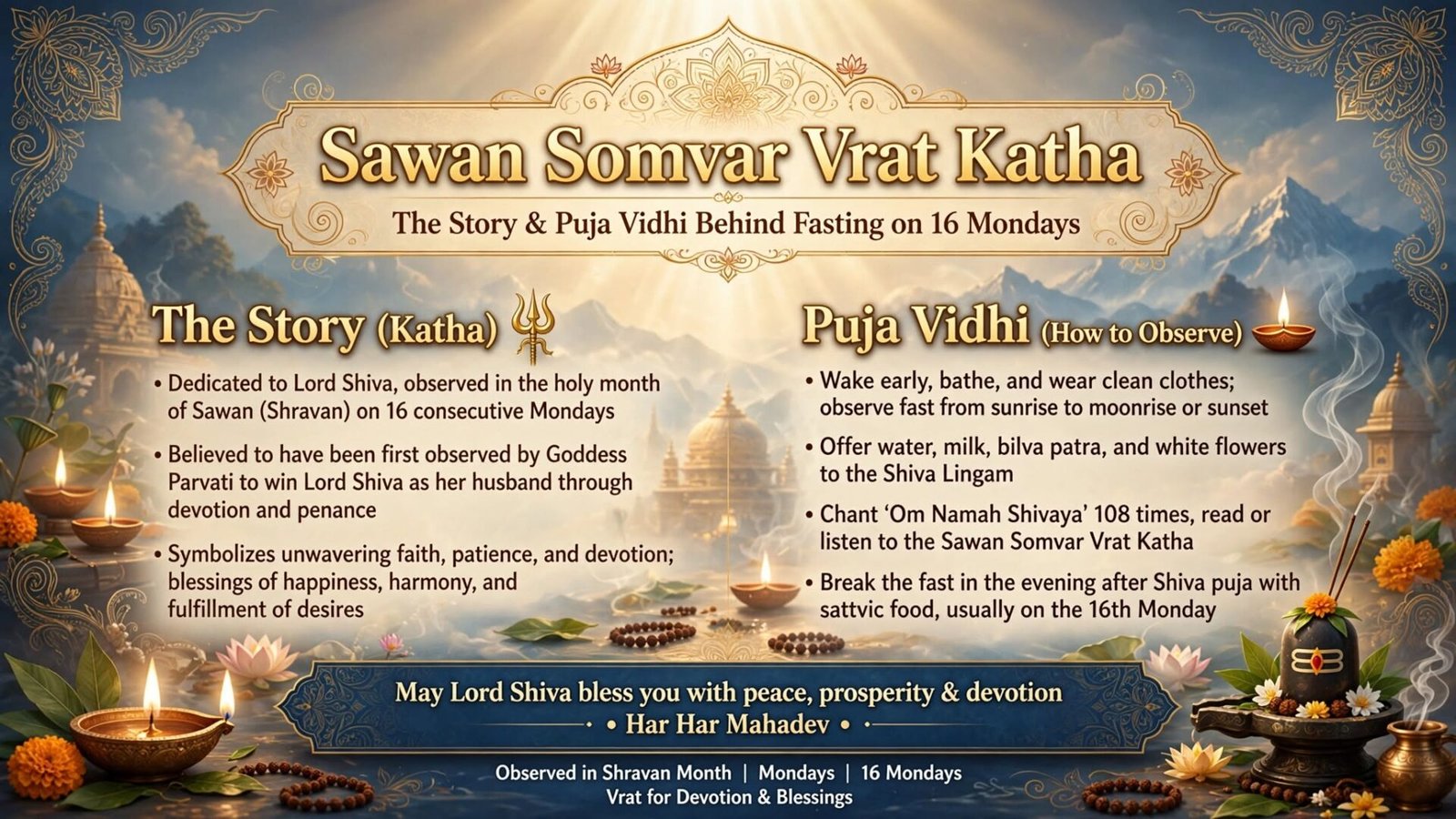
Sawan 2026 begins on July 30 in North India and runs through August 28 — the holiest stretch of the Hindu calendar for devotees of Lord Shiva. Every Monday that falls inside this month is called a Sawan Somvar, and lakhs of devotees turn these four Mondays into the most important fasting days of their year. Many of them are also starting something bigger on the very first of those Mondays: the Solah Somvar Vrat, a vow of sixteen consecutive Mondays that runs for nearly four months, carried forward by nothing but a katha, a routine, and quiet discipline.
This guide untangles the two, tells the traditional katha behind the vrat, and walks through the exact puja vidhi devotees follow, from the first Monday to the last.
Sawan Somvar vs. Solah Somvar: Two Vrats, Often Confused
Most people use “Sawan Somvar” and “Solah Somvar” interchangeably, but they’re two different commitments.
Sawan Somvar simply means any Monday that falls within the Shravan month itself. This year that’s just four Mondays, and the exact dates differ by region because North India follows the Purnimanta lunar calendar while Maharashtra, Gujarat, and the South follow the Amanta calendar — the same month, counted about two weeks apart.
| Region | Sawan 2026 dates | Sawan Somvar (Mondays) |
|---|---|---|
| North India — UP, Bihar, Rajasthan, MP, Punjab, Uttarakhand, HP, Chhattisgarh, Jharkhand | July 30 – August 28 | August 3, 10, 17, 24 |
| Maharashtra, Gujarat, Goa, Karnataka, Andhra Pradesh, Telangana, Tamil Nadu | August 13 – September 10 | August 17, 24, 31, September 7 |
| Nepal & parts of Uttarakhand/HP (solar calendar) | mid-July onward | July 20, 27, August 3, 10 |
Anyone can keep a Sawan Somvar fast for just those four Mondays, with no fixed count or ongoing commitment beyond the month.
Solah Somvar Vrat is a separate, longer vow — sixteen Mondays observed back to back, traditionally begun on the very first Sawan Somvar of the year and carried forward for about four months after that, well past Shravan itself. It’s most commonly taken up by unmarried women praying for a good life partner and by married women for their husband’s health and a peaceful home, though any devotee can take the vow for a wish close to their heart. In North India, the sixteen weeks begin August 3, 2026; in the Amanta states, they begin August 17 — which also happens to be Nag Panchami this year, giving devotees a single morning that covers two occasions at once.
If a Monday is missed by accident somewhere in the middle of the sixteen weeks, tradition doesn’t ask you to restart. Just add one extra Monday at the end so the full count of sixteen stays unbroken.
Why Sawan Belongs to Shiva: The Samudra Manthan Connection
The reason the entire month bends toward Shiva goes back to the Samudra Manthan, the churning of the cosmic ocean by the Devas and Asuras in search of Amrit, the nectar of immortality. As the ocean was churned, it didn’t yield treasures first — it yielded Halahala, a poison so lethal it threatened to destroy every being in creation, gods and demons alike. No one could contain it. Shiva stepped in and drank it, holding it in his throat rather than letting it spread further or spitting it out to harm the world. The poison turned his throat blue permanently, which is why he’s called Neelkanth, “the blue-throated one.”
Tradition places this event during Shravan, which is why devotees pour water, milk, and Gangajal over the Shivling all through the month — not as decoration, but as a literal act of cooling the same throat that once swallowed poison to protect the universe. It’s also the reason abhishek, the ritual bathing of the deity, is treated as the single most important act of Sawan worship, more so than in any other month.
The season adds its own logic to the story too. Shravan falls in the heart of the monsoon, when the earth turns green almost overnight and rivers swell — this is also when the Kanwar Yatra takes place, with devotees walking on foot to carry Ganga water back to Shiva temples at home. The rains that seem to destroy also regenerate, much like Shiva himself, worshipped as both the destroyer and the one who clears the ground for new growth.
The Solah Somvar Vrat Katha
Like most vrat kathas, this one has several regional versions, but the core of the story, the one read at the end of most Solah Somvar pujas, goes like this.
In the city of Amravati there once lived a wealthy merchant, deeply devoted to Lord Shiva, who visited the temple every single day without fail. One evening, as he sat in prayer, he overheard Goddess Parvati asking Lord Shiva what boon the merchant deserved for his years of unwavering devotion. Shiva replied that the merchant’s fate, written at birth, allowed him only a short and childless life, and that no devotion could rewrite fate itself. Parvati, moved by the merchant’s sincerity, gently pressed Shiva to find a way regardless, and Shiva relented: if the merchant began the Solah Somvar Vrat and completed all sixteen Mondays with full faith, his fortune could still change.
The merchant, who had overheard the entire exchange without Shiva and Parvati realising it, went home and began the vrat that very Monday. He fasted, worshipped the Shivling with milk and bel leaves, listened to the katha, and kept his vow through all sixteen weeks without missing a single one. Before long, his wife gave birth to a daughter, and prosperity followed the family in ways it never had before.
Years later, when it came time to arrange his daughter’s wedding, the merchant sent her, along with his trusted clerk, to deliver gifts to her in-laws ahead of the ceremony. On the way, the clerk stopped at a Shiva temple and, testing what he assumed was an empty formality, casually promised the priest that the girl would be “given” to him if the vrat’s blessing ever proved true. He meant nothing serious by it — but the words were spoken inside a Shiva temple, on a Somvar, and in this story’s world, a vow made in that place, on that day, is treated as real.
The wedding preparations continued, but small, unexplainable troubles began to follow the family, until an old woman, herself a quiet observer of the same vrat, gently reminded them what the clerk had said outside the temple, and that a promise made to Shiva on a Somvar cannot simply be forgotten. The family returned to the temple, prayed with sincerity, and asked forgiveness for words spoken carelessly over something sacred. Because the girl and her family had never abandoned the vrat itself even amid the chaos, their devotion held, the difficulty passed, and the marriage that follows unfolds exactly as it should have from the start.
The message is stated plainly in every version of the katha: it was never the merchant’s wealth or status that resolved anything. It was the unbroken, sixteen-week discipline of the vrat, and the refusal to treat a promise made to Shiva as something casual. That’s why the katha is read again at the end of every single Monday, not just once at the start — the story doubles as the reminder of why none of the sixteen weeks can be skipped.
Puja Vidhi: How to Observe Each Somvar, Step by Step
Before sunrise: Wake in the Brahma Muhurat if possible, bathe, and wear clean clothes. White or a light saffron is considered ideal for Shiv puja, though this isn’t a strict rule.
Sankalp: On the very first Somvar, if you’re beginning the Solah Somvar Vrat, take a sankalp — a spoken vow facing the Shivling or an image of Shiva, stating your intention and the wish behind the fast. This step is what actually “starts the count” of sixteen; skipping it means the following Mondays don’t count toward the vow, even if you fast on them.
Samagri to keep ready: raw milk, honey, ghee, curd, and sugar (together, these five make up Panchamrit), plus bel or bilva leaves, dhatura, akshat (unbroken rice), white flowers, sandalwood paste, a rudraksha if you have one, ber (jujube) fruit if in season, and a lota of Gangajal.
The abhishek: Pour each item over the Shivling in turn, Panchamrit first, then plain water or Gangajal to rinse, then arrange the bel leaves, flowers, and sandalwood (tradition holds that bel leaves are placed with the smooth side facing down onto the linga). Many devotees add a short Rudrabhishek, chanting Rudra mantras through the pouring, though a simple jal-abhishek with “Om Namah Shivaya” repeated throughout is enough for a home puja.
The mantra: “Om Namah Shivaya” is chanted through the ritual; devotees observing the vrat for a specific, difficult wish often add the Maha Mrityunjaya Mantra as well, ideally repeated 108 times on a rudraksha mala.
The katha: Read or listen to the Solah Somvar Vrat Katha before or after the aarti. This is treated as a required part of the ritual, not an optional add-on.
Aarti and prasad: Close with the Shiv aarti, and distribute the panchamrit and any fruit offered as prasad.
The fast itself: Most devotees keep it as a phalahar, or fruit-based, fast — a single meal after sunset built around fruit, milk, sabudana, kuttu or singhara flour, and rock salt (sendha namak) rather than regular table salt. Grains and regular cooked food are avoided until the fast is broken the next morning.
What to Eat and Avoid During the Vrat
The food restrictions through Sawan aren’t only about ritual purity — Ayurveda offers its own reasoning too. Monsoon months are when digestive fire, or Jatharagni, runs at its weakest and Vata dosha is naturally aggravated, so a lighter, fruit-and-milk diet is considered easier on the body during exactly this season. The tradition of avoiding leafy green vegetables through Sawan lines up with a more practical monsoon reality as well: heavy rain is when these vegetables are most likely to carry insects and contamination, making them a genuine health risk long before refrigeration existed, not just a ritual restriction invented for its own sake.
Alongside leafy greens, most devotees also avoid non-vegetarian food, alcohol, onion, and garlic for the full month if they’ve taken a month-long vow, and many choose not to cut their hair or shave during this period either. None of this is enforced strictly. The fast is meant to build discipline and devotion, not anxiety, and every telling of this vrat repeats the same reassurance: do as much as your health and daily life genuinely allow.
Frequently Asked Questions
Can I start the Solah Somvar Vrat on any Monday, or does it have to be in Sawan?
You can technically begin on any Monday of the year, but starting on the first Sawan Somvar is considered the most auspicious option, since the entire month is already charged with Shiva’s energy.
What happens if I miss a Monday partway through?
Tradition doesn’t require you to restart. Simply add one extra Monday at the end of the sixteen so the full count stays unbroken.
Is this vrat only for unmarried women?
No. It’s most commonly associated with unmarried women seeking a good marriage and married women praying for their husband’s long life, but men and devotees of any age observe it too, usually for a specific wish or for general wellbeing and discipline.
Do I need to visit a temple every Monday, or can I do the puja at home?
A home puja with a Shivling, an image, or even a simple picture of Shiva is considered completely valid. Visiting a temple adds to the experience but isn’t a requirement of the vrat itself.
What is Udyapan, and when should I do it?
Udyapan is the concluding ritual performed once all sixteen Mondays are complete, typically a more elaborate puja, sometimes with a small havan, followed by feeding Brahmins or the needy. It formally closes the vow.
Is Sawan Somvar the same as Masik Shivratri?
No. Masik Shivratri falls once a month, on Krishna Paksha Chaturdashi, regardless of which month it is, while Sawan Somvar refers specifically to the Mondays that fall inside the Shravan month.
A Final Word
Whichever version of this vrat you choose, four Sawan Mondays or the full sixteen-week vow, the dates above are only a starting point. Confirm the exact Monday list for your own state’s calendar before you begin, since North India and the Amanta states run nearly two weeks apart this year. Beyond that, every telling of this katha ends the same way: it was never really about the wealth or the wish at the end. It was about showing up, Monday after Monday, without skipping the ones that felt inconvenient. That, more than any single ritual detail, is what the vrat is actually asking of you.
