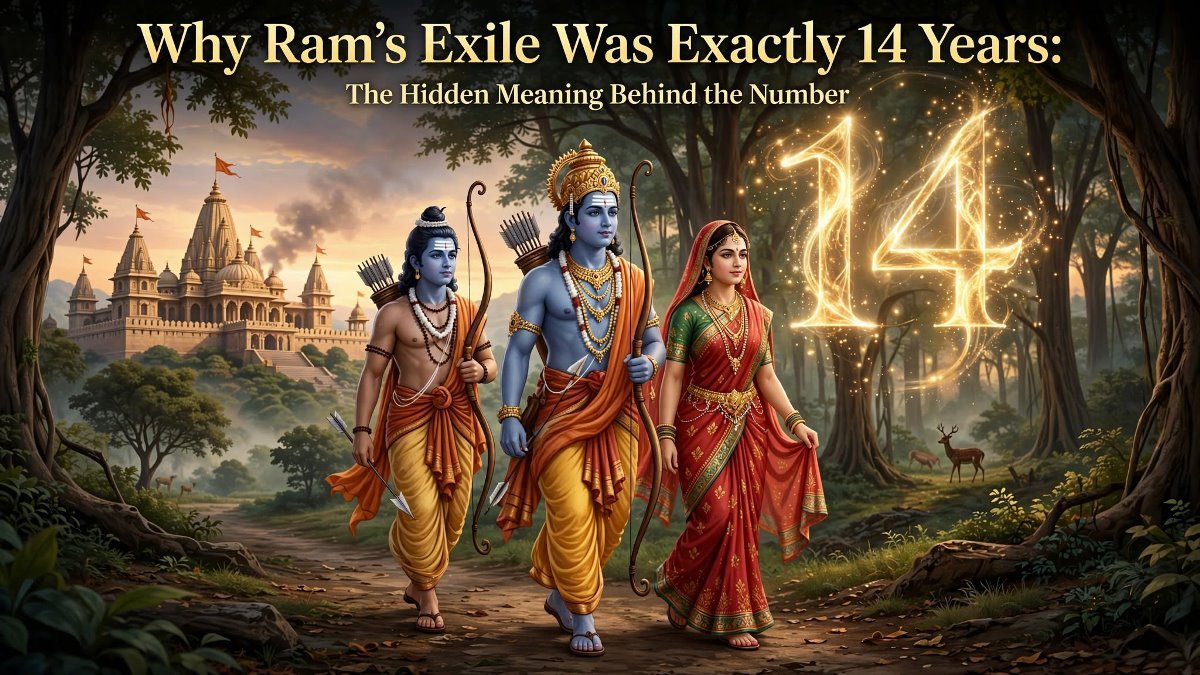
Kaikeyi’s demand for exactly fourteen years of exile is treated in tradition as anything but arbitrary. Readings range from the practical — a political custom said to void a prince’s claim to his throne after fourteen years away — to the cosmic, where the number mirrors the fourteen lokas of Hindu cosmology, to the deeply personal, tracing it back to the fourteen days Kaikeyi was kept in the dark about Rama’s coronation. None of these readings cancel each other out. Together, they’re why this single number has stayed a subject of commentary for as long as the epic itself has been told.
How We Got to Fourteen: The Boons, Manthara, and Kaikeyi’s Demand
Long before Rama was ever due to be crowned, King Dasharatha had promised his wife Kaikeyi two boons after she nursed him back from a battlefield injury (and, in some tellings, personally drove his chariot to safety). Kaikeyi never claimed them — until Manthara, her maidservant, saw the palace being decorated for Rama’s coronation and convinced her that this was the moment her own son, Bharata, would be permanently sidelined.
Manthara’s argument was specific and cutting: this wasn’t just about who ruled today, but about Bharata being reduced to a servant in his own brother’s court for the rest of his life. Convinced, Kaikeyi invoked both boons at once — Bharata crowned king, and Rama sent into exile. The number she attached to that exile, fourteen years, is where the real debate begins.
The First Hidden Layer: “Nine Years, Then Five More”
Here’s a detail that rarely makes it into retellings: in the Ayodhya Kanda, the verse recording Kaikeyi’s demand doesn’t have her say the word “fourteen” at all. It reads nava panchaka cha varshani — “nine years, and five more” — spelling the number out as a sum rather than stating it directly. Some traditional commentaries read real intention into that choice, holding that the number fourteen carried too much cosmic weight to be spoken outright in a moment driven by anger and manipulation, and that Kaikeyi’s own tongue was guided, even in her fury, to phrase it as an addition rather than say the number whole.
Whether or not you read divine stage-managing into a single verse’s phrasing, it’s a striking detail on its own: the most consequential number in the entire epic is introduced not as a number, but as an equation.
The Political Reading: A Kingdom No Longer Yours
The most repeated explanation for exactly fourteen years is also the most practical one. Popular tradition holds that under the customs of the Treta Yuga, a prince who remained away from his kingdom for fourteen years or more forfeited his claim to rule it. On this reading, Kaikeyi’s number wasn’t emotional at all — it was a precisely calculated political minimum, long enough to make Bharata’s position unchallengeable by the time Rama could conceivably return.
It’s worth noting this specific “law” isn’t something you’ll find footnoted to a single verse the way the nava-panchaka phrasing is — it circulates mainly through commentary and retelling rather than as an explicit textual citation, which is worth knowing if you go looking for it yourself. But it’s told and retold precisely because of what it sets up: Rama does return after fourteen years, and Ayodhya receives him back as king anyway, custom or no custom.
What makes this reading even more pointed is what Bharata himself did with the fourteen years he’d supposedly been handed outright. Rather than accept the throne, he refused to rule in Rama’s place at all, placing Rama’s sandals on the throne as a symbolic regent and governing from outside the capital, at Nandigrama, as a caretaker rather than a king. If the number fourteen was meant to hand Bharata an unchallengeable claim, the story goes out of its way to show the one person who could have exploited that technicality refusing to touch it. Read this way, the number becomes a kind of test built into the political system itself — and the story’s answer is that Rama’s claim never actually rested on a technicality to begin with.
The Cosmic Reading: Fourteen Worlds, Fourteen Years
Hindu cosmology describes creation as arranged across fourteen lokas, or realms — seven higher worlds ascending from the earthly Bhuloka through Bhuvarloka, Svarloka, Maharloka, Janaloka, Tapoloka, and finally Satyaloka, and seven lower worlds descending from Atala down through Vitala, Sutala, Talatala, Mahatala, Rasatala, and finally Patala. Together, the fourteen lokas represent the complete structure of existence, not just the visible world humans occupy.
The number resurfaces elsewhere in the same cosmology, too: a single kalpa, one full cycle of creation, is divided into fourteen Manvantaras, each presided over by its own Manu. Commentators who favor the symbolic reading treat this repetition as meaningful in itself — fourteen isn’t just the count of the worlds, it’s also the count of the eras that structure time within those worlds, making it one of the more loaded numbers available in the entire cosmological vocabulary Valmiki had to draw from.
Commentators who favor a symbolic reading point out that Rama’s mission, as an avatar of Vishnu, was never only about restoring one kingdom’s succession — it was about re-establishing dharma at a cosmic scale, since Ravana’s tyranny is described as having spread its reach well beyond a single region. An exile matching the number of worlds in creation, in this reading, isn’t decorative symbolism; it’s the text signaling that what Rama was doing during those years — even the quiet, uneventful stretches of forest life — carried weight across the entire structure of existence, not just the plot events readers usually remember.
The Emotional Reading: Fourteen Days, Fourteen Years
A smaller, more human-scaled explanation exists alongside the grand cosmic one. Some tellings note that Kaikeyi learned about Dasharatha’s coronation plans a full fourteen days after the rest of the court already knew — Dasharatha having consulted only his sage Vasistha before setting preparations in motion, leaving even his own queens uninformed until the last moment. In this reading, Kaikeyi’s fourteen years is read as a wounded, almost petty mirroring of her own exclusion: a year of exile for every day she was left in the dark.
This explanation doesn’t carry the scriptural or cosmological weight of the others, and it isn’t the version most commentators lead with — but it’s worth including precisely because it offers something the grander readings don’t: a plausible, specifically human reason a hurt and manipulated woman might land on that particular number, rather than any other.
Did the Story Actually Need Fourteen Years?
It’s worth stepping back and asking a less mystical question: does the plot of the Ramayana actually require fourteen years to happen at all? Rama, Sita, and Lakshmana’s time is famously front-loaded and back-loaded with incident — the early wandering and encounters with sages, the crucial final year in which Sita is abducted, the search, the alliance with Sugriva, the building of the bridge, and the war itself — but a large portion of the fourteen years, by the text’s own account, passes in relatively uneventful forest life, primarily at Panchavati and earlier hermitages.
Read this way, fourteen years wasn’t chosen because the plot needed that much runway — most of what readers remember happens in the final year. It’s closer to the opposite: the length itself was the point, a duration long enough that nobody, least of all Rama, could treat the exile as a formality to be waited out. For comparison, the Pandavas in the Mahabharata face a shorter but structurally similar exile — twelve years in the forest plus a thirteenth spent incognito — and that number, too, has drawn centuries of commentary about why thirteen rather than some rounder figure. Long, specific, inconvenient exile periods appear to be something both epics reach for deliberately, not incidentally.
What the Number Was Really Testing
Strip away the competing explanations, and they converge on the same underlying point: fourteen years was long enough to make Rama’s dharma, Sita’s devotion, and Lakshmana’s loyalty impossible to fake or wait out. A shorter exile could be endured as an inconvenience. Fourteen years meant giving up an entire era of one’s adult life — watching a kingdom carry on without you, knowing your claim to it might quietly erode with every year that passed, and choosing, every single day of it, not to cut the sentence short even when you clearly could have.
Whether you read the number through cosmology, politics, or a hurt queen’s private arithmetic, they’re all describing the same test from different angles: exactly how long does a person have to hold to their word before it stops being a promise and starts being who they are?
Frequently Asked Questions
Did Kaikeyi ask for “fourteen years” in the original Sanskrit text?
The verse in the Ayodhya Kanda phrases it as nava panchaka cha varshani — “nine years, and five more” — rather than stating the number fourteen directly.
Is there really an ancient law about princes losing their kingdom after 14 years away?
This explanation is widely repeated in commentary and retelling, though it isn’t tied to a specific cited verse the way some other details in the epic are. It’s best treated as a popular traditional reading rather than a directly quoted rule.
What do the fourteen lokas have to do with Rama’s exile?
Hindu cosmology describes creation as fourteen realms, seven higher and seven lower. Commentators who favor a symbolic reading connect Rama’s fourteen-year exile to this structure, framing his mission as one with cosmic rather than purely political scope.
Why did Kaikeyi specifically ask for fourteen years, and not some other number?
No single explanation is universally agreed upon. Tradition offers several: a political calculation to secure Bharata’s throne, a symbolic echo of the fourteen lokas, and a more personal reading tied to the fourteen days Kaikeyi was kept unaware of the coronation plans.
How does Rama’s fourteen-year exile compare to the Pandavas’ exile in the Mahabharata?
The Pandavas spent twelve years in forest exile followed by a thirteenth year incognito — a different number, but a structurally similar test of endurance and hidden identity that has drawn its own centuries of commentary.
What did Bharata do with the throne during Rama’s exile?
He refused to rule as king, instead placing Rama’s sandals on the throne and governing as a caretaker from Nandigrama rather than the capital — a detail often read as the story undercutting any purely political reading of why fourteen years was chosen.
Did the length of the exile actually matter to the plot, or just symbolically?
Most of the epic’s major incidents cluster in the final year of exile. The length itself functions more as a test of endurance and commitment than as time the plot strictly needed to unfold.
Conclusion
Fourteen years shows up in the Ramayana looking like a simple number attached to an angry queen’s demand, and it turns out to be nothing of the sort — a figure that Sanskrit commentary won’t even let you read as a whole word, that political tradition ties to the loss of a throne, that cosmology ties to the shape of creation itself, and that one quieter reading ties to nothing grander than fourteen days of a hurt woman’s silence. The Ramayana rarely explains itself when it doesn’t have to. This is one of the places it clearly didn’t have to — and generations of readers have kept asking anyway.
