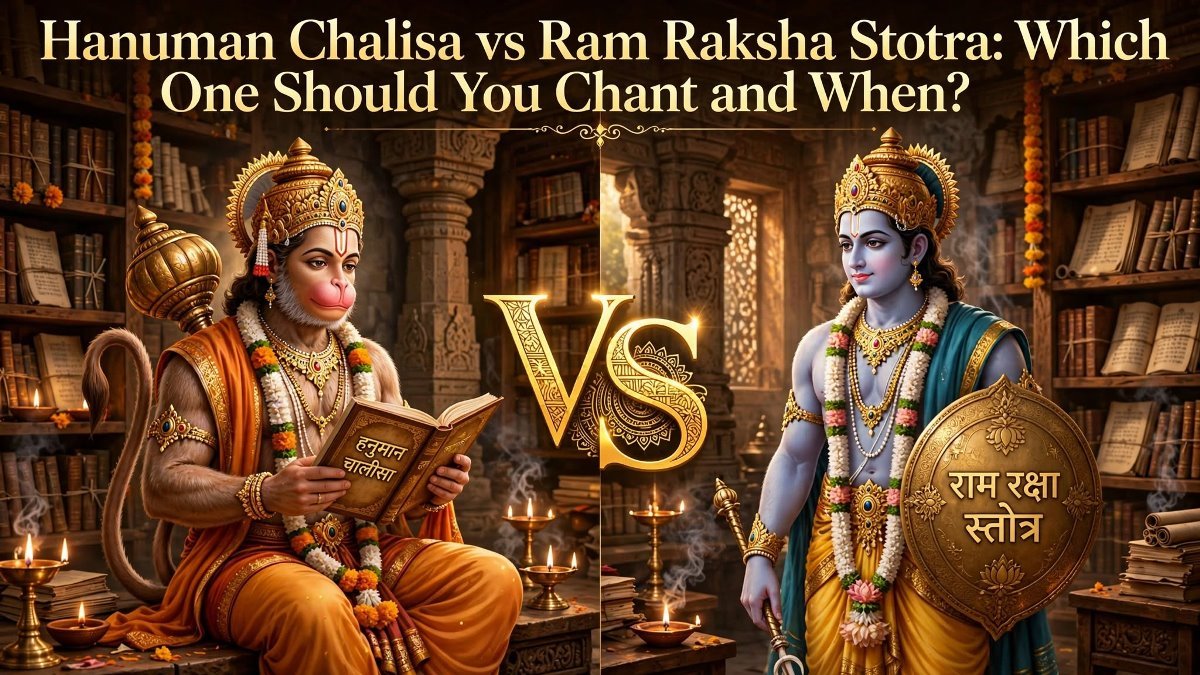
Reach for the Hanuman Chalisa when you need courage in the moment — fear, obstacles, a run of bad luck, or Saturn and Mars-related astrological difficulty — since it’s built in accessible Awadhi around Hanuman’s role as Sankat Mochan, remover of dangers. Reach for the Ram Raksha Stotra when you want a structured daily shield, especially first thing in the morning or before something specific like travel or an exam, since it’s a Sanskrit kavacha (armor) hymn that ritually assigns Rama’s protection to every part of your body. Plenty of devotees don’t choose between them at all — they chant Ram Raksha Stotra as a morning routine and add the Hanuman Chalisa on Tuesdays, Saturdays, or whenever a specific difficulty shows up.
What Each One Actually Is
| Hanuman Chalisa | Ram Raksha Stotra | |
|---|---|---|
| Deity | Hanuman | Rama directly |
| Language | Awadhi (accessible, spoken Hindi-adjacent) | Sanskrit (classical, Anushtup meter) |
| Composer | Tulsidas, 16th century | Sage Budha Kaushika |
| Length | 40 chaupais plus opening and closing dohas | Roughly 38–40 stanzas |
| Structure | Devotional praise-poem | Kavacha (armor) — assigns protection to specific body parts |
| Core character | Courage, obstacle removal, fearlessness | Structured, full-body protective shield |
| Best-known for | Saturn/Mars remedies, warding off fear and negative energy | Daily protection, travel, exams, challenges |
Hanuman Chalisa: What It’s Actually Built For
The Hanuman Chalisa reads less like a formal ritual text and more like a devotee speaking directly to Hanuman in a language ordinary people could understand and memorize — which is exactly why it became, by a wide margin, the most recited prayer in North India. Tulsidas composed it in Awadhi rather than Sanskrit specifically so that its power wasn’t locked behind a language only scholars could parse.
Its content leans hard into Hanuman’s identity as Sankat Mochan — remover of difficulties — celebrating his strength, his unwavering devotion to Rama, and his feats: crossing the ocean to Lanka, carrying an entire mountain to save Lakshmana’s life, burning Lanka with his tail. One line in particular, “bhoot pishach nikat nahi aavai” — that ghosts and evil spirits dare not come near wherever Hanuman’s name is recited — is why the Chalisa is so often reached for specifically in moments of fear, whether that’s a frightening situation, disturbed sleep, or a general sense that something negative has attached itself to your circumstances.
There’s also a well-known legend behind its power that devotees still tell today: that Tulsidas composed it while imprisoned by the Mughal emperor Aurangzeb, after refusing to perform a miracle to prove Rama’s existence on demand, and that upon completing the recitation, a horde of monkeys was said to have descended on the city until the saint was released. Whatever weight you give the story itself, it captures exactly how the Chalisa is used today — not as a calm daily routine, but as something reached for under real pressure.
Astrologically, the Chalisa is considered the primary remedy for two specific afflictions: Mangal Dosha, tied to a difficult placement of Mars often blamed for obstacles in marriage, and Shani-related hardship, including Sade Sati, the roughly seven-and-a-half-year period of Saturn’s transit associated with prolonged difficulty. The connection to Saturn has its own legend attached — that Hanuman once rescued Shani Dev after Ravana had held him captive, and that Shani in turn promised never to trouble Hanuman’s true devotees, which is why Saturday chanting specifically is believed to soften Saturn’s harder edges.
Ram Raksha Stotra: What It’s Actually Built For
Where the Chalisa reads as devotion, the Ram Raksha Stotra reads as engineering. Its very name means “protection given by Rama,” and its structure earns that name literally: verse by verse, it assigns a specific form or name of Rama, or a figure closely tied to him — Sugriva, Hanuman, Vibhishana — to guard a specific part of the reciter’s body, moving methodically from the head down to the feet until the entire body is wrapped in an invoked shield. This style of composition, called a kavacha, is also why the stotra carries the alternate name Vajra Panjar Kavach — the thunderbolt-cage armor.
Tradition holds that Sage Budha Kaushika received the stotra directly, appearing to him in a dream in which Lord Shiva recited the entire hymn and instructed him to record it exactly as given, as a gift of protection for anyone who would recite it afterward. Composed in Sanskrit using the disciplined Anushtup meter — the same 32-syllable structure used across many of the tradition’s older stotras — it’s treated as carrying a more precise, formal kind of mantric power than a vernacular composition, even though that formality also makes correct pronunciation matter more.
Its use leans toward the preventive and the daily rather than the acute. Devotees recite it first thing in the morning, ideally during Brahma Muhurta before sunrise, treating it as a shield put on before the day’s difficulties have even shown up — closer to a daily armor than an emergency response. It’s also specifically favored before travel, exams, and other defined challenges, and is associated with mental clarity and focus in addition to physical protection, which is part of why students in particular are often pointed toward it.
When to Chant Which
Chant the Hanuman Chalisa when:
- You’re afraid, anxious, or facing something that feels bigger than you right now
- You suspect negative energy, disturbed sleep, or something unsettled around you
- You’re dealing with Manglik Dosha, Sade Sati, or another Mars or Saturn-related difficulty an astrologer has flagged
- It’s Tuesday or Saturday specifically, the two days most closely tied to Hanuman’s worship
- You want something you can understand line by line without needing a Sanskrit translation alongside it
Chant the Ram Raksha Stotra when:
- You want a structured, full-body protective routine to start your day
- You’re heading into something specific — a flight, an exam, a difficult meeting, an uncertain journey
- You want the more classical, formal register of a Sanskrit kavacha rather than a vernacular hymn
- You’re building a consistent morning spiritual practice rather than responding to an immediate concern
Can You Chant Both?
Yes, and many households do exactly that, treating them as complementary rather than competing. A common pattern is the Ram Raksha Stotra in the morning as a daily shield for whatever the day holds, with the Hanuman Chalisa added on Tuesdays and Saturdays specifically, or on any day a particular fear, obstacle, or difficulty needs a more direct, immediate response. There’s no scriptural conflict between the two — one is addressed to Rama directly as an architected armor, the other to Rama’s own greatest devotee as an appeal for courage and protection, and traditions that revere one have no obstacle to reciting the other alongside it.
Festival Days: Which One Gets Priority
A few dates on the calendar make the choice more obvious than usual. On Hanuman Jayanti, Hanuman’s birth anniversary, the Chalisa is the natural centerpiece of the day’s worship, often recited repeatedly through the day rather than just once. On Ram Navami, Rama’s birth anniversary, the Ram Raksha Stotra fits the occasion more directly, since it’s addressed to Rama himself rather than to his devotee. During Navratri and Dussehra, both are commonly recited side by side, since the season’s focus on overcoming adversity and negativity suits both a devotional appeal for courage and a formal protective shield equally well. Outside of these specific occasions, day-to-day timing comes down more to what a given moment calls for than the calendar itself.
How to Chant Each Correctly
For the Hanuman Chalisa: bathe or at least wash before beginning, sit facing east if possible, and aim for either Brahma Muhurta or the Tuesday/Saturday timing described above for maximum traditional benefit — though reciting it the moment you actually need courage matters more than waiting for the ideal astrological window. Eleven repetitions is a common daily target; seven is the specific count often prescribed for Saturday Saturn remediation.
For the Ram Raksha Stotra: cleanliness and a quiet, undistracted space matter here too, and tradition is stricter about one thing in particular — recite it in a single sitting, start to finish, without breaking partway through, since the body-by-body protective sequence is considered incomplete if interrupted. Eleven recitations are traditionally said to carry effect through the full day, with continuous daily practice over 45 days considered especially powerful.
Frequently Asked Questions
Is one of these more powerful than the other?
They’re not really comparable on a single scale — the Chalisa is a devotional hymn built for direct emotional and spiritual response, while the Ram Raksha Stotra is a structured kavacha built for systematic, full-body protection. Most traditions treat them as differently shaped tools rather than ranking one above the other.
Can beginners chant the Ram Raksha Stotra without knowing Sanskrit?
Yes, though correct pronunciation is considered more important here than with the Chalisa, given its formal Sanskrit meter. Many devotees start with a transliterated version and a guided audio recitation until the pronunciation feels natural.
Why is Tuesday specifically linked to the Hanuman Chalisa?
Tuesday is associated with Mars, and Hanuman’s energy is traditionally connected to Mars’s qualities of strength and courage, making it considered the most powerful day for his worship alongside Saturday.
Do women have any restrictions on chanting either one?
Practices vary significantly by family and regional tradition, and there’s real disagreement even within Hindu practice today on this point. If this matters to you, it’s worth asking a trusted priest or elder within your own tradition rather than relying on a single generic rule.
Can I chant the Ram Raksha Stotra in the evening instead of the morning?
Morning is the traditional preference since it’s meant to shield the day ahead, but most sources agree it can be recited at any time of day if morning genuinely isn’t possible — consistency matters more than rigid timing.
Which one should a student chant before exams?
Both are commonly used, but the Ram Raksha Stotra’s association with mental clarity and focus makes it the more specifically recommended choice, often alongside the Hanuman Chalisa on the exam day itself for added courage.
Is it disrespectful to switch between the two depending on mood or need?
No — Hindu devotional practice generally treats this kind of flexibility as normal rather than careless. Choosing the prayer that matches what a moment actually calls for is closer to how these texts have traditionally been used than picking one and reciting it mechanically regardless of context.
Conclusion
The real difference between these two isn’t which one works better — it’s what kind of moment each one was built for. The Hanuman Chalisa meets you where you already are: afraid, stuck, or worn down, and speaks to you in words simple enough to reach for without thinking twice. The Ram Raksha Stotra gets there earlier, built to be put on like armor before the day has had the chance to test you at all. Most devotees who’ve chanted both for years don’t pick a side. They just learn which one the moment is asking for.
